
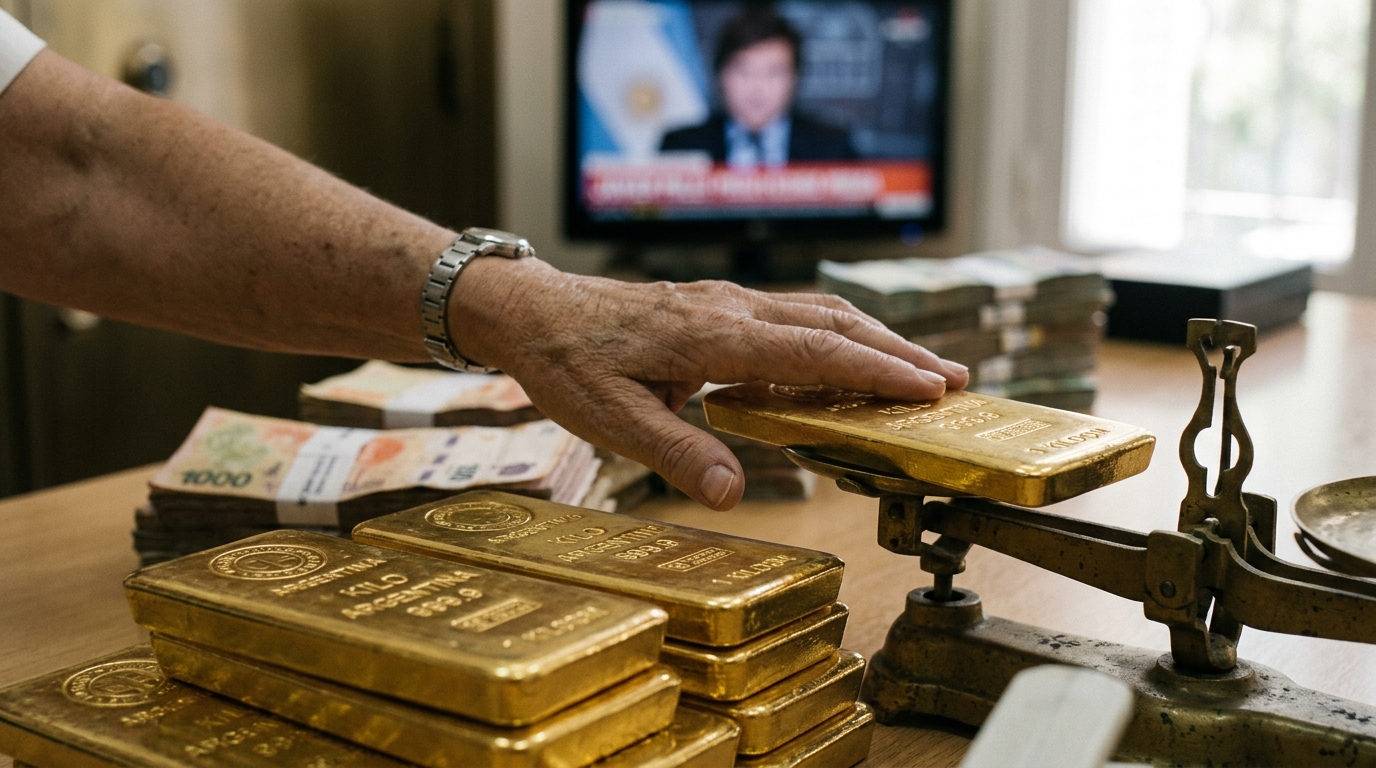
On Monday, Argentine President Javier Milei said his government has $125 billion ready to fight a peso run during next year’s election cycle, a claim he made in an interview with Radio Mitre, a Buenos Aires talk-radio station. Economy Minister Luis Caputo traveled to Bangkok the same day, aiming to advance Argentina’s third review under its IMF programme. The IMF and World Bank Group annual meetings run from October 12 to 18 in Bangkok, Thailand.
The number Milei cited deserves scrutiny before it reassures anyone. He described a mix of tools, including central bank dollar purchases, a swap line with China, and currency futures, and he bundled those elements into a headline figure. The government has not published an official calculation that would confirm the total amount of $125 billion. Some of what he counts as firepower is contingent, not cash in hand.
A Market Already Pricing In the Doubt
The peso market has been less generous than Milei’s arithmetic. The official exchange rate has been sliding, but the specific figures in this draft are not supported by a primary, public series in a way that can be cleanly verified here, so they should not be treated as hard reference points. Country risk tells a clearer parallel story. Argentina’s risk premium touched 655 basis points on October 2, the highest of the year. It has since pulled back to roughly the high-500s, depending on the close used. The relief is real but shallow. Borrowed calm is not the same as restored confidence.
The peso, which had been gradually depreciating within its band, moved quickly toward its upper limit, forcing heavy dollar sales by Argentine authorities, while the JPMorgan spread on Argentine dollar bonds widened sharply at the worst of last year’s stress. The echo of that episode is still audible in Buenos Aires bond desks.
What Argentines Actually Do
People who have lived through Argentina’s recurring currency dislocations did not wait for a president to announce his defence fund before thinking about where to keep savings. Argentina’s history of frequent and disruptive financial crises severely undermined the population’s trust in their domestic currency, turning Argentines toward the dollar to preserve their savings from repeated bouts of inflation and devaluation. When the system collapsed in 2001, the peso was brutally devalued and bank accounts holding dollars were forcibly converted at an unfavorable rate, an event that permanently shattered trust in both the currency and the banking system, making saving in pesos widely viewed as financial suicide.
That instinct to escape a depreciating currency is not unique to Argentina. Gold has outpaced the S&P 500 by more than three to one since 2000, driven largely by dollar debasement and emergency money printing.
Now something more interesting is happening. Argentina’s deep-rooted reliance on the greenback is being challenged by a growing appetite for gold, a shift that signals a change in investor psychology. What this draft described as the “recent removal of foreign exchange controls for individual investors” is too broad as written: Argentina has eased some FX restrictions for individuals in recent years, but the overall regime still includes rules and frictions, and the wording here overstates the case. That said, local retail channels have been marketing ways to buy physical gold with peso payment plans, which has helped open the market to smaller savers. Banco Piano, one of the few Argentine banks selling certified .999 pure physical gold, said its volume of gold imports from Switzerland quadrupled in 2025.
The Investment Angle
For precious metals investors outside Argentina, the country functions as a live stress test of what happens when sovereign promises collide with market reality. Argentina’s central bank gold holdings have been reported at 61.74 tonnes, a figure widely carried in public datasets, but the claim that they “held steady” through the second quarter of 2026 cannot be verified cleanly from a primary, time-stamped central-bank release here. The broader point still stands: the headline gold stock is not something the government can expand on command the way it can layer swaps, forward contracts, or conditional credit lines.
That is the lesson Argentine savers keep relearning. Currency swaps expire. IMF tranches come with conditions. Futures positions get unwound. Physical gold does none of those things. Savers still buy dollars aggressively, absorbing much of the export surplus, but the shift toward gold suggests a deeper rethinking: dollar holdings carry their own sovereign counterparty risk, as 2001 proved when dollar accounts were forcibly pesofied.
The same logic applies when central banks move in opposite directions across emerging markets. Policy divergence between Latin America’s largest economy and the Fed reshapes the reserve-asset case for gold regardless of which direction rates move.
Bottom Line
Milei’s $125 billion figure is a political number as much as a financial one, designed to deter speculation ahead of 2027 elections rather than fully describe the reserve position. Caputo’s trip to Bangkok, where roughly $900 million from the IMF could be unlocked if the third review is completed, is the more consequential number this week. Neither development changes the underlying argument for gold. Argentines learned decades ago that when a government needs to announce how much firepower it has to defend its currency, the currency already needs defending. The investors who reached that conclusion first didn’t wait for the press conference. They bought gold.