
The Coating That Lets Old Steel Carry Tomorrow’s Fuel
Diamond-like carbon and graphene-composite barriers are solving the iron pipeline problem that quietly blocks the hydrogen economy.
The world’s largest hydrogen pipeline buildout has a materials problem hiding in plain sight. When hydrogen moves through steel pipe, atoms can penetrate the metal lattice and degrade mechanical properties. That process, hydrogen embrittlement, is not hypothetical risk management language. It is one reason planned repurposing projects can stall at the engineering phase, long before a single cubic meter of hydrogen flows.
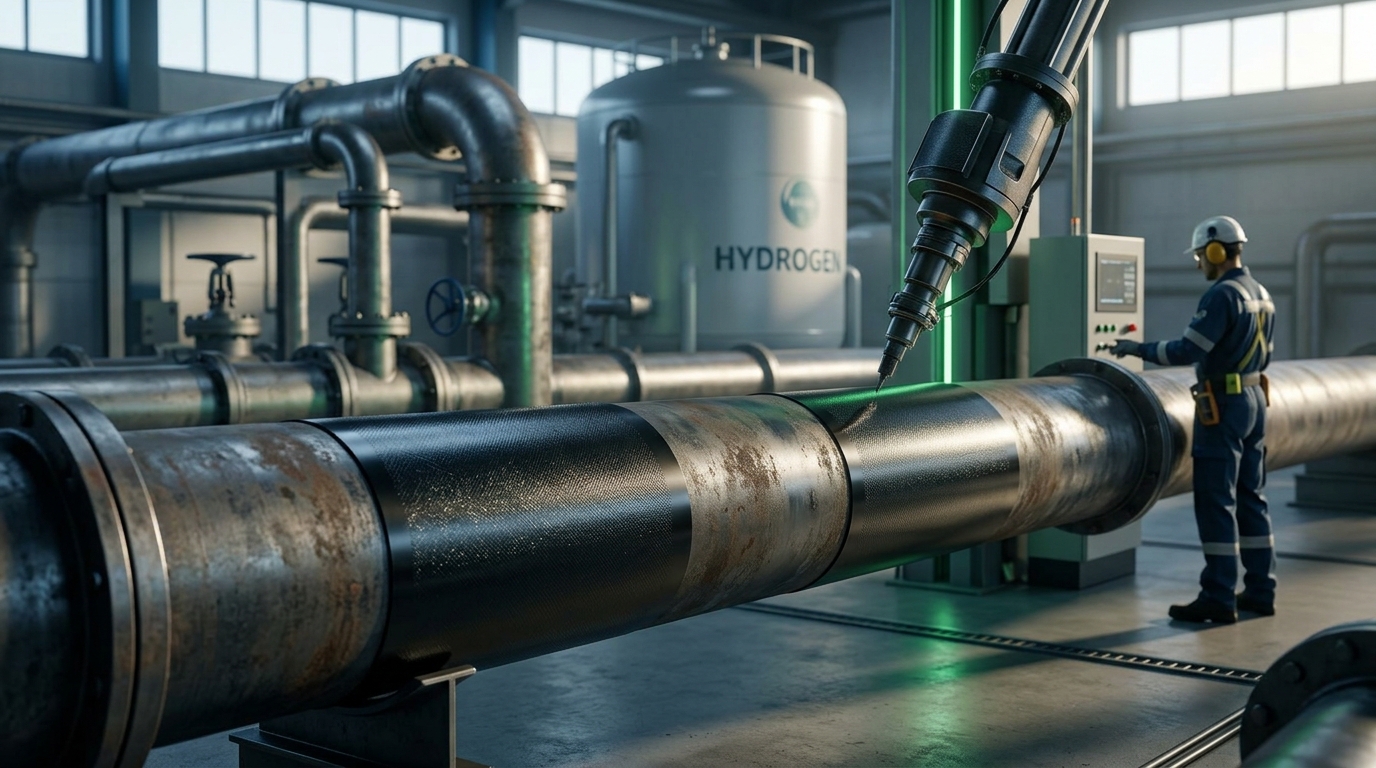
The fix is not a new pipe. It is a coating thin enough to measure in micrometers, engineered at the atomic level, and capable of turning existing iron infrastructure into a hydrogen-ready asset.
Three primary coating families have emerged: graphene-based composites, polymer-based composites, and metal or metal oxide coatings. Each attacks the same mechanism from a different direction. Graphene-based composites have earned particular attention for their barrier properties. In one multilayer-graphene approach reported in the academic literature, the process deposits a nickel catalytic layer onto pipe steel via electroplating, then implants carbon atoms, which are annealed to form multilayer graphene structures.
The numbers behind these coatings are striking. In published lab studies, alumina (aluminum oxide) coatings around 1 micrometer thick have been associated with hydrogen permeation reductions on the order of three to four orders of magnitude under certain test conditions. Diamond-like carbon coatings of the a-C:H type have also been reported in the literature to reduce hydrogen permeability by as much as a factor of 1,000 on stainless steel substrates, depending on the stack design and test conditions. For context, that means a coated pipe can allow roughly one-thousandth the hydrogen ingress of bare steel in that specific measurement.
The investment case is not speculative. The hydrogen pipeline coatings market is entering a sustained expansion phase driven by national hydrogen strategies and scaling clean production hubs, with IndexBox estimating a 12% compound annual growth rate across 2026 to 2035. The broader hydrogen pipeline materials market was estimated at $3.7 billion in 2025 and is projected to advance at a 13.1% CAGR through 2035, reaching $12.8 billion. Tenaris is one of the industrial incumbents pushing into hydrogen transport, and in 2022 it said it had qualified certain line pipe grades for high-pressure gaseous hydrogen transportation according to ASME B31.12 requirements.
Anglo Belgian Corporation has a pending Korean patent publication describing spheroidal graphite (ductile) cast-iron elements for a hydrogen collector unit, with example operating pressures discussed up to 50 bar. That is a notable materials departure from the long-held assumption that cast ferrous materials cannot serve hydrogen duty. That assumption is now being dismantled one coating chemistry at a time.
The angle that most investors miss is not the pipeline itself. It is the coating layer sitting between the hydrogen molecule and the iron wall. Companies like Swedish startup TerraBarrier are developing advanced coating technologies that explicitly position themselves as mitigating hydrogen embrittlement and hydrogen permeation risks across equipment that can include valves, fittings, and pipeline-adjacent components. The firms that own the chemistry protecting those pipes may prove more durable than the pipe manufacturers themselves. Commodity steel bends to price competition. A proprietary coating qualified for hydrogen service under international standards does not.
The real barrier to hydrogen distribution was never production cost. It was always the wall of the pipe.