
November 5, 2026
Software margins and a one-time U.S. tariff refund are doing the work that hardware volume no longer can.
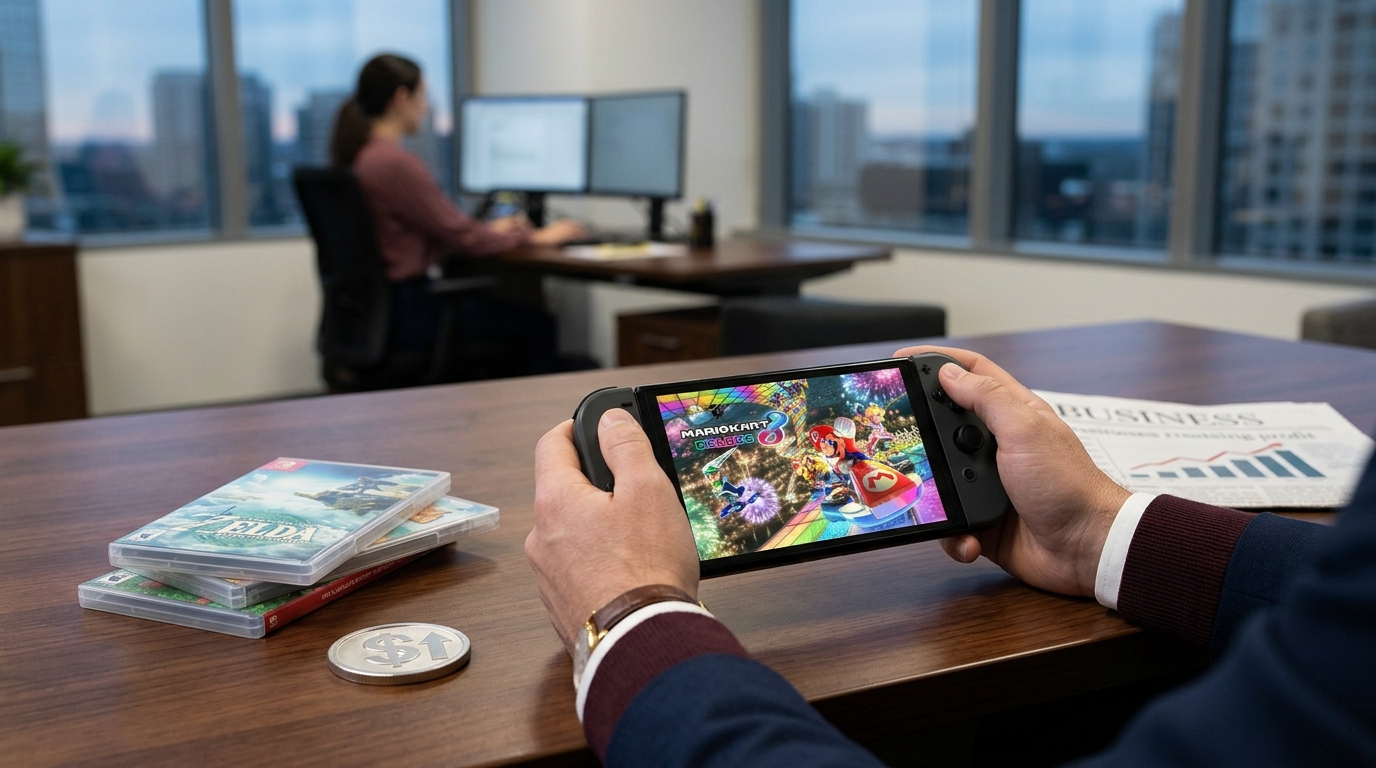
Nintendo reported first-half results on Thursday that contain one of the more striking margin stories in consumer electronics this year. Revenue fell 12.1% to ¥966.0 billion. Operating profit rose 49.1% to ¥216.5 billion. Those two numbers moving in opposite directions, and by that magnitude, is not an accident of accounting. It reflects a deliberate and ongoing structural shift in how Nintendo makes money.
For Traders Protecting a Nest Egg
If you’re trading with money you spent decades saving, one bad options trade hurts more than it should.
The first few checks on this list are all about protecting your account before you think about anything else.
The Smart Trade Options Checklist.
Normally $29.97. Free today.
What’s Driving the Numbers
Two forces explain almost all of the operating profit expansion. The first is software mix. Nintendo said operating profit benefited from steady software sales, which accounted for a larger proportion of total revenue, as well as a first-quarter refund of U.S. tariffs imposed under the International Emergency Economic Powers Act that had previously been recorded as cost of sales. The second is that one-time tariff refund, which Nintendo said was approximately $300 million, and it flows directly through the cost structure rather than the revenue line.
Sales of the Nintendo Switch 2, launched in June 2025, totaled 6.49 million units for April through September, down 37.4% year-on-year. That is a steep decline, and it accelerated through the period. Nintendo said it sold 2.67 million units of the Switch 2 in the three months ended September 30, down 41% from the same period last year. The launch-year comparison was always going to be punishing, but unit deceleration of this pace still exceeded analyst estimates.
Switch 2 software, however, rose to 24.49 million units from 20.62 million in the same period a year earlier, while original Switch software sales rose 6.8% to 65.73 million units. Software is higher-margin than hardware by a significant distance, so a mix shift toward it is structurally positive for profitability even when it fails to offset total revenue.
The Silver Mine Elon Needs
365 million ounces. That’s how much silver one American mine has produced since 1884.
And a permitted refinery sits 1 mile away.
Starting January 1st, Washington squeezes Chinese suppliers out of America’s solar factories. American silver becomes the prize.
The company trades on the NYSE. And Elon’s factories haven’t started buying yet.
The Hardware Problem
Hardware demand is facing two headwinds that Nintendo cannot fully control. Memory, a core component of Nintendo’s consoles, continues to face a supply shortage and huge demand, which is driving a sharp price surge. Samsung, SK Hynix and Micron dominate global DRAM supply, and they have shifted production toward high-bandwidth memory for AI data centers. That leaves less supply, at higher prices, for consoles, phones and computers. Because those data-center orders are large and steady, the chipmakers have little reason to shift capacity back to consumer products.
In the United States, the Switch 2 price rose $50, from $449.99 to $499.99, effective September 1, 2026. The price increase follows a similar move by Sony, which raised PlayStation 5 prices by as much as $150 in March 2026, with the higher prices taking effect in early April. Neither company raised prices by choice. The game pipeline adds a second layer of pressure. “Nintendo’s only real blockbuster this fiscal year is the Ocarina of Time remake. It’s not enough to make investors happy, especially after the device is now as expensive as it is,” Serkan Toto, CEO of Kantan Games, said.
What Nintendo Is Betting On
Nintendo stuck to its previous Switch 2 sales forecast of 16.5 million units in the current fiscal year, which ends in March 2027. Hitting that number from 6.49 million in the first half implies a sharp second-half acceleration, one that will depend heavily on the Zelda remake landing as a hardware driver and on new Pokémon games slated for release in 2027 sustaining momentum beyond this fiscal year.
Strange “Loophole” Allows Anyone to Collect “SpaceX Royalty” Payouts
Thanks to a little-known loophole…
Mainstreet investors can collect a fair share of a $3.6 billion payout from what Marc Lichtenfeld calls “SpaceX Royalty Shares…”
It’s all thanks to a “loophole” in the U.S. tax code…
Nintendo said it aims to expand the installed base of Switch 2 by increasing sales of existing titles and continuing to introduce new games, while also leveraging the existing Nintendo Switch installed base and its software lineup to expand game sales and maintain consumer engagement. That is a reasonable strategy, but it depends on execution the market has not yet seen.
The Cleaner Read
Strip out the tariff refund and the picture is still better than the revenue line suggests, because the software mix improvement is real and durable. The refund, by contrast, is gone. Memory-market analysts do not expect DRAM supply to ease meaningfully before mid-2027 at the earliest, which means the cost pressure on hardware is structural through much of the Switch 2’s core selling years. Nintendo’s margin story holds as long as software volumes grow. The hardware volume story requires a game catalyst that has not arrived yet.