
October 13, 2026
Bonus Content: Farm Methane Is Starting to Out-Earn the Farms
The Fed Failed to Stop Inflation – Your Retirement Pays
See What This Could Mean for Your Retirement
The Fed has been fighting inflation for FIVE YEARS.
And it still hasn’t beaten it.
Inflation is still running well above the Fed’s 2% target.
And every month it stays high…
Your retirement dollars buy LESS.
Food.
Healthcare.
Insurance.
Electricity.
Everything you’ll need in retirement keeps getting more expensive.
That means your IRA doesn’t have to crash for inflation to gut your retirement.
Your savings just have to lose purchasing power.
See what the Fed’s inflation failure could be doing to your retirement.
We’ve put together a free guide revealing 3 steps you can consider taking as inflation keeps squeezing the value of your savings.
The Fed has had five years to fix this.
How much longer can your retirement afford to wait?
Farm Methane Is Starting to Out-Earn the Farms
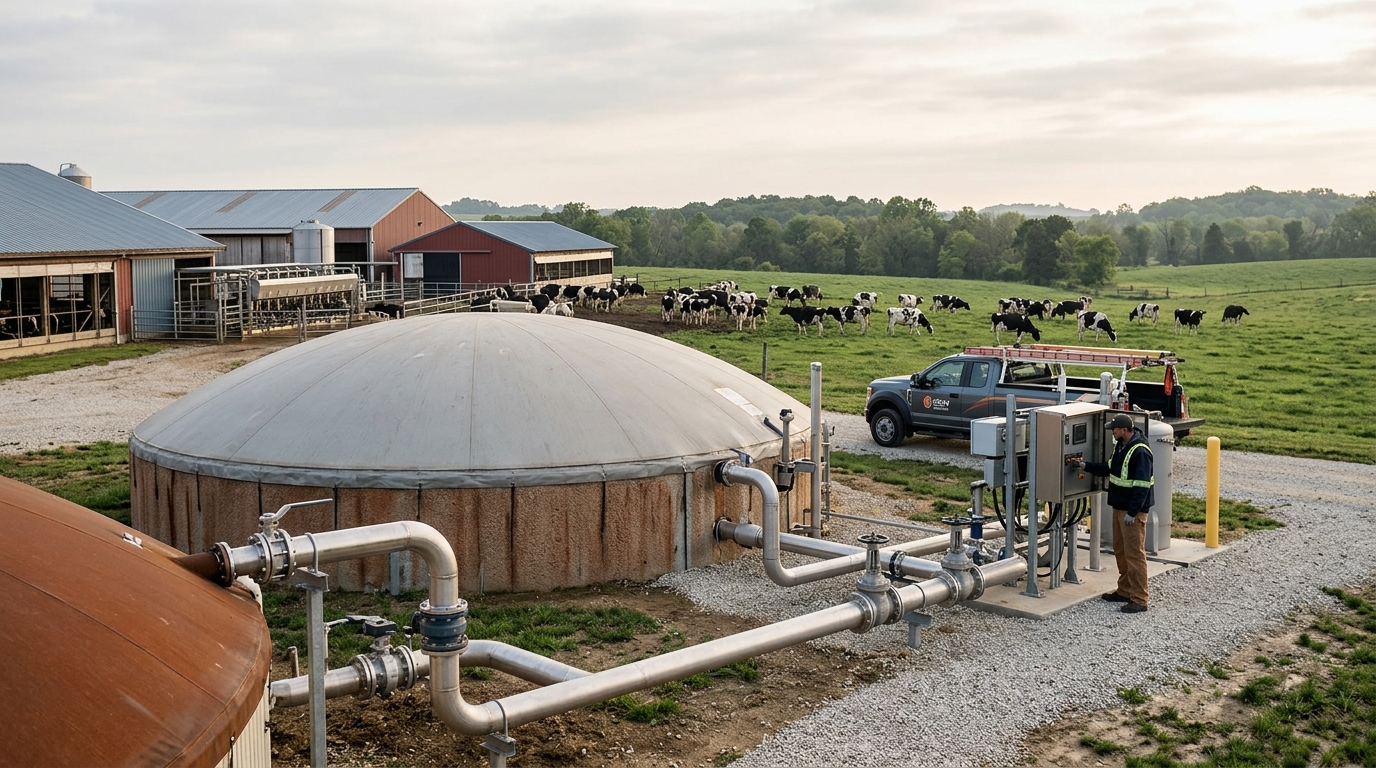
The most interesting fuel trade of 2026 is not happening at a port terminal or a petrochemical refinery. It is happening on dairy farms in Illinois, landfill sites in Florida, and wastewater facilities in the Mid-Atlantic, where a quiet cohort of rural infrastructure operators is converting methane emissions into transportable fuel and selling it into a shipping industry desperate for compliance-grade alternatives.
The catalyst for this shift is literal. This year, researchers at the U.S. Department of Energy’s Brookhaven National Laboratory disclosed work on converting methane into liquid oxygenates such as methanol and related derivatives using an inexpensive catalytic system that includes molybdenum disulfide (MoS2). The work is still early-stage and is not yet commercial deployment, but it points to a pathway that could lower costs versus precious-metal catalysts, particularly for dirty, sulfur-containing gas streams such as raw biogas.
What makes this commercially consequential rather than merely interesting is the demand side. Since January 2026, the EU Emissions Trading System added methane and nitrous oxide to its maritime scope. Shipping’s surrender obligation also phases up over time, reaching 100% for reported emissions from 2026 onward. Companies that fail to surrender allowances are liable to an excess emissions penalty of €100 per tonne of CO2-equivalent (indexed for inflation) and still must surrender the required allowances.
This is the gap rural methane infrastructure fills. The American Biogas Council reported in July that developers brought 20 new landfill gas projects online in 2025 and that total estimated investment in landfill gas facilities has reached nearly $14.9 billion. In Florida, a $50 million project at Manatee County’s Lena Road landfill has been moving forward as a landfill-gas-to-renewable-natural-gas facility aimed at displacing diesel in local truck and bus fleets, and the resulting gas would feed into Florida’s pipeline system.
The economic argument is cleaner than it looks at first. Over a 20-year horizon, methane’s global warming potential is commonly cited at about 80-plus times that of CO2, meaning every tonne captured from a farm or landfill can carry disproportionate climate value relative to what the gas itself costs to harvest. When that captured gas can be converted to a liquid fuel on-site at low temperature using an earth-abundant catalyst, the margin on the liquid product can start to compete with conventional diesel, especially for buyers facing EU compliance costs that can run to six figures per voyage when allowance prices are high.
The conventional fuel side of this equation is under its own structural pressure. Supply disruptions at major export terminals have already pushed Brent toward levels that widen the cost gap between conventional bunker fuel and compliance-grade alternatives.
The risks are not trivial. Methanol bunkering infrastructure is still limited, commonly estimated at roughly 48 ports globally, while LNG bunkering is available in far more locations. Supply must scale. The Brookhaven catalyst remains in early-stage development, not commercial deployment. And shipping’s growing orderbook for methanol-capable vessels, which industry tallies in the high hundreds rather than the low hundreds, will outpace rural production capacity for years.
Infrastructure bottlenecks are not unique to methanol bunkering. The same dynamic of capital availability outpacing physical supply chain capacity is already constraining the broader energy buildout, with lead times on critical equipment stretching years beyond historical norms.
Still, the structural logic holds. Shipping needs low-carbon liquid fuel at scale. Rural operators are sitting on methane streams that regulators increasingly penalize them for releasing. A cheap, sulfur-tolerant catalyst may be emerging. The infrastructure investment is already underway. The question is which rural operators move fast enough to capture the spread.