
September 13, 2026
A rare two-central-bank divergence this week is rewriting the case for gold as a reserve asset.
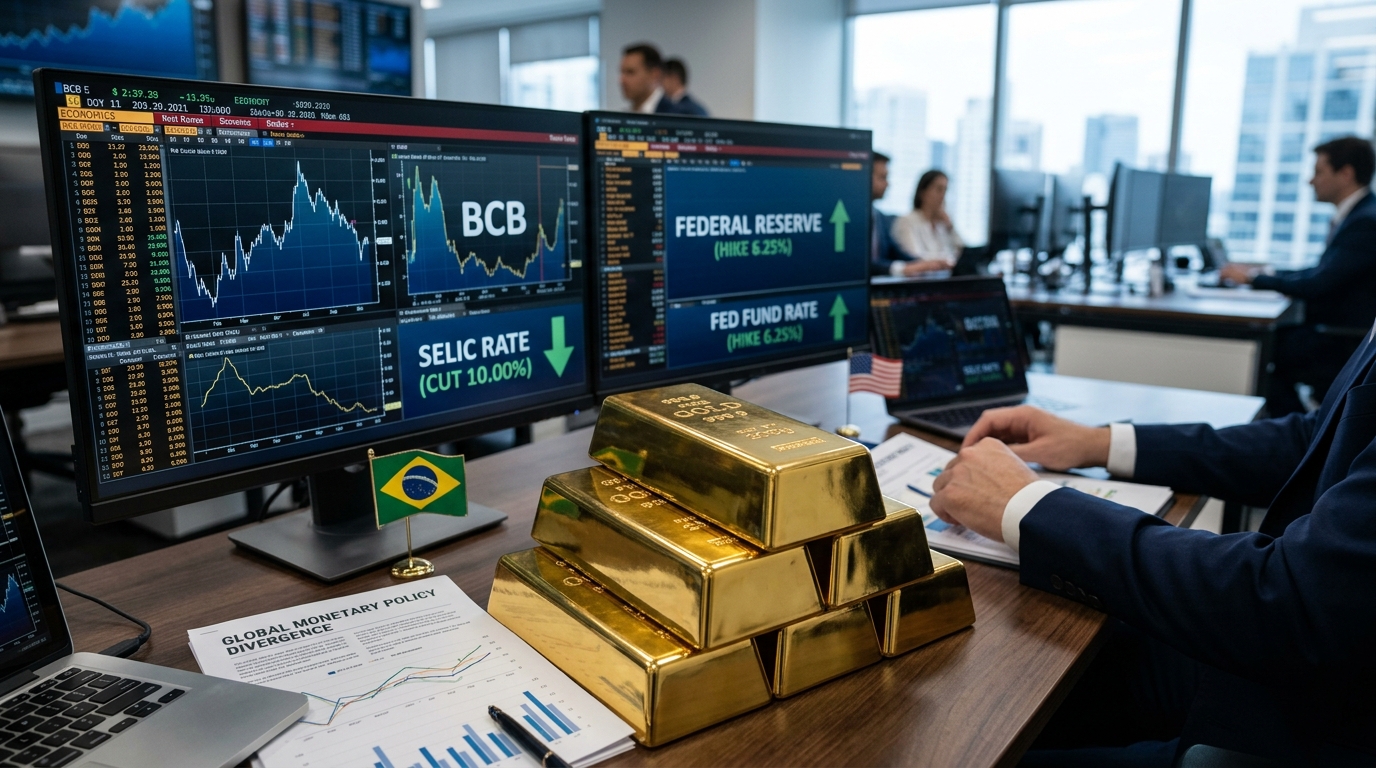
Two of the world’s most important central banks sit down this Tuesday and Wednesday, and they are moving in opposite directions. Brazilian policy makers at the Central Bank of Brazil are scheduled to decide policy on September 16, 2026, and U.S. policy makers at the Federal Reserve are scheduled to decide on September 16, 2026 as well. Markets have been leaning toward a Selic cut at that Copom meeting, while also assigning high odds to a Fed hike. That is not a routine policy divergence. It is the largest developed-market central bank raising rates at the precise moment the largest Latin American economy is lowering them, against a backdrop of bond markets already under stress.
971 Trades. One Surprisingly Simple Approach.
Five years. Bull markets, selloffs, sideways stretches – and 971 trades along the way. Dave Aquino’s Ultimate Income System focuses less on predicting the next big move and more on finding consistent trading opportunities. His new report explains the approach, why it works differently, and what most traders may be missing.
The 10-year Treasury yield closed around 4.98% on September 11, 2026. Hotter-than-expected August CPI data, with core prices rising 0.3% month-over-month and headline inflation at 3.4% year-over-year, have reinforced trader expectations for a 25-basis-point rate increase. That combination of a Fed poised to hike and a 10-year yield flirting with 5% creates an immediate, concrete problem for emerging market currencies and the sovereigns that manage them.
What This Does to the Real and EM Currencies
The Brazilian real has been holding up better than the macro backdrop might suggest. The real strengthened to around 5.08 per dollar in September after Brazil’s annual inflation rate eased to 4.22% in August, slightly below forecasts and moving further within the central bank’s target range. That relief, however, is fragile. When the dollar strengthens broadly against major currencies during Fed tightening cycles or global risk-off periods, all emerging market currencies including the BRL weaken.
If Copom cuts while the Fed holds or hikes, analysts expect only modest pressure on the currency, because the remaining spread would still be wide by historical standards. But the arithmetic in this paragraph was off: the fed funds target range has been 3.50%-3.75% since December 2025, not 3.75%-4.00%. A Selic in the mid-teens against a fed funds target range in the mid-3% area still offers a generous carry cushion. But that arithmetic gets murkier quickly if the Fed signals further hikes ahead. The outlook references a narrowing interest-rate differential and potential carry trade outflows, with one EM strategist targeting USD/BRL at 5.35 by year-end.
REVEALED: Trump just green-lit what could be the biggest AI budget in history.
Over $1 trillion aimed at AI-powered defense, surveillance, and autonomous weapons.
But the real money isn’t in fighter jets..
It’s in the small AI company supplying the core tech – the same one rumored to be working with Elon Musk.
It’s tiny compared to Nvidia…
Yet it could be the fastest way to ride Trump’s AI surge + Musk’s next supercycle.
The Gold Angle Sovereigns Are Playing
Here is where this week’s dual decision becomes a precious metals story. When a 10-year Treasury yield approaches 5% and EM currencies face structural pressure from a tightening Fed, reserve managers face a question that recurs throughout monetary history: what do you hold instead of dollars?
Central banks purchased a net 244 tonnes of gold in the first quarter of 2026 in the World Gold Council’s initial estimate. But the World Gold Council later revised that Q1 2026 estimate down sharply, to 57 tonnes, after new data and analysis. Brazil itself has been part of that shift: Brazil re-entered the gold-buying market after a four-year absence.
The freezing of roughly $300 billion in Russian central bank assets in 2022 marked a turning point for global reserve management. That event accelerated a structural rethink about dollar-denominated reserves. Thirty-eight percent of central banks say they would fund new gold purchases by selling existing reserve assets, which in practice can mean trading dollars for bullion. A Fed that hikes while EM central banks ease only sharpens that incentive.
Gold’s Short-Term Headwind and the Longer Argument
Gold was on track to lose nearly 2% this week through Thursday, its third consecutive weekly decline, falling to around $4,350 an ounce as traders increased bets on a Fed rate hike following stronger-than-expected producer price data. That is the near-term friction. Gold serves as a debasement hedge, but because it carries no real yield it tends to perform poorly when yields on assets like Treasuries are moving higher.
A Forgotten Energy Source Is Powering Back Up
While investors chase the next tech story, one long-ignored sector is quietly heating up. A mix of global policy, rising demand, and tightening supply could reignite this market before 2026. See what the latest research reveals.
The more durable argument runs in the opposite direction. Higher yields are historically a headwind for gold, but the driver of the increase matters. When premiums reflect fiscal and inflation risk rather than policy rates, gold’s appeal can persist even if long-end yields remain elevated. Goldman Sachs Research notes that geopolitical developments, including the Iran conflict, may accelerate diversification beyond central banks to private investors by weighing on perceptions of Western fiscal sustainability.
Risks to Monitor
The bullish case for gold rests heavily on central bank demand remaining sticky. The figures in this paragraph could not be verified as written, so they have been softened: in recent years, central bank net purchases have often been very large by historical standards, and many market forecasts still expect substantial official-sector buying in 2026. A meaningful slowdown in official-sector buying would remove the most rate-insensitive pillar of gold demand. On the Brazil side, in its August statement Copom said inflation risks remained higher than usual and declined to commit to further cuts, which means Tuesday’s expected cut may be the last for several months, limiting BRL pressure and reducing some of the EM currency urgency that drives reserve diversification.
Bottom Line
This is not simply a central bank policy story. It is a demonstration of why the gold-as-reserve argument has staying power independent of any single week’s yield move. When the Fed tightens and EM central banks ease simultaneously, the dollar strengthens, EM currencies weaken, and sovereign reserve managers in Brasilia and a dozen other capitals are reminded, concretely, of what holding too many dollars costs. That structural incentive does not disappear when gold sells off 2% on a hot CPI reading. It gets sharper.