
October 15, 2026
Bonus Content: RTX Won a Space Force Radar Upgrade Contract
One student learned this Friday trading method and tried it on a little-known stock.
He bought in late Friday.
Spent the weekend with his family.
By Tuesday, he had closed the trade for $15,820 in total profit.
Results like this aren’t typical, trading carries risk and results may vary.
But this is the type of setup the method is designed to find.
The full training is now available for $7.
It covers the step-by-step process, how to spot the right opportunities, and when to exit.
RTX Won a Space Force Radar Upgrade Contract
Low Earth orbit is not simply crowded. It is statistically dangerous, and the numbers released this year make the case better than any policy paper could.
Between June 2025 and May 2026, SpaceX’s Starlink satellites performed more than 355,000 collision-avoidance maneuvers, with each spacecraft in the constellation now dodging debris or rival satellites on average more than 40 times per year. That figure is more than three times the total Starlink recorded in 2024.
The fundamental problem is geometric, not technical. As the International Association for the Advancement of Space Safety’s Tommaso Sgobba put it, doubling the satellites in a given orbital shell roughly quadruples the number of object pairs that need constant monitoring. With roughly 16,000 to 18,000 active satellites in orbit as of September 2026, and 4,510 objects launched in 2025 alone, the pace of conjunctions is compounding faster than the governance frameworks designed to manage them.
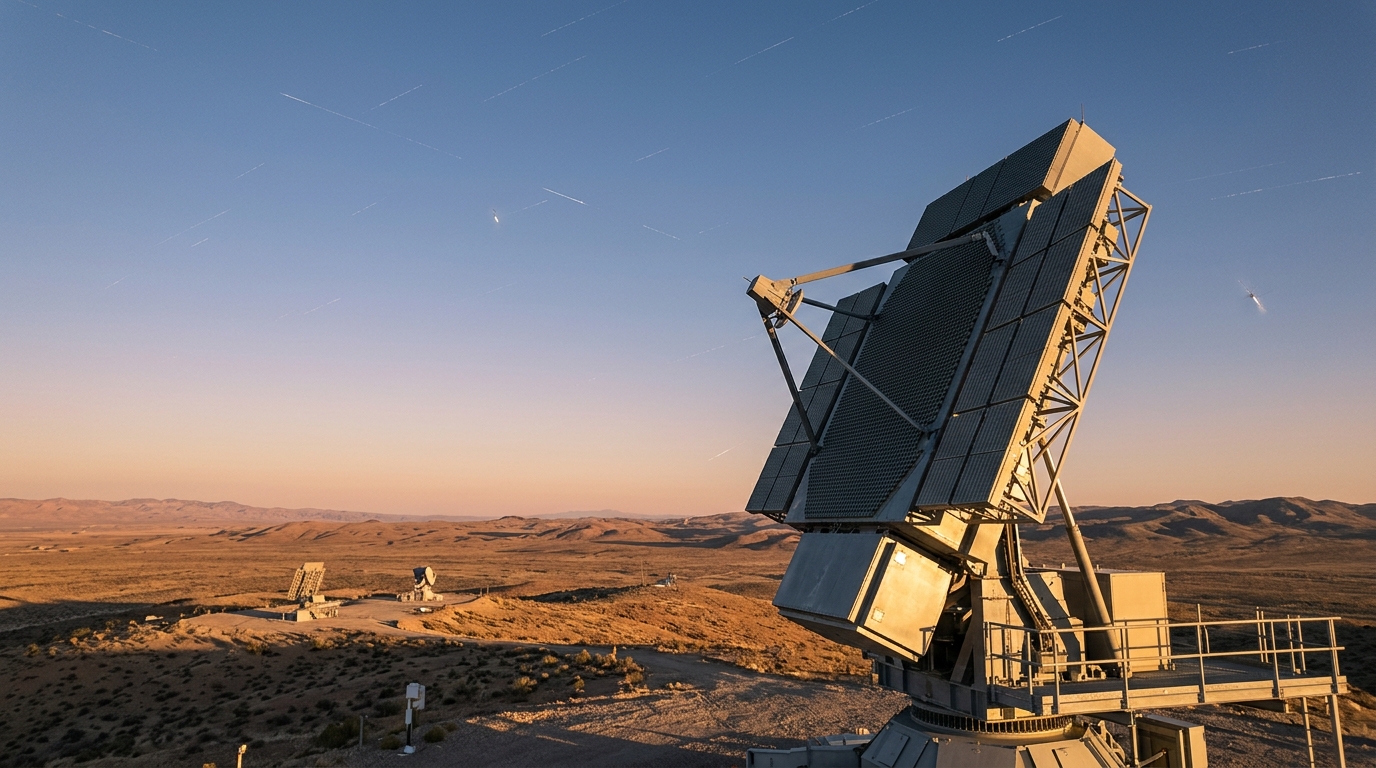
That gap between physical reality and regulatory bandwidth is precisely where Raytheon, RTX’s defense business, is building durable revenue. This morning, October 15, Raytheon was selected under the Ground-Based Radar Digitization program to modernize a network of U.S. Space Force global early-warning radars. These sensors provide launch detection, object characterization, and activity tracking across orbital regimes, the outermost layer of a surveillance architecture that was never designed to watch 18,000 objects move at 17,000 miles per hour. The program will convert long-serving analog systems to digital architecture using a modular open framework intended to simplify future upgrades and reduce vendor lock-in.
RTX is not the only prime assembling durable positions inside this spending wave. RTX ended 2025 with a $251 billion backlog, making it one of the clearest expressions of the defense supercycle at a still-reasonable valuation.
The contract value was not disclosed, but the strategic logic is clear. RTX generated $88.6 billion in revenue in 2025, and its Raytheon segment has quietly assembled a broad suite of space domain awareness tools: the LOCI sensor network tracking objects in LEO across a distributed set of sites; the FORGE ground system now in operational use at U.S. Space Force’s OBAC center; and now the Ground-Based Radar Digitization program extending the life of strategic radars for decades. Each contract reinforces the others.
The commercial satellite industry is funding RTX’s growth whether it intends to or not. Every new Starlink satellite SpaceX launches, every BlueBird unit AST SpaceMobile adds, every Kuiper satellite Amazon deploys into LEO increases the conjunction count that someone with Raytheon’s radar infrastructure gets paid to track. SpaceX has called on all operators to share ephemeris data openly; fewer than half of the roughly 650 unique maneuvering third-party satellites Starlink encountered this year actually did. That data gap is a government procurement budget in the making.
The same government urgency driving radar modernization is replenishing depleted missile stockpiles across the defense industrial base. Lockheed Martin received a sole-source $35 billion contract to quadruple THAAD interceptor output after the spring conflict consumed most of the U.S. inventory.
The risk investors should weigh: RTX’s space domain awareness work is embedded inside a much larger defense portfolio, so it is hard to isolate as a valuation driver. A significant de-escalation in geopolitical tension could slow the urgency of radar modernization. And the GPS OCX program termination earlier this year, after costs reached about $6.27 billion against a $3.7 billion baseline, is a reminder that large Raytheon development programs carry execution risk.
Still, the direction of travel in LEO is not reversible on any timeline that matters for investors today. The orbit is filling. The tracking infrastructure is not keeping pace. RTX is the company the Space Force calls when that gap becomes acute enough to fund.