
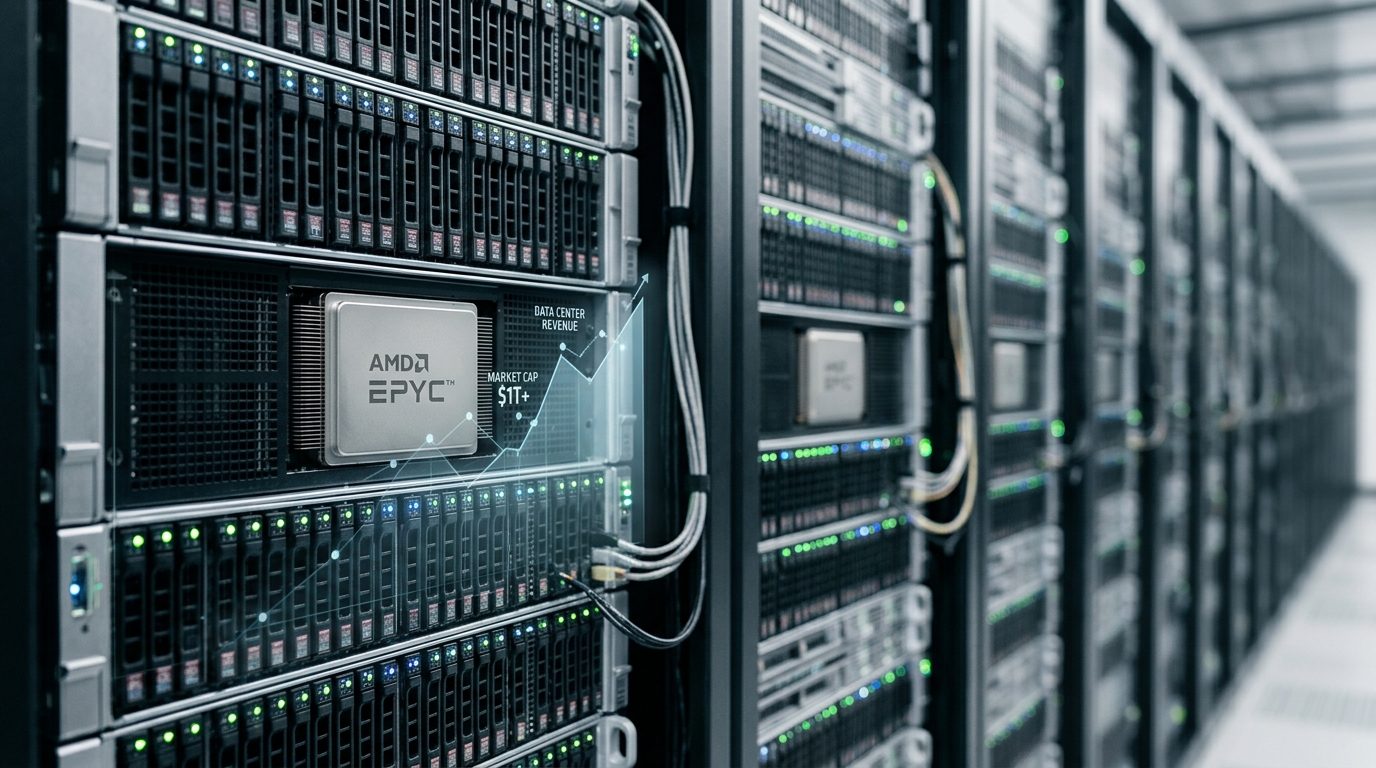
Advanced Micro Devices crossed $1 trillion in market capitalization on September 21, joining Nvidia, Broadcom, and Micron in a club that held almost no semiconductor names as recently as 2023. The stock is up roughly 185% in 2026. That is not speculation built on promises. It is built on data center revenue that doubled year over year and a competitive position that is visibly improving.
The question now is whether AMD can sustain the growth rate that justified the multiple, and whether a fresh $8.2 billion acquisition answers the questions investors have been asking about its software gap.
The Business
AMD reported Q2 2026 revenue of $11.5 billion, up 50% year over year. Data center grew 107% to $6.7 billion, now 58% of total revenue. EPYC server processors are taking CPU share from Intel at a pace analysts describe as structural. Instinct GPU accelerators are the credible second option behind Nvidia for AI training workloads at hyperscale.
AMD guided Q3 revenue to approximately $13 billion at the midpoint, up 41% year over year, with a non-GAAP gross margin of 56%. Analysts expect Q3 earnings per share of roughly $1.93. Earnings are expected on November 3.
Why Wall Street Is Paying Attention
The World Labs acquisition, announced September 28, is the clearest signal of where AMD believes the competitive fight is heading. World Labs, founded two years ago by Stanford AI pioneer Fei-Fei Li, develops spatial intelligence models that generate and simulate interactive 3D environments from text, image, and video inputs, as well as technology for robotic learning and simulation.
Li will join AMD as executive vice president and chief scientist, reporting directly to CEO Lisa Su. The deal is valued at $8.2 billion in stock and expected to close by the end of 2026. Su’s framing was direct: building next-generation compute platforms requires understanding how models are evolving. World Labs’ researchers represent a direct attempt to close AMD’s software gap by designing hardware that better reflects how leading-edge models actually consume compute.
What’s Driving the Opportunity
AMD’s data center momentum runs on two separate tracks. EPYC is taking server CPU share as cloud providers diversify away from Intel on cost and performance. The company said it expects Data Center sales to accelerate in the second half of 2026. On the GPU side, Instinct is finding real hyperscaler placements by offering an open alternative to Nvidia’s CUDA ecosystem.
What Could Go Wrong
The valuation requires consistent execution. AMD trades above 160x trailing earnings. The Q2 report beat estimates, yet the stock fell nearly 9% after hours because the guidance exceeded consensus only modestly. The market is unforgiving at this level.
The World Labs deal adds dilution, as the all-stock structure raises the share count at closing. Research talent does not immediately translate into chip revenue. Integrating a focused AI lab into a 25,000-person semiconductor company is a management challenge that will show up in results before it shows up in roadmaps.
The Bottom Line
AMD’s trillion-dollar arrival is earned. Data center revenue doubling in a single quarter is a revenue line, not a forecast. The World Labs deal addresses the most legitimate long-term competitive question: whether AMD can shape its hardware around where AI is going rather than where it has been. With Q3 earnings expected November 3 and the guide already pointing to 41% revenue growth, the near-term thesis rests on numbers that exist today.