
October 16, 2026
Bonus Content: Greenland Minerals Could Chip Away at China’s Rare-Earth Hold
Editor’s Note: See the following from Joel Litman, Chief Investment Officer and Analyst at Altimetry, whose followers include names at Fidelity, BlackRock, Vanguard, and half of the top 300 money management firms in America. Joel has deep ties to Washington, DC and he’s consulted for the Pentagon, the FBI, the Department of Defense, and has lectured at the US Marine Corps War College. Today he secured access to one of the most heavily guarded areas in the world to uncover the truth about what could soon become the biggest stock market story of the decade.
Dear Reader,
For years, we’ve been told SpaceX is a rocket company… that will one day take humans to Mars (and the moon).
But according to new satellite images from 300 miles above the Earth’s surface, there is something very strange going on at SpaceX right now that has nothing to do with space.
A new division of SpaceX is deploying a new way to power our world… that could replace our need for foreign oil forever – without using nuclear fission, solar, wind, geothermal, coal, or any sort of battery.
When you consider SpaceX burns 29,600 gallons of fuel per launch… it makes sense the business would want a better way to generate energy.
But what it’s doing right now could change not only SpaceX’s operations… but also dramatically affect the entire country – and your investments.
What it’s deploying is a newly permitted technology I know simply as “Dark Energy.”
Most people have no idea something like this is even possible.
And it will sound like science fiction – at first.
But as I prove in my new boots-on-the-ground interview from West Texas, this is the beginning of what could be a $10 trillion boom for investors who know what to do – and who take the right steps now.
SpaceX can’t make this “Dark Energy” by itself. It relies on a small group of little-known suppliers to make it happen.
And I believe that’s why a laundry list of billionaires and tech CEOs are getting themselves into position.
Early supporters of “Dark Energy” include Nvidia CEO Jensen Huang, Oracle founder Larry Ellison, and OpenAI CEO Sam Altman.
Not to mention names like Brad Gerstner, a legendary tech investor who managed to be early on Uber, Microsoft, Amazon, Meta, and Nvidia.
He just joined a $300 million round backing this technology.
Or Garry Tan.
Garry invested in Coinbase back in 2012… turning a $300,000 stake into $2.4 billion in less than 10 years.
He’s backed Airbnb, Stripe, DoorDash, and Dropbox… and his firm has invested in companies that are now worth more than $1 trillion combined.
Today, he’s backing “Dark Energy.”
This discovery could change our daily lives… and radically lower the cost of power.
And I believe that for you, this could be one the most profitable moments of your financial life if you position your money behind the right stocks before this news spreads.
I’m sharing all the details right now, on camera.
Click here to see how you could double your money or more by backing this new “Dark Energy.”
Regards,
Joel Litman
Chief Investment Officer, Altimetry
Greenland Minerals Could Chip Away at China’s Rare-Earth Hold
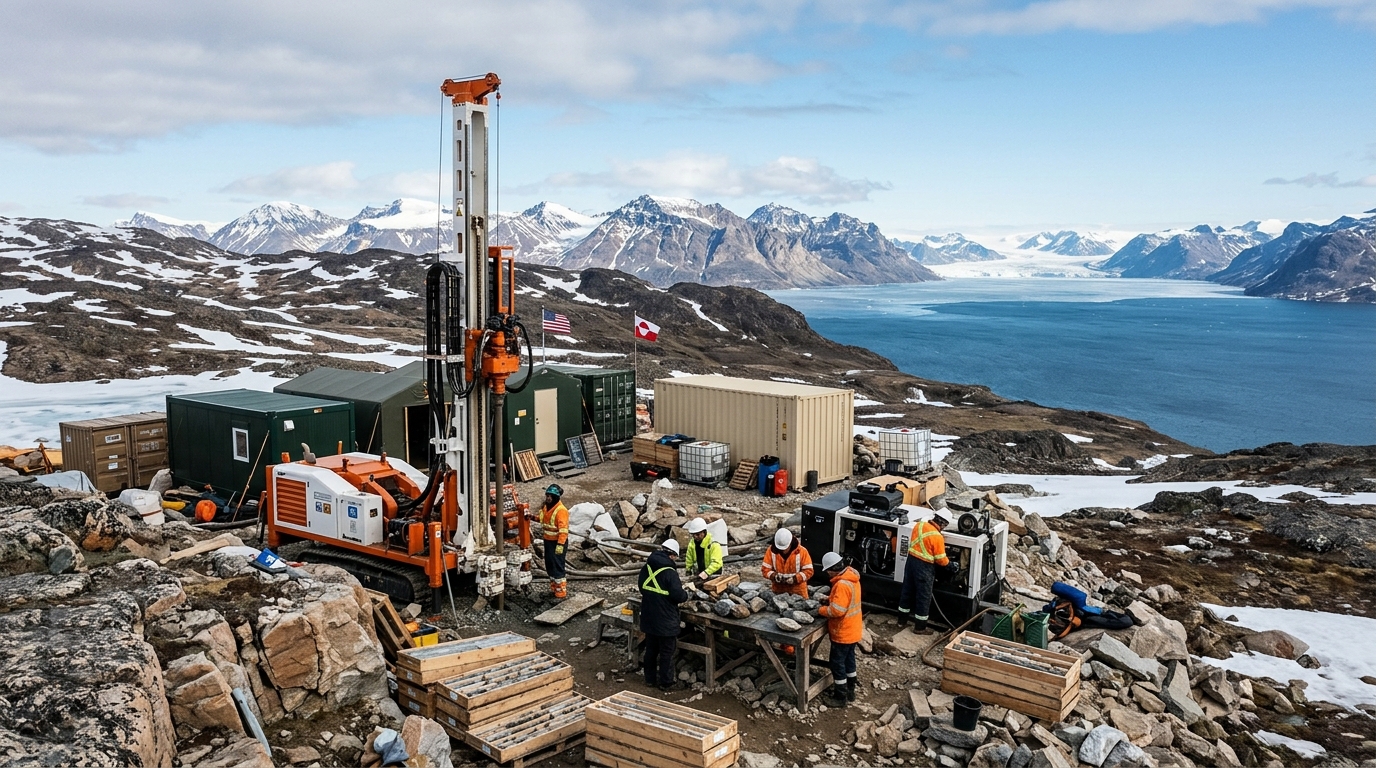
President Trump claimed early Wednesday that “massive oil, gas and mineral exploration is getting ready to begin” in Greenland, without providing further detail about the operation. The Truth Social post is short on specifics, as Trump posts often are. But the investors paying closest attention are not focused on oil. They are focused on what happens to Beijing’s leverage over the rare-earth supply chain if Washington succeeds in opening Greenland’s mineral belt to Western developers.
The security agreement signed by the U.S., Denmark and Greenland is viewed by companies in the mining sector as minerals-focused. The parts of the arrangement regarding sensitive sectors require all three parties to agree before states or investors from countries that are not NATO members, NATO partners, or EU members can gain control, significant influence, or access to non-public information in “particularly sensitive” activities in Greenland. In practice, that raises the bar for capital from countries like China, Brazil and Russia, unless the U.S., Denmark and Greenland agree those investments do not pose a national security or public-order threat. That effective veto mechanism is what matters most to investors.
What’s Driving the Market
The strategic logic behind the land grab is straightforward. China accounts for about 69% of global rare-earth mine output. It still dominates downstream processing and manufacturing, but the best-supported recent estimates put China at roughly 85% of refining and separation capacity and about 94% of permanent magnet manufacturing. This concentration creates profound supply chain exposure for Western defense, automotive and technology sectors.
As of late September 2026, U.S. and Chinese officials said the broader trade truce was extended until January 10, 2027, ahead of the Trump-Xi meetings in Washington. Separately, China’s one-year suspension of certain expanded rare-earth export controls had been set to expire on November 10, 2026, and public documentation of any change to that specific deadline has been uneven across official channels. The rollover buys time. It does not alter the dependency.
Greenland’s potential is substantial but not immediate. Greenland is estimated to hold approximately 36 million tonnes of rare earths, though only 1.5 million tons are currently considered proven, economically viable reserves. It is generally ranked around eighth globally in reserves and, with further exploration, may ultimately be proven to contain one of the world’s largest deposit bases outside China.
The European Commission has said Greenland is home to 25 of the 34 minerals it defines as critical under the EU’s Critical Raw Materials framework.
The Investment Opportunity
The company most directly positioned is Greenland Mines (NASDAQ: GRML). It is a Western-aligned critical-minerals developer advancing the Sarfartoq neodymium-praseodymium rare-earth project in southwest Greenland and the Skaergaard palladium-platinum-gold project in southeast Greenland. In late September, Greenland Mines announced it had applied to the Government of Greenland for a new exploration license covering approximately 262 square kilometres immediately east of its existing Sarfartoq license. That expansion would increase the company’s total exploration area at Sarfartoq from roughly 192 square kilometres to about 454 square kilometres.
The company’s Initial Assessment for the ST1 deposit includes a high-case pre-tax NPV of approximately $2.05 billion, and planned NdPr oxide output was presented as roughly 34% of NdPr oxide refined outside China at 2025 consumption levels. Greenland Mines completed a $12-per-share equity financing in late September, raising more than $42 million and describing itself as fully funded through 2027 milestones.
Critical Metals (NASDAQ: CRML), which holds an interest in Tanbreez Mining Greenland A/S, is the other direct beneficiary. Tanbreez Mining Greenland A/S holds the exploitation permit for rare earths at the Tanbreez project in southern Greenland. The September agreement is a positive for Critical Metals, which has an early-stage rare-earth project at Tanbreez from which it hopes to supply heavy rare-earth elements to North America and Europe. It also benefits REalloys (NASDAQ: ALOY), which has disclosed a long-term offtake agreement linked to Tanbreez Phase 1 production.
USA Rare Earth (USAR) and MP Materials (NYSE: MP) have traded sharply around recent headlines, even though they are unlikely to be directly affected by Greenland-specific permitting outcomes because neither holds Greenland assets.
Risks to Monitor
The geological reality is harder than the political enthusiasm. Greenland’s rare-earth deposits remain undeveloped despite ranking among the top ten globally for reserves, with geographic constraints, regulatory restrictions and infrastructure deficits presenting barriers to commercial production. Researchers have long noted that extracting Greenland’s minerals can be extremely difficult and expensive because many deposits are in remote Arctic locations with limited infrastructure and harsh operating conditions.
Permitting risk is real. Nothing announced so far grants any company a permit, an offtake or funding. The U.S. Government Accountability Office has cited industry estimates that building major mining projects can take 7 to 15 years to bring a property fully online, and rebuilding a U.S. rare-earth supply chain could take up to 15 years under certain assumptions. Trump’s post names no operator, cites no contract and offers no timeline. Enthusiasm priced ahead of approvals has a long history of reversing sharply.
Bottom Line
What changed today is not the geology. It is the political signal. The September agreement with Denmark and Greenland gave Western developers a structural advantage by tightening scrutiny of foreign investment in sensitive sectors and requiring tripartite agreement for investors from outside NATO, NATO partner countries, and the EU. Trump’s statement this morning reinforces that the White House intends to act on that framework. For precious metals investors, the names worth watching are the companies already holding Greenland exploration licenses, not the broader rare-earth sector that rallies on sentiment alone. The opportunity is real. The timeline is long. Position accordingly.