

October 15, 2026
Bonus Content: Copper Just Hit a Cash-Market Record. What That Tells Gold and Silver Investors.
Dear Reader,
I recently built a new investment model for the AI economy.
It contains just 5 stocks.
And you won’t find one big AI-related name anywhere on the list: Nvidia.
Look, I know Nvidia well. My system turned Bullish on the stock before one of the greatest runs of the AI boom.
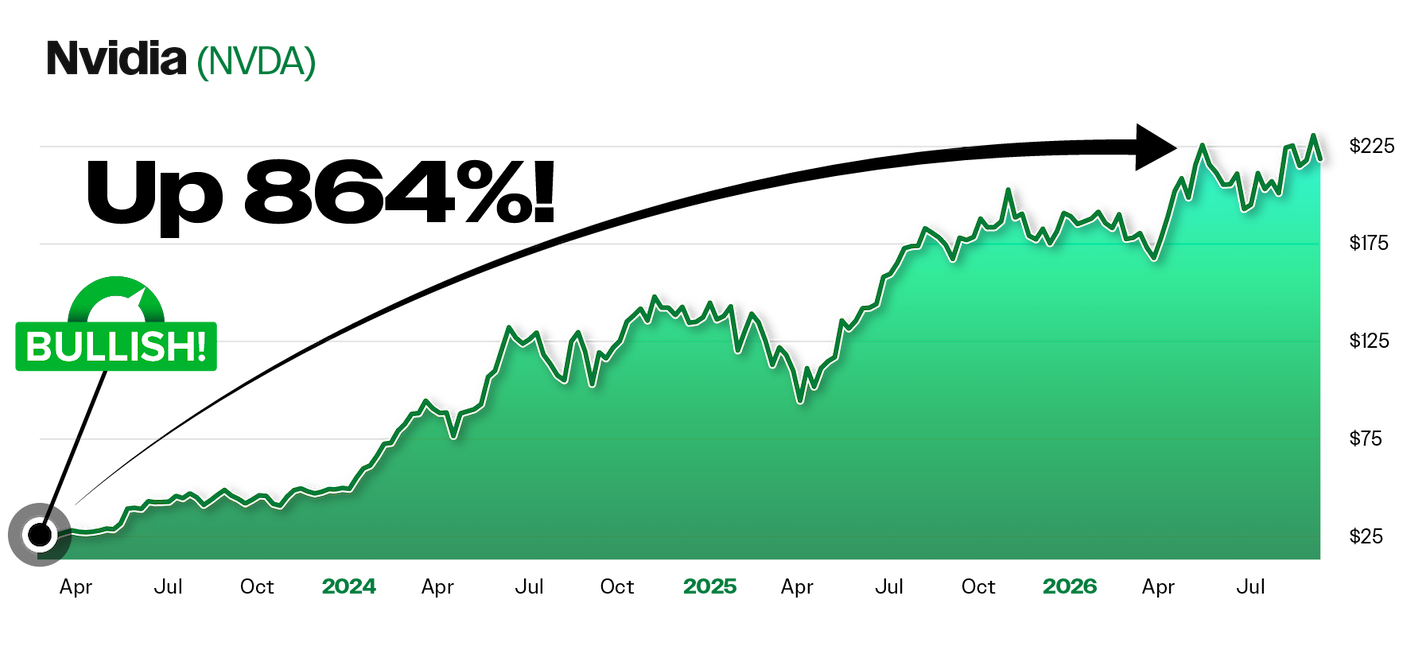
But I’m not interested in telling you about yesterday’s winners. I’m interested in finding what’s next.
That’s the entire idea behind my new 401(ai).
Instead of chasing the AI stock everybody already knows about…
I’m using my system to search for companies that could benefit from where the AI economy is going next.
And right now, five stocks have risen to the top.
Not 500… Not 50…
Just five.
That’s why Nvidia isn’t in my 401(ai).
KEEP IN MIND: My system already gave bullish ratings to the first round of big AI winners, including Nvidia before it soared 864%… Super Micro Computer before it soared 2,346%… Vertiv before it went up 611%… and AppLovin before it soared 539%.
The next round of winners could do even better – but only if you get in before Wall Street catches on.
You can watch my new presentation – which includes a free demo of how it all works – by clicking here.
Sincerely,
Marc Chaikin
Founder, Chaikin Analytics
P.S. I’ve spent nearly 60 years watching one generation of market leaders give way to the next. Nvidia has already created massive wealth. My question now is much simpler: What’s next? Find out by clicking here before it’s too late.
Copper Just Hit a Cash-Market Record. What That Tells Gold and Silver Investors.

Cash copper settled at a record $14,822 a tonne on Monday and $14,741 on Tuesday. On Wednesday, three-month copper on the LME climbed as far as $14,700, its highest since September 23, before easing to $14,532. Behind those numbers is a detail that matters more than any single session’s close: LME inventories have fallen for seven straight sessions to 229,650 tonnes. That persistent drain is not noise. It is a signal about where the world’s physical metal is, and where it is not.
Visible stocks worldwide are up 300,000 tonnes this year, but that is the US build. Everywhere else they are down 168,000 tonnes, and Macquarie says sentiment will not turn until LME and Shanghai inventories start rising again, either quickly on a tariff decision or gradually as forecast surpluses feed through. The geographic split is the whole story. Copper has not disappeared; it has been rerouted.
The spread that built the US stockpile has all but disappeared on a spot basis. Comex October copper at $6.62 a pound trades below LME cash, which at Tuesday’s $14,741 works out to $6.69, and John Gross of The Copper Journal calculates the month-to-date average has flipped to an 85-point LME premium from a 17-cent Comex premium in June. The arb that sucked metal across the Atlantic is gone. The metal, however, has not come back.
What Copper Confirms About the Broader Metals Story
Gold is trading around $4,146 an ounce this morning and silver near $55.84. Both remain in long-term uptrends driven by real-rate uncertainty, dollar softness, and central bank buying. Copper at record cash levels adds a different layer to that picture.
When the industrial metal with the most direct read on global electricity demand and construction activity pushes to all-time cash highs, it typically means one of two things: genuine demand acceleration, or a supply distortion severe enough to mimic it. Right now, it is mostly the second. Prices “have disconnected from the fundamentals and could arguably move higher or lower depending on the outcome of the Section 232,” Macquarie’s strategists write in a quarterly compendium whose copper chapter is headed “The great copper gamble,” listing the metal among preferred commodities for the next six to nine months “but very binary.”
For gold and silver investors, that binary outcome matters. If tariff resolution floods LME warehouses with redirected US copper, a sharp price unwind in the industrial complex could drag silver with it. Silver’s dual identity as both a monetary and industrial metal means it carries that risk in a way gold does not. A copper collapse would likely widen the gold-silver ratio, at least temporarily. Conversely, if the tariff standoff continues and ex-US tightness deepens, silver’s industrial demand profile becomes a tailwind.
The Investment Case for Copper Equities
The miners have run hard. Copper producers fell with the metal on Wednesday, Freeport-McMoRan down 3.7% and Southern Copper 3.3%, but the year has been kind. Southern Copper is up 44.1% in 2026, taking its market value to $169 billion, with Glencore ahead 38.6%, BHP 38.0% and Freeport 37.4% at a $100 billion valuation.
The more important question is what the stocks are pricing. RBC Capital Markets calculates that North American copper producers at 1.0 times net asset value imply a copper price of $5.03 a pound, from $5.98 for Freeport down to $3.96 for Ivanhoe Mines, against a futures price near $6.70. That gap is the embedded optimism, and it cuts both ways. If the Section 232 decision locks copper above $6.50, the stocks look cheap on a cash-flow basis. Freeport generated $1.5 billion in operating cash flows in the first quarter of 2026, and its full-year operating cash flow is projected at approximately $8.7 billion based on $6.00 per pound copper. At $6.70, those numbers improve materially. At $5.00, the valuation re-rating runs in reverse.
Freeport’s cash-flow sensitivity to copper price is not the only variable the market is repricing. Freeport’s Grasberg gold output is the secondary lever analysts are leaning on when upgrading the stock at current copper prices.
Risks to Monitor
The tariff outcome is the dominant variable, and it is unresolved. The US Commerce Department was due to report on the domestic copper market by June 30 so the White House could decide whether to impose a 15% tariff on refined copper imports from January 1, 2027. Since then, the White House has directed Commerce to provide an update on domestic copper markets by June 30, 2026 to inform whether moving ahead with a phased refined-copper tariff would be warranted. No refined-copper tariff decision has been announced.
Supply disruptions in Chile add genuine tightness on top of the tariff-driven distortion. A mudslide following heavy rainfall at Chile’s El Teniente mine is fuelling concerns about further supply disruptions. Chinese inventories are thin, and importers are paying a premium of around $118 over the LME price, the highest since 2022.
The El Teniente mudslide is not the only Chilean supply risk in play. BHP’s Escondida, which alone accounts for roughly 5% of world supply, entered mandatory government mediation after supervisors voted 94.8% in favour of strike action.
Wall Street Is Quietly Stepping Back From the Dollar
Analysts are calling it the ‘Sell America’ trade. Goldman Sachs analysts describe gold as a hedge against currency debasement, and when confidence in the dollar softens, money has historically flowed into gold. If decades of your savings sit in dollar-based accounts, this shift matters. America’s Gold Company’s FREE guide shows how physical metals may help diversify your savings.
See what the smart money sees. Get your FREE Precious Metals Retirement Guide today.
Bottom Line
Record cash copper with falling LME inventories tells precious metals investors that industrial demand for hard assets remains intact, but that the architecture underneath the copper price is fragile in a specific way. The tightness is real where you cannot access US-held stockpiles, and artificial where you can. That distinction matters enormously for silver. Gold, insulated from the industrial demand channel, is less exposed to a copper unwind. For investors holding both, watch whether LME inventories stabilize in the coming sessions. A reversal there would be the first concrete sign that the Section 232 calculus has shifted, and that copper’s record cash premium is beginning to unwind.