
September 29, 2026
Bonus Content: Eaton Just Paid €810M to Get Ahead of a Switchgear Bottleneck. Copper Investors Should Notice.
Tim Sykes became a self-made millionaire not by chasing “good” companies…
But by flipping so-called “bad” ones.
He calls them “Supernova” stocks.
And the secret is simple:
- Under $100 million market cap
- Low trading volume
- Bad fundamentals
When all 3 line up, the stock can explode in a matter of hours.
Like HOLO, which ran from $1.50 to $98.40. Or LAES, which shot from $0.49 to $10 in days.
These gains are not typical and past performance doesn’t mean future success.
But Tim recorded a short video showing exactly how he finds these stocks.
Results are not typical and will vary from person to person. Making money trading stocks takes time, timing, proper execution, dedication, and hard work. There are inherent risks involved with investing in the stock market, including the loss of your investment. Past performance in the market is not indicative of future results. Any investment is at your own risk.
Eaton Just Paid €810M to Get Ahead of a Switchgear Bottleneck. Copper Investors Should Notice.
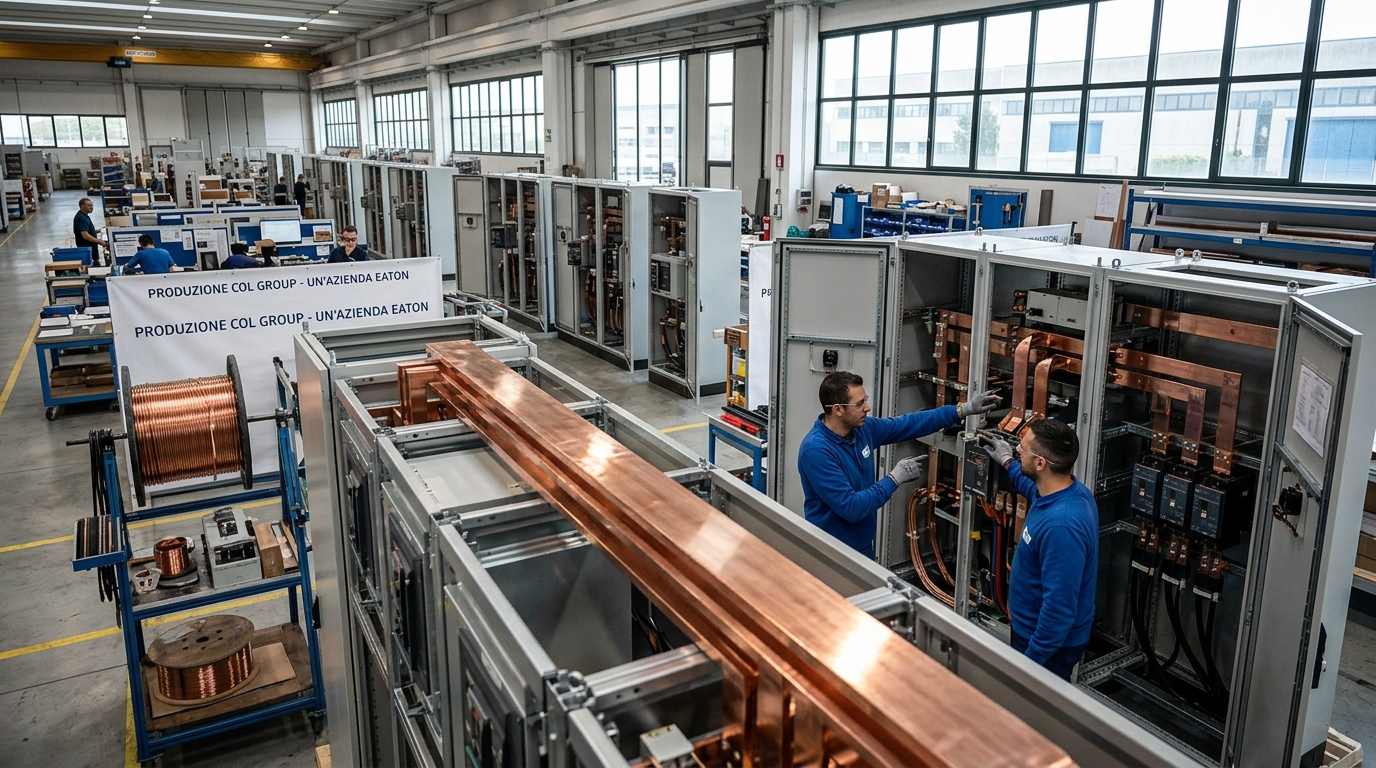
The queue is the message. Eaton agreed on Friday, Sept. 25, 2026, to acquire Italy-based COL Group from Oaktree Capital Management for an enterprise value of €810 million.
The price looks steep for a company forecasting €250 million in sales for 2027, implying a multiple well above 3x forward revenue. Eaton did not pay that premium for idle capacity. It paid it because switchgear capacity in Europe is constrained, and constrained capacity commands a premium.
What does that have to do with copper? Everything.
COL Group develops medium-voltage electrical distribution solutions, including switchgear, grid automation technologies, and modular power systems. The company operates facilities in Turin, Milan, Bergamo, and Catania. Every one of those products is copper-intensive at its core. Busbars distribute electrical power within switchgear assemblies and are typically made from copper or aluminum conductors. Medium-voltage gear is not a software product. It is fabricated metal, and the metal doing the conducting is copper.
Eaton said the acquisition will expand its European power distribution capabilities and manufacturing footprint, enhancing its ability to support growing customer demand across data center and utility markets. That framing points directly at the two demand pools now driving grid investment: AI data centers consuming power at unprecedented density, and utilities scrambling to modernize aging infrastructure. As electrification accelerates and AI factories drive data center demand, power infrastructure must evolve at the same pace as the digital services it supports, a point Schneider Electric made on Monday, Sept. 28, 2026 when it unveiled software-defined medium-voltage switchgear at the YOTTA 2026 conference in Las Vegas. Competitors are moving. Eaton’s acquisition of COL is its answer: buy the physical plant, because you cannot serve demand you cannot build fast enough to fill.
Oaktree invested in COL Group in 2021 as part of its focus on essential infrastructure businesses serving the global energy transition and the electrification of power networks, and its specialist team supported COL in expanding its product portfolio and customer base, including through the acquisitions of TeamWare and IME Group. A private equity firm with a five-year horizon exiting at a multiple well above 3x forward revenue is itself a data point: infrastructure tied to grid buildout is monetizing above what a conventional industrial sale might have fetched a decade ago.
The copper connection runs deeper than switchgear components. S&P Global projects global copper demand rising from roughly 28 million metric tons per year in 2025 to about 42 million metric tons by 2040, an increase of about 50%. Grid expansion and infrastructure investment are locking copper demand into capital expenditure cycles that will take years to unwind, regardless of short-term economic softness. Eaton’s willingness to pay a control premium for Italian switchgear manufacturing capacity is evidence that those cycles are already running.
Distribution hardware, medium-voltage switchgear, distribution transformers, MV cables, smart meters, and protection relays, is typically sold to distribution network operators in higher volumes at lower unit values, with shorter lead times. ABB, Schneider Electric, Hubbell, and Eaton have stronger distribution exposure. That peer group matters. Hubbell (HUBB) and Schneider Electric carry similar exposure to the distribution upgrade cycle. Siemens Energy sits further up the voltage stack in transmission, but the underlying demand driver is the same.
There is a regulatory tailwind worth noting. Under EU Regulation 2024/573, SF6 and other fluorinated gases are being phased out in electrical switchgear. The regulation prohibits the putting into operation of new medium-voltage electrical switchgear for primary and secondary distribution up to and including 24 kV from Jan. 1, 2026, and from more than 24 kV up to and including 52 kV from Jan. 1, 2030. COL already produces SF6-free switchgear for secondary distribution. Replacing tens of millions of legacy units across Europe with compliant alternatives is a replacement cycle measured in decades, not quarters, and it runs through copper at every junction.
The risk is straightforward: copper prices that have already surged could reverse if global growth disappoints, particularly in China. Long-term tailwinds are compelling, but copper remains sensitive to global growth and China demand. Eaton’s €810 million bet is a vote that the structural demand holds. The medium-voltage market expanding at a forecast CAGR of 6.3% from 2026 to 2034 supports that read, but execution risk on cross-border integrations is real.
The bottom line: when a company the size of Eaton pays €810 million for the right to make more switchgear in Italy, it is not speculating on the future of electrification. It is acknowledging that the future is already here and that the constraint is not demand. It is the physical capacity to build the copper-laden hardware that grid modernization requires.