
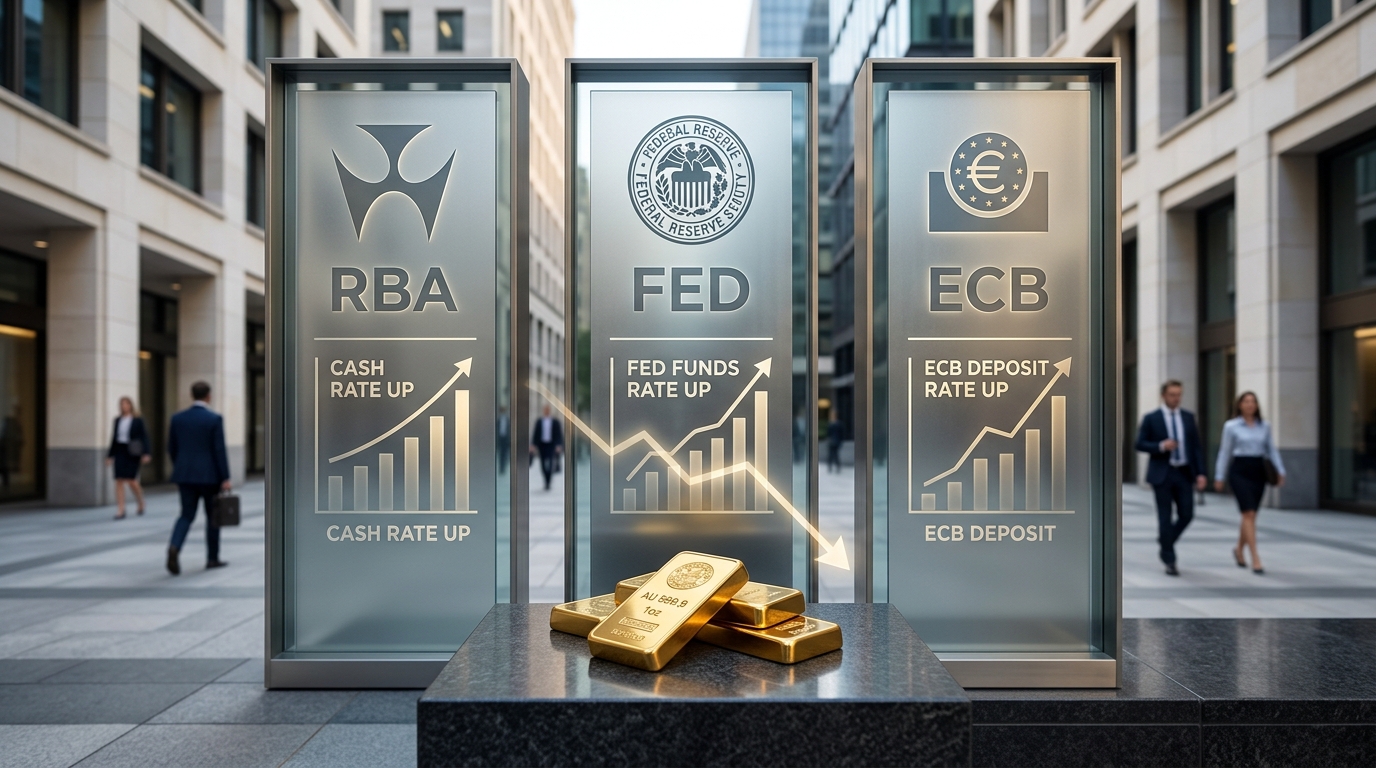
Gold is trading near $4,143 per ounce this morning, a seven-week low. The proximate cause is the Reserve Bank of Australia, which hiked its cash rate by 25 basis points to 4.6% on Tuesday, the fourth increase of 2026 and the highest level since October 2011. But the real story is not what Australia did. It is what Australia, the United States, and Europe are doing simultaneously.
What’s Driving the Market
The RBA increased the official cash rate by 25 basis points to 4.6%, marking the fourth monetary tightening of 2026 and pushing borrowing costs to their highest level since 2011. Governor Michele Bullock left no ambiguity about the direction of travel. Inflationary pressures are expected to last longer than anticipated, and the board will raise rates again if needed. In Bullock’s own framing, the Middle East conflict made things worse, but Australia had a CPI problem before it.
That last point deserves weight. On 16 September, the US also hiked interest rates by 0.25 percentage points. The ECB has moved twice this year, including a 25 basis point hike in September. Economists are now pointing to a Reserve Bank of India hike in October. What investors are watching is not an isolated decision by a Pacific central bank. It is the architecture of global monetary policy shifting in lockstep.
The transmission to gold runs through real yields and the US dollar. The 10-year US real yield has surged toward the high-2% range, raising the opportunity cost of holding non-yielding gold and adding pressure to XAU/USD. The US 10-year yield has recently traded around 5.2% and touched its highest level since 2007, while markets are pricing the risk of another Federal Reserve hike later this year. Key factors contributing to the decline in gold prices include a stronger US dollar, increasing Treasury yields, and higher crude oil prices.
When one central bank hikes, currency markets absorb the shock and redistribute capital. When the Fed, ECB, and RBA all tighten within the same quarter, the dollar does not merely benefit versus one currency; it benefits broadly. That broad dollar strength compounds the headwind for gold, which is priced in dollars and pays nothing to hold.
The Investment Opportunity
The near-term case for gold requires threading a narrow path. The critical distinction investors must make is whether yields are rising from Fed tightening, which is bearish for gold, or from fiscal deficit pressures overwhelming bond supply, which is bullish, because the two look identical on a yield chart but point in opposite directions.
The structural argument has not disappeared. The World Gold Council reported central banks globally bought 289 tonnes of gold in Q2 2026, about five times the revised Q1 figure and 62% higher year-on-year. Poland and China were among the reported buyers, with reserve managers focused on diversification and protection against geopolitical and financial risks. That is mandate-driven buying by institutions with decades-long horizons. They are not reacting to this week’s rate decision.
In Volcker’s era, the US could tighten aggressively without crippling its own balance sheet. That option is far narrower now. With debt at current levels, the Fed cannot replicate Volcker-era aggression without dramatically increasing the cost of servicing existing obligations, which is itself a structural argument for gold as fiscal-risk insurance.
For investors with existing gold positions, the near-term pressure is real. Gold came under heavy selling pressure to start the week. Royalty companies with diversified, low-cost asset bases will weather this better than leveraged junior producers whose project economics assume a price floor well above current levels.
Risks to Monitor
Bond markets already expect further rate rises from the RBA in the coming months, with the next meeting set for Melbourne Cup Day, November 3. If that pricing hardens alongside another Fed hike later this year, real yields could climb further and compress gold more before any structural support reasserts itself. Weak PCE or payrolls data would reduce expectations of further Federal Reserve rate hikes, push yields lower, and support gold.
Bottom Line
The RBA’s move to 4.6% matters to gold investors not as an isolated data point but as confirmation of something broader. Three major central banks are tightening simultaneously, real yields are at levels not seen in well over a decade, and the dollar is reflecting all of it. The short-term headwind is genuine. The structural case built on central bank reserve diversification and fiscal constraints on how far any tightening cycle can actually go remains intact. Those are two different time horizons, and confusing them is the mistake most likely to cost investors money right now.