
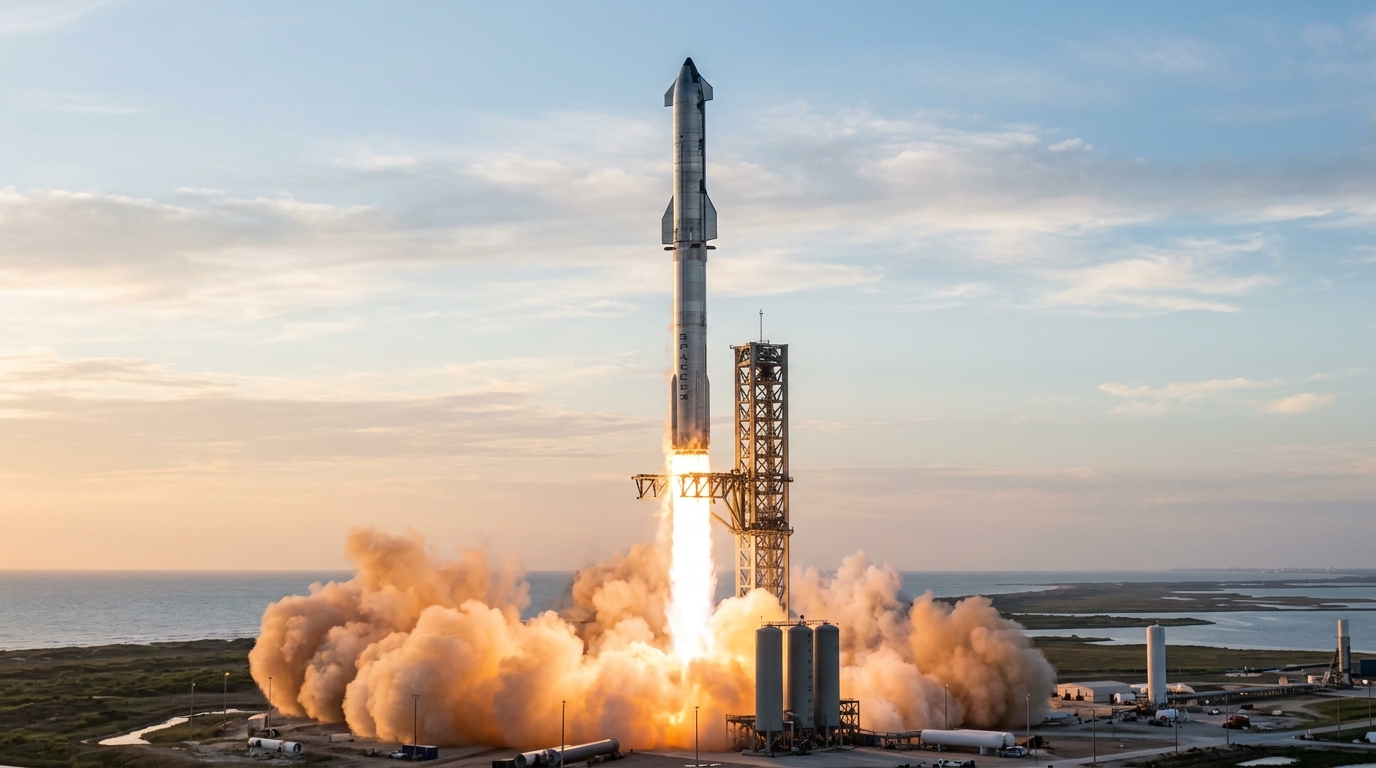
At 8:15 a.m. ET this morning, SpaceX ignites the most consequential launch window in the company’s public-market life. The 75-minute window opens at 8:15 a.m. EDT on Monday, September 28, for liftoff of Starship’s Flight 14, the vehicle’s first attempt to reach orbit. Not a suborbital arc, not a controlled splashdown demo. The upcoming flight is planned to be the first to send Starship into orbit around Earth; flight tests until this point have intentionally flown passively safe suborbital trajectories.
Starship’s initial orbital mission is expected to fly at an altitude approximately 275 km above Earth and complete approximately six orbits over the course of a nearly 10-hour flight, with splashdown targeted in the Pacific Ocean to the west of Chile. Key objectives include a nominal booster offshore landing, orbital insertion, the deployment of 26 Starlink V3 satellites into orbit, a nominal deorbit burn, and landing in the Pacific Ocean. Twenty-six commercial-grade Starlink V3 satellites, not simulators, make the payload real in a way no prior Starship test was.
The Stock Behind the Rocket
SPCX priced its IPO at $135 per share, listing on June 12, 2026, with Goldman Sachs and Morgan Stanley as lead underwriters. The stock closed its first day at $160.95, giving it a market capitalization of approximately $2.1 trillion. Since then it has been cut down hard. As of September 27, SPCX was trading at $148.68, with its 52-week high sitting at $225.64. That puts the stock roughly 34% below the peak it touched just days after its debut.
The reason for the compression is not a mystery. 7% tranches of locked shares have been releasing every two to four weeks from August through October, with Q3 earnings set to trigger the single largest single-event release: roughly 28% of the 180-day lock-up block. The next dated milestone is October 9, with up to 328.4 million shares eligible. Supply pressure, not business deterioration, is what has chased SPCX from $225 to $148.
That distinction matters enormously for today’s trade. The underlying business generated $11.4 billion of revenue and $4.4 billion of operating income in 2025 in its Connectivity segment, and Starlink remains the profit engine investors keep coming back to. The average 12-month analyst price target sits at $222.42. A successful orbital flight this morning does not solve the lock-up calendar, but it reframes the question the market is asking.
What the Options Market Is Saying
As of September 18, implied volatility remained elevated into Flight 14, but I could not verify the specific 47.0% ATM implied volatility and 41.8% 20-day historical volatility figures from primary options and pricing sources. The practical point still holds: with a binary catalyst arriving this morning and the lock-up clock still ticking toward October 9, the surface is not pricing in much room for a big upside gap without paying up for it.
Options market structure shows heavy open interest clustered at $160 on the call side and around $150 on the put side, with the stock currently sandwiched between both. A clean orbital success could push through $160 and force dealers to buy delta aggressively on the way up.
The Trade: October Call Debit Spread
The structure that fits this morning: a call debit spread in SPCX, buying the October $155 call and selling the October $170 call. Defined risk equals the premium paid. Maximum reward is the $15 spread width minus premium if SPCX closes at or above $170 by October expiry. The position does not require a moonshot; it requires the stock to recover modestly from where it sat last Friday.
The thesis has two legs, not one. The first is the launch itself. A successful orbital insertion, six laps around Earth, and 26 live Starlink V3 satellites deployed gives the market a tangible milestone it can point to. The second leg is subtler: the biggest near-term supply pressure events are Q2 earnings (now past) and Q3 earnings later in 2026. If the stock can absorb that unlock with Flight 14 as a positive catalyst behind it, the re-rating toward analyst targets becomes a credible path, not a hope.
What Kills the Trade
A scrubbed launch today sends SPCX lower. Backup days run from September 29 through October 4, meaning a delay does not end the story, but it does compress the timeline into the teeth of the October lock-up window. A vehicle loss or failed orbital insertion is worse: it resets the program timeline, calls NASA’s Artemis reliance on Starship into question, and removes the fundamental catalyst entirely. Position sizing must reflect that possibility. This is not a spread to overweight.
The window is 75 minutes. The risk is the premium. The catalyst is either the most significant commercial spaceflight milestone in years or a reminder that Starship development is still development. Only one of those outcomes sends SPCX back toward $170 before the October lock-up supply arrives. That is the bet, and this morning is when it resolves.