
September 28, 2026
Escondida’s safety-driven closure removes roughly 3,500 tonnes of copper a day from a market
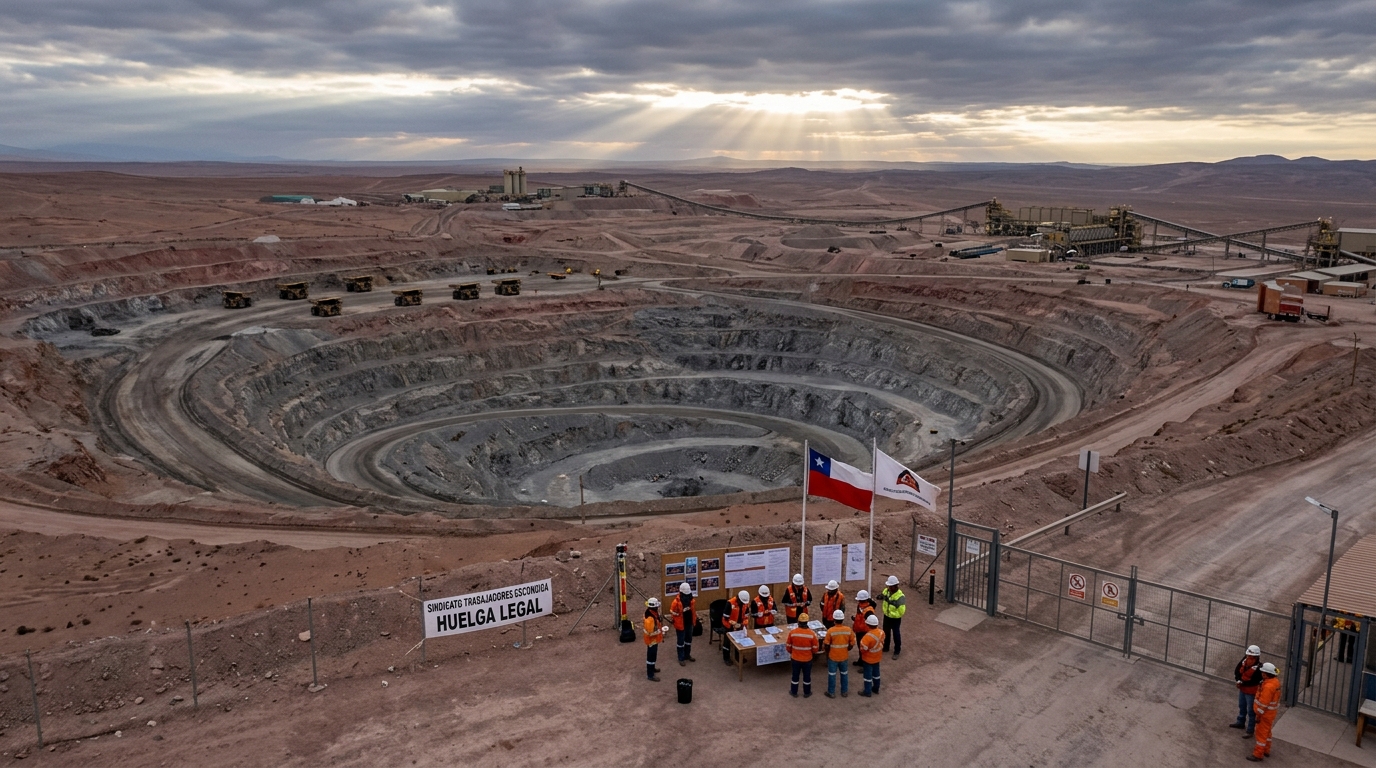
The shutdown at BHP’s Escondida mine in Chile’s Atacama Desert has now stretched into its fifth day, and the market faces the realistic possibility that it gets longer. Reuters reported that a contractor was killed on September 23 during maintenance work, and that operations at the mine were subsequently suspended. Chile’s mining regulator Sernageomin dispatched personnel to investigate. No restart timeline has been provided.
The Playbook Every Options Trader Should Have!
Do you dream of retirement but it seems like an impossibility? Wish you knew the best moves to get you there sooner?
It’s closer than you think and you won’t have to work overtime to get it!
Hi! I’m Dave Aquino, expert options trader and my e-book, “How To Master the Retirement Trade” has helped thousands reach their goals!
Follow the link to get your copy and see what you’ve been missing!
The scale of what is sitting idle matters. Escondida produced 1,261,200 tonnes in the year to June 30, 2026, a rate near 3,455 tonnes a day. Metal available in LME warehouses stood at 133,725 tonnes on September 21, roughly 39 days of the halted mine’s output. The shutdown removes about 3,455 metric tons of copper per day with no restart timeline. That is not a rounding error. Escondida alone accounts for roughly 5% of global annual mined supply, and the outage hits a weaker supply base after a soft first half for Chilean output.
Then comes the second risk, arriving this morning. Reuters reported that about 1,020 Escondida supervisors were set to vote September 28 to 30 on whether to accept or reject BHP’s latest offer. Reuters also reported that if workers reject the offer, mandatory mediation lasts five days and can be extended by another five before a legal strike becomes possible. On Friday, one of the unions rejected BHP’s attempt to delay contract talks after the worker was killed, with the Australian miner having sought a temporary suspension of negotiations. The unions are not in a conciliatory mood.
What’s Driving the Market
Comex copper pushed to fresh highs late last week, but the price picture is more complicated than a single headline figure. More than 18 months of tariff-driven metal flows have pushed a large share of global exchange copper stocks into Comex warehouses, leaving LME and Shanghai inventories comparatively depleted. In plain terms: copper in New York reflects a US tariff premium built by arbitrage trade, while copper in London reflects genuine physical scarcity for European and Asian buyers.
LME readily available inventory had already fallen to low levels, and the LME cash-to-three-month spread has swung into pronounced backwardation at points in recent weeks. Shanghai inventories were also low heading into China’s National Day Golden Week from October 1 to 7, with those holidays expected to pause restocking by Chinese consumers. Yet recent copper price declines have remained shallow and short-lived because fabricators cannot defer purchases for long.
The A-Z breakdown of this “battle-tested” income strategy – FREE (ticker included)
Most traders who struggle with options aren’t bad at trading – they’re just drowning in noise. New charts, tools, alerts, algorithms, and opinions crop up daily… and simply figuring out where to start can become overwhelming. Dave Aquino’s 11-Hour Options for Beginners guide cuts through that noise with a clear plan and shows you real results. Inside, you’ll get the A-Z breakdown of his 11-hour options income strategy in plain English, complete with the “battle-tested” ticker he’s used nearly 900 times with a 95.3% success rate. And today, it’s yours – FREE.
This is not a Chile-specific story. Escondida’s halt lands on top of an already deteriorating supply picture.
One structural point that does not resolve with a restart: this is the second contractor fatality at Escondida’s Patio 900 zone within twelve months. Reuters reported in October 2025 that, after a prior fatal incident, sources said mining operations continued normally. This week’s full operational shutdown is a direct contrast. Regulators appear to be tightening their posture, and that raises the cost of operating in Chile across the board. Every major copper producer with Chilean exposure now carries a higher probability of unscheduled downtime than the models priced in a year ago.
The Investment Opportunity
The beneficiaries of a sustained Escondida outage are the producers who can increase output elsewhere without Chilean jurisdiction risk. Freeport-McMoRan nudged its 2026 unit net cash cost estimate to about $1.90 per pound, and management has said second-half copper sales are expected to be over 20% higher than first-half sales, with 2027 copper sales up more than 20% compared with 2026. That volume ramp, concentrated in Indonesia and the Americas, means FCX captures the price upside with production growth that does not depend on Chilean regulatory clearance.
Southern Copper (SCCO) offers a different angle. Its assets sit in Mexico and Peru, both jurisdictions with lower recent disruption frequency than Chile, and consensus expectations imply strong year-over-year growth in 2026. Antofagasta and Teck, both with Chilean and Canadian exposure, carry more concentrated jurisdiction risk in the current environment, but benefit directly from any sustained copper price floor above $6.50 per pound.
Over 1,400 Institutions Currently Collecting “SpaceX Royalty Payouts”
BlackRock, Vanguard, JP Morgan…
Along with over 1,400 institutional investors are set to collect over $3 billion in payouts from a unique investment one expert is calling “SpaceX Royalty Shares.”
It’s all thanks to a “wrinkle” in the U.S. tax code…
If you’re looking to collect predictable, cash payouts like clockwork…
This is it.
Risks to Monitor
The supervisors’ vote this week is the most immediate binary. An accepted contract strips out the labor risk premium quickly. A rejected offer extends Escondida’s operational uncertainty through at least two more weeks of mandatory mediation, a meaningful window at current price levels.
The tariff variable sits behind that. Positioning is crowded and inventory is unusually concentrated in US warehouses relative to prior years, reflecting tariff arbitrage as much as outright scarcity. A White House reversal on refined copper tariffs could unwind a portion of the Comex premium rapidly, even if the physical market outside the US remains tight.
Bottom Line
What Escondida makes clear this week is that the copper market’s vulnerability to Chilean safety stoppages has been systematically underpriced. The regulatory regime is tightening. Restarts now require explicit Sernageomin clearance, and the regulator’s timeline is not BHP’s timeline. Wood Mackenzie has projected copper demand growing 24% to 42.7 million tonnes per year by 2035, anchored by EV and AI data center demand. Every week Escondida sits idle is a week that structural gap widens a little further. Investors who treat this solely as a near-term price event are missing the more durable point: Chilean jurisdiction risk is a permanent feature of global copper supply, and it just got reset higher.