

October 19, 2026
Bonus Content: Argentina’s Debt Alarm Is a Reminder of Why People Buy Gold
Most traders have never noticed the weird market anomaly that happens at 9:35 AM every morning.
They’re too busy with lagging indicators trying to predict the next move… when the market makers have already set the tone for the trading day.
It’s this weird anomaly that points us to the market maker’s key levels above and below.
And by playing the move within that range…
Regular folks like you have been able to reach for $100 or more (on a $1K stake) over 600 times in the last 2 years.
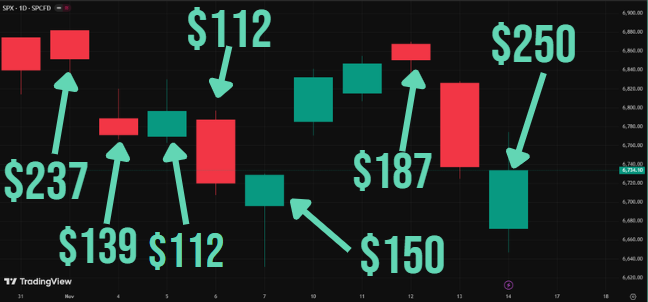
We’ve seen this straightforward approach play out whether the market broke out… broke down… or stayed choppy.
Granted, I can’t make trading guarantees here.
But I’ve opened up the data behind those trades, as well as how you can get in on the very next morning opportunity.
You’ll find the full details right here.
See you in the market.
Chris Pulver
Argentina’s Debt Alarm Is a Reminder of Why People Buy Gold

Six straight sessions. That is how long Argentina’s country risk gauge had been climbing, and on Friday October 16 it arrived at 648 basis points, its highest reading of 2026. The Merval fell 0.35% to 2,848,945 as sovereign dollar bonds lost 1.5%, with country risk rising 24 points to 648, a sixth consecutive daily increase. The number is not abstract. Country risk measures the extra yield investors demand to hold a country’s dollar bonds instead of US Treasuries, counted in basis points, where 100 points equal one percentage point. At 648, investors are asking roughly 6.48 percentage points more from Buenos Aires than from Washington.
The peso sits in a managed band whose ceiling rises over time, with adjustments tied to inflation with a two-month lag. The band’s upper limit was around 1,936 pesos per dollar on October 16, against a wholesale reference rate of 1,514.57 that week. That leaves roughly 28% of room before the band’s upper limit is reached. For now the peso holds. The question investors are asking is for how long.
The underlying math is uncomfortable. The central bank bought about US$15.21 billion from January 1 to October 13, yet gross reserves rose only about US$8.75 billion. Over roughly the first nine months of the year, consumer prices rose 23.6% while the official dollar gained about 4.0%. Buying dollars and not accumulating them at anything close to the same pace is not a sign of reserve strength. Market estimates suggest demand for exchange-rate hedges rose sharply into mid-2026, reaching a stock a little above US$12 billion, and the central bank also scaled back its own purchases at points. When the private sector is quietly buying insurance, that tells you something.
This is precisely the environment that makes gold useful. Not as a trade, Argentine households cannot easily access London gold futures, but as a principle. When the unit of account is unreliable, when a currency band can be reset by decree, when sovereign bonds lose 1.5% on an unremarkable Friday, physical gold held outside the banking system is the one asset that carries no counterparty. It does not require a government to honor it.
Argentina’s own gold reserve is a live illustration of the political risks that attach even to state-held metal. The country’s state auditor said on October 8 that the central bank lost US$1.023 billion on gold hedges in 2025, with the National Audit Office arguing that the bank took an improper risk with gold-linked derivatives. The central bank rejected the charge the same day, saying hedging is routine and that its gold position, metal and hedges together, earned US$2.505 billion in 2025. The dispute itself is the point: even a nation’s gold holdings are subject to the decisions, and the errors, of its institutions.
The same tension between a currency’s reliability and gold’s appeal plays out in developed markets through a different mechanism. Real yields on inflation-protected bonds, not headline inflation, are what ultimately set the price gold must compete against.
For investors outside Argentina watching this unfold, the lesson is not that Argentine equities or bonds are necessarily uninvestable. US investors mostly access Argentina through the ARGT fund and New York-listed shares; ARGT edged up 0.11% to US$88.00 on October 16, while energy company YPF gained and bank shares fell. The lesson is structural: in any economy where the currency can shift about 28% within its own official band, where sovereign spreads climb for six consecutive sessions without a confirmed catalyst, and where the gap between dollar purchases and reserve accumulation runs to about US$6.5 billion in a single year, the local currency is not a store of value. It is a medium of transaction, and a fragile one.
Gold’s role in this context is not speculative. It is the baseline from which savers in weak-currency economies measure everything else. Argentina is not unique in this regard. It is just the most visible current example of a pressure that operates, with varying intensity, across dozens of economies. Investors in stronger-currency markets who hold gold as portfolio insurance are doing, in a more comfortable setting, the same thing Argentine savers have done for decades: opting out of the bet that the local institution will perform as promised.
Argentina is the extreme case, but the underlying logic travels easily to economies with more stable institutions. British savers facing inflation above 3% and gilt yields at multi-decade highs are reaching the same conclusion through a different route.