
September 16, 2026
Bonus Content: China’s Collapsing ICE Market Is Gutting Platinum and Palladium Demand
What If The Best Time To Look At Gold Is: RIGHT After It DROPS 11%?
Sounds backwards, but that’s exactly what MarketWatch just reported, noting that gold has fallen nearly 11% since the Iran war began while the reasons to buy the metal are piling up again.
Why would analysts say that? Because the ceasefire cooled the headlines, but it didn’t touch the risks that sent oil and gold soaring in the first place.
- The Strait of Hormuz? Still the world’s most critical oil chokepoint.
- America’s emergency oil reserve? At its lowest level since 1983, per CBS News.
- The next flare-up? Nobody can predict when.
This isn’t just theory. CNBC reported gold and oil moving together on every twist of the U.S. – Iran deal talks.
But here’s what most savers miss.
An energy shock does not stop at the gas pump. Higher oil costs can work through nearly everything Americans buy, and history suggests that when oil spikes, inflation can get sticky. In those environments, investors have historically turned to physical gold and silver as a potential diversification tool.
That’s why many retirement savers see this pullback differently: not as a warning, but as a window to review their options before the next headline.
We put together a FREE Precious Metals Retirement Guide that explains how eligible IRA and 401(k) accounts may be diversified into physical gold and silver through a properly structured self-directed IRA, without taking a taxable distribution when completed correctly.
Get your free guide now by clicking here >>
Or call [PHONE NUMBER] to speak with a precious metals specialist.
Because pullbacks like this don’t announce when they’re closing.
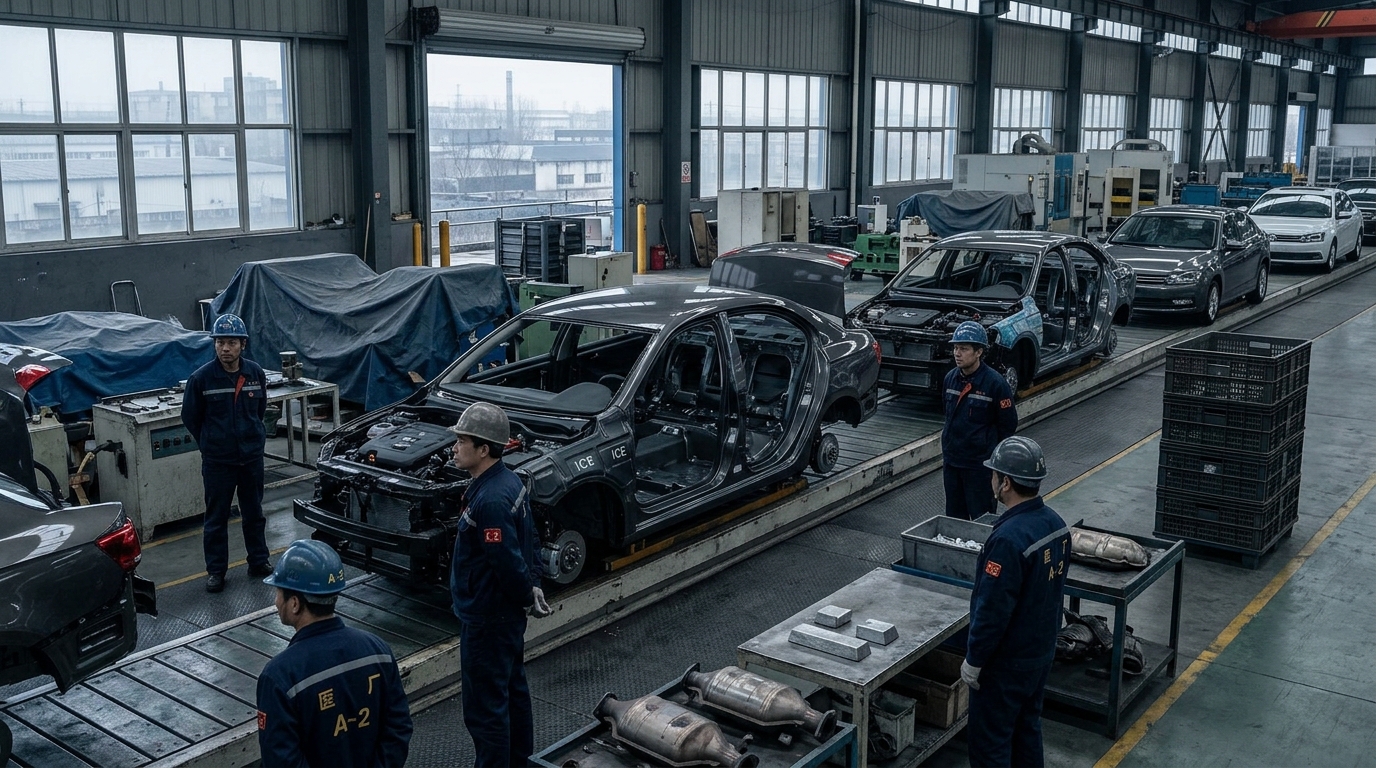
China’s Collapsing ICE Market Is Gutting Platinum and Palladium Demand
Beijing has rarely moved this openly. On Monday, GAC disclosed that it signed a letter of intent with FAW Group to acquire part of FAW’s stake in a Toyota joint venture through a new A-share issuance, making FAW GAC’s second-largest shareholder with strategic influence. Reuters reported that the state-run Economic Daily confirmed the target as FAW Toyota and said the consolidation has moved into a substantive phase, with Toyota’s preferred end-state being one merged sales company in China owned 50% by Toyota and 25% each by FAW and GAC, with fully integrated dealer networks.
For the precious metals market, the corporate drama is secondary. What matters is what drove Beijing to act at all.
A Market in Structural Retreat
Domestic auto sales in China fell by roughly 21% year-on-year in the first half of 2026, based on industry tallies cited in company coverage of the sector. That is not a cyclical dip. CPCA data shows total passenger-car retail sales reached about 11.7 million units in the first eight months of 2026, down 20.8% year-on-year, while NEV penetration hit a record 65.2% in August. The collapse is almost entirely in gasoline-powered vehicles: CPCA-based reporting shows retail sales of gasoline-powered passenger cars in China fell 40% year-on-year in August, with about 536,000 ICE units sold compared to roughly 894,000 a year earlier.
GAC’s own financials illustrate the damage. In its 2025 annual report, GAC reported a net loss attributable to shareholders of RMB 8.78 billion. In its first-half 2026 results, the company reported a net loss attributable to shareholders of RMB 4.47 billion, widening 75.98% year-on-year. FAW Toyota sold 273,700 vehicles from January through August 2026, down 27.4% year-on-year, according to sales data cited in coverage of the FAW-GAC talks. These are the companies being merged. The consolidation is a response to an industry that has already contracted sharply, not a precaution against one that might.
What This Means for Platinum and Palladium
Autocatalysts remain the dominant end use for both metals. More than 80% of palladium demand comes from the auto sector, where it is used in catalytic converters. That demand profile depends heavily on gasoline-engine production volume, and China has been the world’s largest auto market for over a decade.
‘Please, Please, Please’: OpenAI CEO Sam Altman Begs Small Company for Help
As reported by Financial Times, those are the exact words OpenAI CEO Sam Altman spoke on an open line to a small company in Arapahoe County, Colorado… which now controls what could be the most important technology in the world. Altman is desperate to get his hands on it… and he’s not alone. This tech is now backed by Elon Musk, Jensen Huang, and more.
Click here to learn how you could invest in this breakthrough alongside Sam Altman and Elon Musk.
The numbers are moving against both metals. Heraeus has said automotive palladium demand is expected to decline in 2026, and market commentary summarising its outlook describes the drop as more than 5%. The World Platinum Investment Council projects light-duty vehicle production falling 1% year-on-year in 2026 and automotive platinum demand at about 729,000 ounces, down 6% year-on-year, with weakness concentrated in catalysed vehicles. Capacity rationalisation through restructurings like the FAW-GAC tie-up accelerates this: fewer parallel operations, fewer catalytic converters required per unit of output as platforms consolidate, and a deliberate tilt toward NEV output.
With carmakers facing significant cost pressures, producers are expected to push harder on thrifting, trimming platinum, palladium and rhodium loadings wherever regulation allows. A Toyota venture running leaner than two separate ones is precisely the kind of structural efficiency that compounds demand erosion.
The Partial Offset Investors Often Miss
NEVs are not a pure negative for metals. Hybrids and plug-in hybrids still use catalysts, and industry analysis often finds their PGM loadings can be similar to, or in some cases higher than, comparable pure ICE vehicles, depending on duty cycle and emissions strategy. China’s market is not fully electric yet; plug-in hybrids and extended-range EVs still carry catalysts. But two consecutive months above 65% NEV penetration marks a structural threshold driven not only by NEV share gains but by the sharp contraction in ICE demand, and battery-only vehicles carry no platinum or palladium at all.
Copper faces its own crosscurrent. EVs use more copper than conventional cars, and a transition toward electrification should be constructive for the metal over the cycle. The near-term problem is that China’s total vehicle market is shrinking, not just rotating. Fewer cars of any kind means less copper consumed in wiring harnesses, motors and charging systems in the immediate term.
Risks on Both Sides
The consolidation could stall. Past precedents, including a scrapped planned merger between Dongfeng Motor and Changan Auto reported by Caixin in June 2025, show that complex regional interests and the coordination process between central and local governments are decisive variables. No definitive agreement exists yet, and the plan still needs internal and regulatory approvals.
On the metals side, platinum retains a structural case that palladium does not. WPIC expects the platinum market to remain in deficit in 2026, with the shortfall smaller than in 2025 and recycling supply improving, including via higher recovery volumes in mature markets. Palladium, by contrast, is widely expected to trend toward surplus as BEV share grows and substitution continues.
Bottom Line
The FAW-GAC deal is being read as a corporate governance story. For precious metals investors, it is a demand story. Beijing is managing the decline of its ICE auto sector, not reversing it. CPCA-based reporting shows NEV penetration hit 65.1% in July 2026 and 65.2% in August. The trajectory does not leave much room for optimism on autocatalyst volumes. Palladium’s fundamental position is weakest; platinum’s deficit provides partial insulation but not immunity. Investors in either metal should treat China’s state-directed auto restructuring as a signal about the direction of demand, not just a headline about two struggling carmakers.