
September 7, 2026
Signet’s Wednesday Results Will Show What $4,400 Gold Does
Signet reports into the toughest conditions its category has faced this cycle
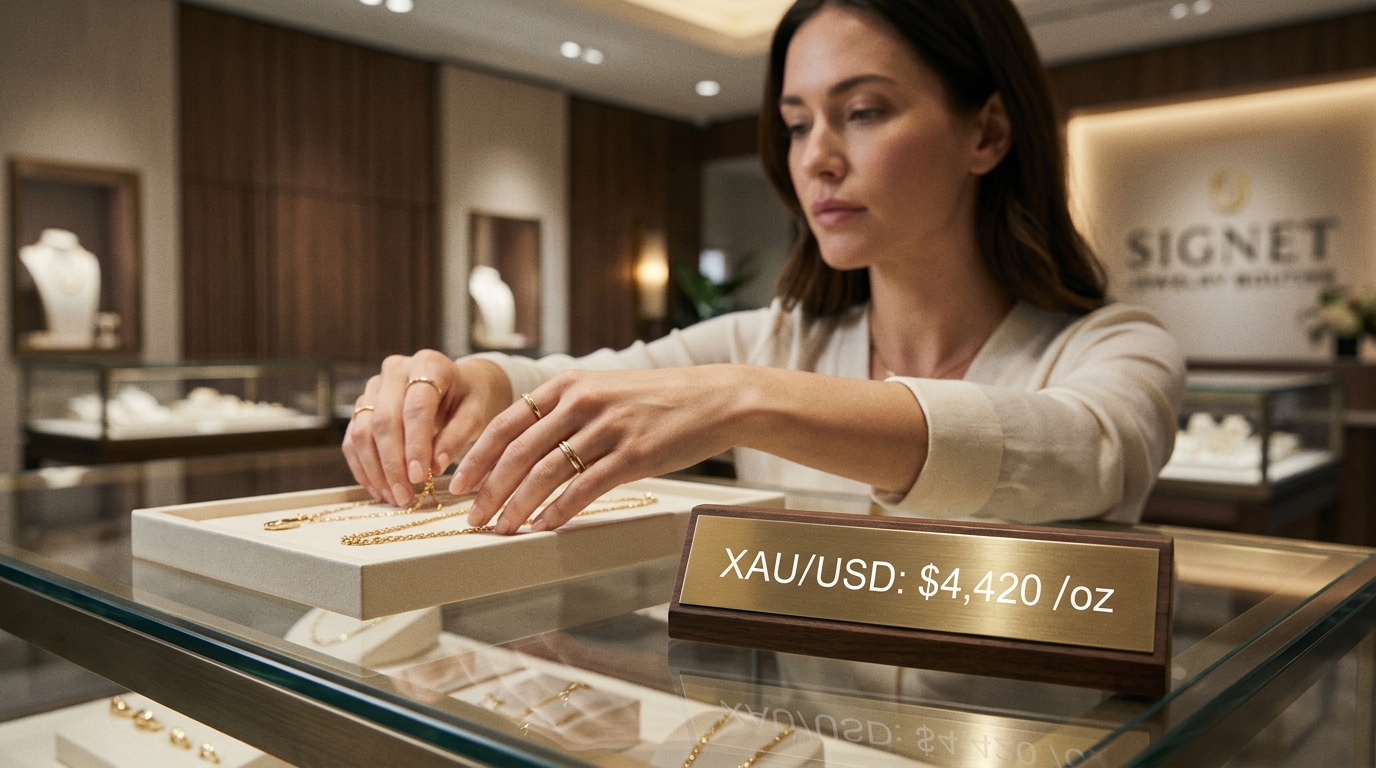
Gold ended last week at approximately $4,420 an ounce after one of the more instructive two-day sequences of the year. The metal had dropped to around $4,282 earlier in the week, its lowest level in nearly four weeks, then rebounded sharply before falling about 2% back toward $4,380 on Friday as a much stronger-than-expected August payrolls report, 162,000 jobs versus estimates in the high-50,000s, rekindled bets on a Federal Reserve rate hike. The round trip happened in 48 hours. Call it $4,477 at the intraday high. Call it wherever it opens Monday. The number that matters for this Wednesday is simply that physical gold costs more than twice what it did three years ago.
If You Had to Start Over Today with Just $500…Where Would You Put It?
Hey, Tim Sykes here.
I recently sat down with one of the most successful traders I know, he’s a $24 million trading legend.
And I asked him point blank – one simple question:
“If you had to start over today with just $500…where would you put it?”
What he said next blew me away.
This has nothing to do with AI or the Magnificent 7.
Click here to watch this free presentation now – before it’s too late
Signet Jewelers (NYSE: SIG) reports fiscal second-quarter results at approximately 7:00 a.m. ET on Wednesday, September 9, with a conference call at 8:30 a.m. ET and a simultaneous webcast. The company operates approximately 2,600 stores primarily under Kay, Zales, Jared, Banter by Piercing Pagoda, Diamonds Direct, Blue Nile, Peoples Jewellers, H.Samuel, and Ernest Jones. It is, in short, the single clearest window into what record gold prices are doing to ordinary consumers who still want to buy rings.
What the Metal Is Costing the Category
The World Gold Council’s Q2 2026 data released in late July confirmed what the price chart implied: jewelry demand fell to its lowest quarterly volume since the pandemic at about 278 tonnes, as high gold prices and broader inflationary pressures constrained affordability, though spending on gold jewelry was still up 14% year-over-year at $40 billion. Volume down, value up. That is the dominant dynamic in physical gold jewelry right now, and it maps almost exactly onto what Signet reported for Q1.
Signet posted Q1 fiscal 2027 sales of $1.55 billion, up 0.8% year-over-year, with same-store sales rising 1.8%. Growth came across categories at higher average selling prices, but unit volumes declined. Gross margin fell to 35.8% from 38.8%, pressured in part by higher gold costs. The company itself anticipated average unit retail growth across categories with modest unit declines, especially at lower price points, largely because of higher gold costs.
The Q1 beat was real. Signet surpassed Wall Street expectations with an adjusted EPS of $1.56, compared to the forecasted $1.38. But management guided for gross margin pressure in the first half from commodity costs, with recovery expected in the second half as pricing architecture work anniversaries. Wednesday’s result is that first-half pressure, reported live.
5 Little-Known Stocks Behind Today’s Defense Tech Shift
Behind the headlines, a major transformation is underway.
Modern warfare is being driven by AI, autonomous systems, and next generation technology. A handful of lesser known companies are helping power this shift.
This report uncovers five stocks quietly playing a critical role in the future of defense.
How Signet Manages the Metal It Has to Buy
A jeweler cannot simply pass through a 37% year-over-year increase in gold prices without some protection. Signet’s policy is to reduce the impact of precious metal commodity price volatility through the use of outright forward purchases of, or by entering into options to purchase, precious metals. When price and volume warrant, Signet hedges its requirements for gold through forward purchase contracts or option contracts. The Q1 10-Q confirmed the company uses derivative transactions for risk management to address risks inherent in business operations, currently utilizing financial derivatives to mitigate foreign currency and commodity price risks.
Management said on the Q1 call it was using hedging to balance inventory, with CFO Joan Hilson adding that pricing and promotion work, along with centralized diamond sourcing, would help improve margins and inventory turns. The hedge is not a windfall instrument. It buys time. The question for Wednesday is how much time it bought, and whether Q2 guidance for the second half still holds with gold near $4,400.
The Consumer Backdrop Has Worsened Since June
Consumer discretionary fundamentals have weakened with softer revenue and free cash flow relative to other cyclical sectors, and low consumer confidence is likely to continue impacting the group. As of early September, consumer discretionary is among the worst-performing S&P 500 sectors year to date. Since Signet’s Q1 call in June, the category has had new and specific warnings. Lululemon posted a sharp decline in comparable sales in the Americas and reduced its guidance, a signal that premium discretionary spending is softening even among consumers who could previously absorb higher prices without much friction.
Signet CEO J.K. Symancyk said on the Q1 call that the company continues to see strength in the higher-end consumer, with some of its best performance at higher price points. Units above $2,000 represent mid-single digits in penetration but roughly 40% of revenue, while lower-end price points face challenges due to gold exposure. That bifurcation is the fragile architecture going into Wednesday. If the higher-end buyer remains committed to bridal and fashion jewelry even at $4,400 gold, Signet’s Q2 guidance holds. If that buyer hesitated during the quarter, the second half picture gets complicated fast.
A Forgotten Energy Source Is Powering Back Up
While investors chase the next tech story, one long-ignored sector is quietly heating up. A mix of global policy, rising demand, and tightening supply could reignite this market before 2026. See what the latest research reveals.
Risks on Both Sides
The bullish case is that Signet has consistently navigated commodity volatility better than the headline metal price implies, and that jewelry spending is expected to remain resilient even as high prices weigh on volumes, per the World Gold Council’s own commentary. The company has hedges in place, its balance sheet reported no long-term debt at the end of fiscal 2026, and it held roughly $603 million in cash and cash equivalents at the end of Q1.
The bearish case is simpler: jewelry buyers are acting more selectively because high prices make discretionary purchases harder, and every week of $4,400-plus gold is another week where a consumer defers an engagement ring or trades down in carat. Wednesday’s same-store sales number and any revision to second-half gross margin guidance will answer which force dominated the fiscal quarter ended August 1.
Bottom Line
Signet’s Wednesday result is not just an earnings report. It is the most current data point available on whether physical gold jewelry demand can sustain value growth while losing volume, and whether a well-run hedger can protect its margins through the most extreme commodity environment in its modern history. Watch the average unit retail figure closely. If it stays above the prior year while units decline modestly, the model is working. If it stalls, gold at $4,400 has finally become the deterrent that $3,000 was not.