
September 7, 2026
Bonus Content: The AI Power Bill Is Coming Due. Copper and Uranium Cash In.
For 137 years now…
A little-known public land trust has been quietly sitting on millions of acres of American land…
Paying royalties on every drop of energy that gets pulled out of the ground.
Oil. Natural gas. Even water.
Every barrel. Every cubic foot. Every gallon.
The checks just keep rolling in.
It’s so profitable… a single $1,000 investment since January 2000 turned into $556,000!
That works out to a 29% return… every year for 25-straight years.
You can check out the details by clicking here.
But get this…
Donald Trump just TURBOCHARGED the entire opportunity…
He just pledged $500 billion to develop massive new AI data centers – and he’s beginning with this specific area.
More drilling means more royalties.
More royalties mean bigger payouts.
Bigger payouts mean even better returns for anyone holding what I call “The 29% Account.”
The big banks figured this out decades ago.
BlackRock, Wells Fargo, JPMorgan – they’ve all quietly parked billions here.
Now you can do the same.
Click here to start tapping this cash gushing machine before drilling starts.
Good investing,
Marc Lichtenfeld
Chief Income Strategist, The Oxford Club
P.S. This account is open to any American – no matter your age or income. Click here to see how it works.
The AI Power Bill Is Coming Due. Copper and Uranium Cash In.
Wall Street’s September conference season opened Tuesday with a familiar cast: Goldman Sachs Communacopia, Citi TMT, and the rest of the tech circuit filling midtown hotel ballrooms with hyperscaler executives talking about inference speeds and agent deployments. But the most important conversation for precious metals investors this week is happening at a different gathering entirely.
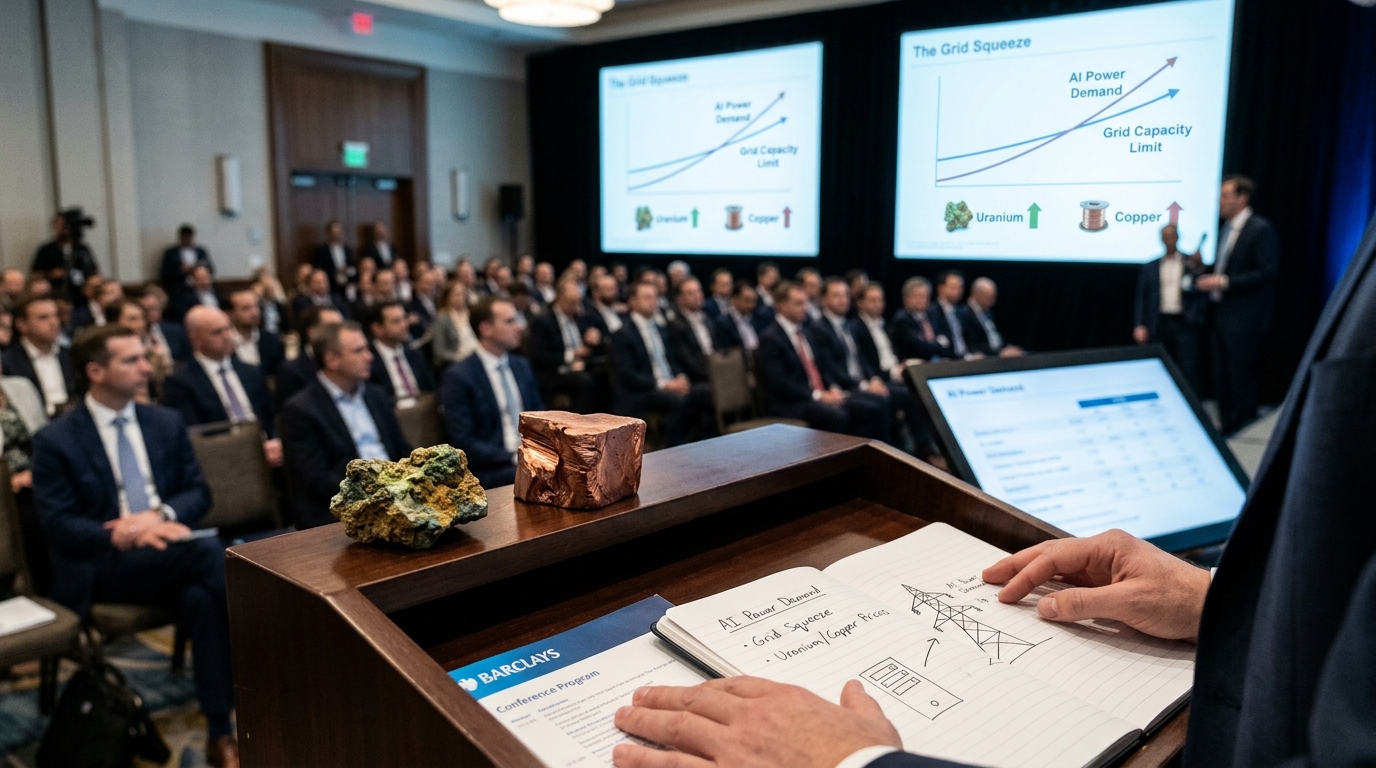
The Barclays 40th Annual Energy-Power Conference runs September 8 through 10. It runs from 7:00 a.m. ET on September 8 through September 10 at 5:15 p.m. Eastern. The agenda is dense with oil majors and utilities. What the sell-side crowd attending it may underweight is the conference’s timing relative to a structural shift that has been building for months: the AI buildout has become an electricity problem, and an electricity problem is a metals problem.
The Demand No One Has Fully Priced
OpenAI has said GPT-6 Astra was built on its largest-ever training run, using more than 100,000 GPUs at its Stargate site in Texas. GPT-6 Astra is OpenAI’s newest large language model, released September 3 as a limited rollout that expands more broadly over the coming days. Every frontier model after it will be larger still. The infrastructure required to train and serve those models is the critical variable.
Stargate is a $500 billion endeavor involving OpenAI, Oracle, and SoftBank. OpenAI has described a 10 gigawatt U.S. infrastructure commitment over the next four years, and has said planned Stargate capacity is already well beyond halfway to that 10 gigawatt target. For context, 10 gigawatts is roughly 10 times the average electric load of a city that draws about 1 gigawatt, all of it dedicated to running GPUs.
Credible forecasts vary, but the direction does not: multiple major estimates put U.S. data centers in the high single digits to low teens as a share of total electricity use by 2030. That is not a rounding error in the power grid. It is a structural reordering of who gets power, how fast, and at what cost.
What Energy Executives Will Actually Say This Week
The Barclays conference is where utility and energy executives speak without the filter of a tech keynote. The questions pressing them are not about model benchmarks. They are about gigawatts, transmission queues, and fuel mix. Some AI campuses are exploring on-site generation to accelerate timelines. That is a confession embedded in a capital expenditure decision: the grid, as currently built, cannot absorb the load fast enough.
That gap between announced AI compute and available baseload power is exactly the gap copper and uranium fill.
The Metals Case
Each new hyperscale AI facility creates three distinct copper demand waves: construction-phase demand for internal electrical, cooling, and connectivity systems; grid-connection demand for substations, transformers, and transmission upgrades; and ongoing operational demand for maintenance and expansion over the facility’s life. Some research has suggested a single very large AI data center could require tens of thousands of tonnes of copper, but those figures vary widely by design, grid distance, and power density.
Copper has hit record highs in 2026 and is currently trading around $14,300 a ton on the London Metal Exchange. The supply side has not kept pace. Copper production growth has slowed as the industry faces declining ore grades and more complex deposits, with multiple industry sources documenting a long-term decline in average ore grades over recent decades.
Nuclear is the other side of this coin. AI-linked electricity demand is increasingly viewed as structural rather than cyclical, at a time when uranium supply is already constrained. A common industry concern is that primary mine supply may not cover future reactor requirements without sustained new investment, given long development timelines and the shrinking role of secondary supply.
The Fed Risk That Sharpens the Opportunity
Energy and metals investors cannot ignore the macro backdrop. The U.S. economy added 162,000 jobs in August, well above most forecasts clustered in the mid-five-figure range. Rate markets have since priced a meaningful chance of a Federal Reserve increase at its September 15-16 meeting. The FOMC decision will likely hinge on upcoming inflation data, with the PPI due September 10 and the CPI due September 11. A rate increase would strengthen the dollar, adding short-term pressure on metals prices.
That is the entry condition. The structural demand for copper in transmission infrastructure and uranium in baseload generation does not resolve itself at any rate level. The energy executives speaking at Barclays this week are managing capital against a power demand curve that the Fed cannot adjust.
Bottom Line
GPT-6 Astra arrived last week built on more than 100,000 GPUs. The model after it will need more. Every increment of AI capability announced at technology conferences translates, with a lag, into gigawatts of additional electricity demand and tonnes of additional copper and uranium. The Barclays Energy-Power conference is where that translation becomes visible. Investors focused on the semiconductor supply chain are reading the right story from the wrong end.