
China’s factory sector crossed back above 50 this morning for the first time in two months. The manufacturing PMI, the non-manufacturing business activity index, and the composite PMI output index stood at 50.1, 50.2, and 50.7 respectively, up 0.3, 0.8, and 1.2 points from the previous month. The production sub-index rose to 51.7, the highest level of 2026. On any other Wednesday in the calendar, this would be the kind of data point that sends copper and gold-adjacent trades sharply higher in Shanghai.
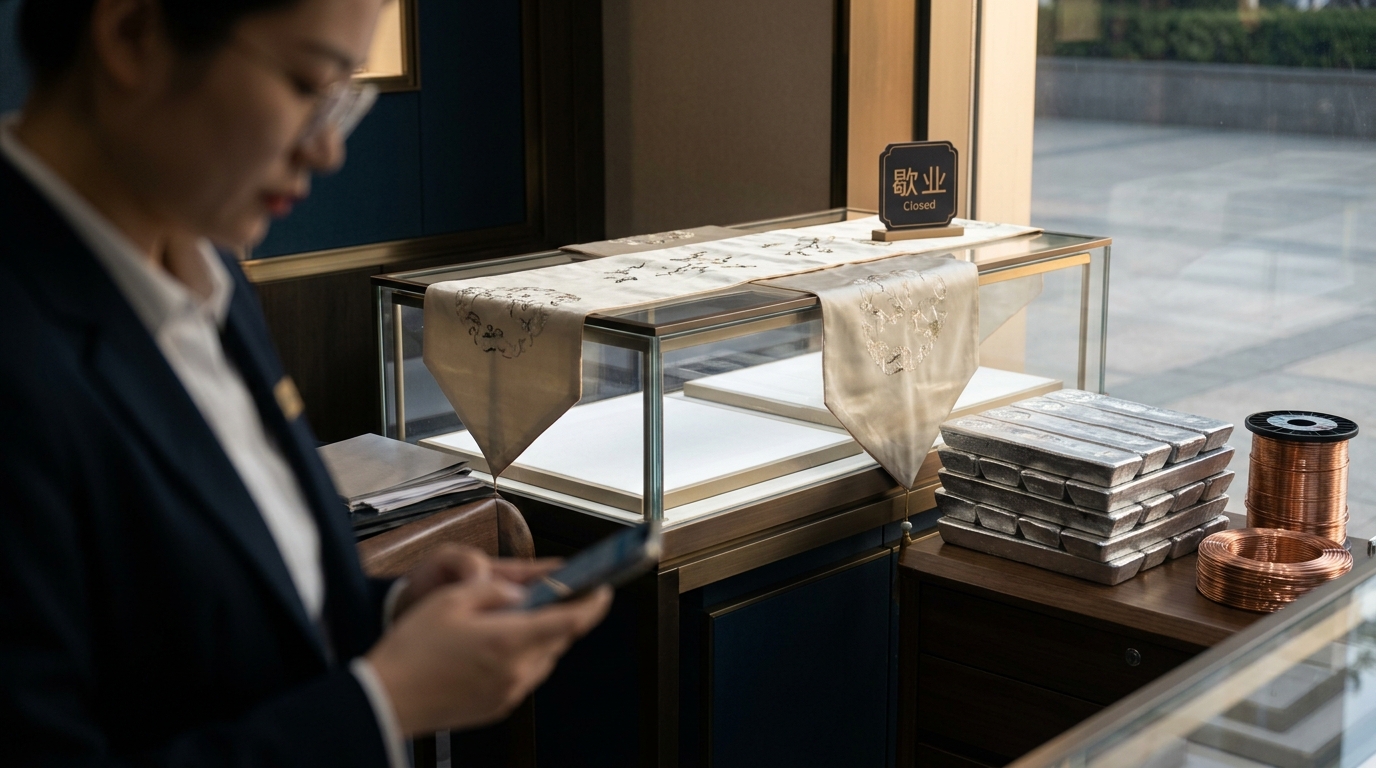
The catch: mainland markets are about to go dark. Wednesday’s reports came ahead of China’s weeklong October national holiday in which domestic consumption and spending are closely watched by policymakers. The Shanghai Gold Exchange, the Shanghai Futures Exchange, and China’s equity markets all close for the seven-day Golden Week. The buyers who would normally translate a PMI beat into real physical orders will be offline.
What’s Driving the Market
Beijing did not wait for the PMI to publish good news. China’s latest economic support package looks aimed at keeping growth on target rather than delivering a broad revival, leaving the country’s underlying demand weakness largely unaddressed. Government agencies unveiled mortgage interest subsidies and expanded central bank support after markets closed Tuesday.
One notable piece is a national interest subsidy on new commercial mortgages for eligible first-time homebuyers. Qualified borrowers can receive an annual subsidy equal to 1 percentage point of interest for up to five years, with the subsidised portion capped at 1 million yuan per household.
The measures amount to the biggest property-focused push in months, and they fit with Beijing’s stated 2026 growth target range of 4.5% to 5% after China reported 4.3% growth in the April to June quarter. But the property channel that historically pulled copper and gold demand together remains structurally weak. The mortgage subsidy may pull some demand forward, but confidence is still the real hole in the property story. Cheaper credit cannot manufacture borrowers when households and local governments are still deleveraging.
Copper entered this window with momentum. The Yangshan copper premium, a gauge of Chinese demand for imported copper, climbed through September to about $124 a ton, its highest level in nearly four years. Medium-sized and small-enterprise PMIs came in at 49.7 and 48.9 respectively, still below the expansion line, which matters because those firms represent the bulk of China’s copper fabrication. BHP and Rio Tinto, the two mining majors most exposed to China’s commodity appetite, will watch whether this PMI reading translates into firm October order books once mainland buyers return on October 8.
The Investment Opportunity
For precious metals investors, the more instructive question is what Golden Week does to gold’s Chinese demand picture. The Golden Week holiday traditionally marks the start of China’s peak gold-buying season, bringing stronger jewellery sales, active trade restocking, and firmer local premiums. Elevated gold prices and low consumer confidence have dented China’s gold jewellery demand so far in 2026. But recent price stability, combined with holiday spending, may unlock some postponed gold jewellery demand and provide seasonal support into year-end.
On imports, the direction is clearly higher in 2026, but the original figures here were too specific to leave standing. Customs and industry reporting this year have pointed to unusually strong inflows, including very heavy mid-year months, and multiple reports have put cumulative 2026 imports above 1,000 tonnes by late summer using an eight-month window, not the first seven months. The key takeaway still holds: a meaningful share of China’s import demand has looked more like institutional restocking and official-sector accumulation than like price-sensitive discretionary jewellery buying, which is why the post-holiday restocking bid when Shanghai reopens October 8 could be more durable than a single seasonal pop.
The People’s Bank of China added 20.2 tonnes in August, its largest monthly purchase since October 2023, extending a central-bank bid that has cushioned many dips this year.
Risks to Monitor
The seven-day absence of mainland participation cuts both ways. Physical buying pauses, but so does selling pressure from the Shanghai Gold Exchange. Western markets will carry gold and copper price discovery alone for a week, meaning Fed rate expectations and the U.S. dollar will dominate. The big data points are U.S. inflation (PCE) due today and the jobs report on Friday, both of which will shape how the Fed acts in October. A hot reading on either front would strengthen the case for another hike and pressure gold regardless of what Beijing’s mortgage subsidy signals.
For copper specifically, the risk is a gap between the PMI headline and the underlying sub-indices. New orders and new export orders both edged down 0.1 points to 50.5 and 50.0 respectively. The 50.1 headline keeps China in expansion, but only barely, and the demand side of the ledger is softer than the production data suggests.
Bottom Line
A China PMI beat and a national mortgage interest subsidy landing on the same morning would normally be a clear bullish signal for copper and gold demand. Today, the timing matters as much as the data. Mainland buyers will not be at their desks to act on either development for a week. When they return, the question is whether the policy package has shifted housing confidence enough to generate real copper and gold demand, or whether it simply secured a quarterly GDP statistic. The answer will arrive in October import data, not in this morning’s PMI.