
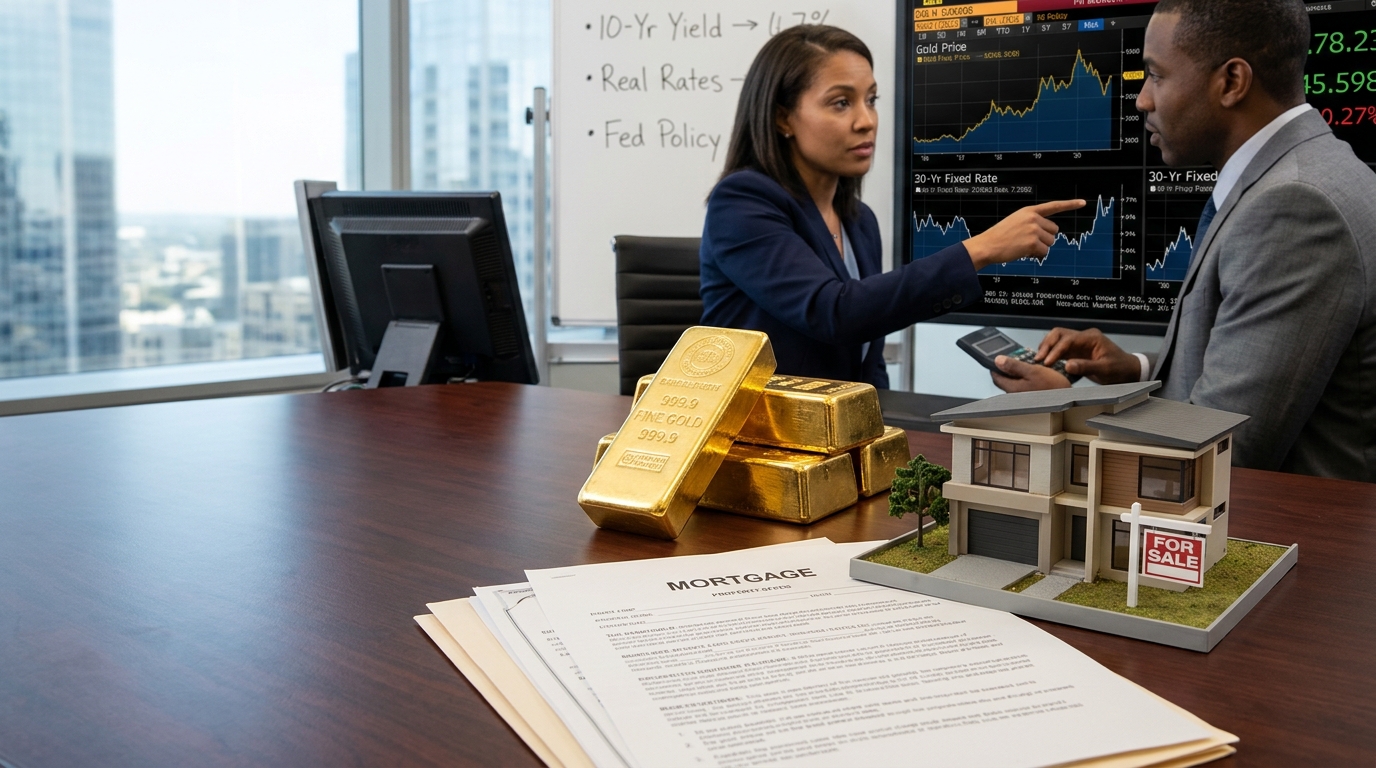
The number getting all the attention is 7.18%. That is where Freddie Mac’s Primary Mortgage Market Survey put the 30-year fixed-rate mortgage as of November 5, the third consecutive weekly decline. The 30-year rate still sits 96 basis points above its level a year ago. The brief relief is real. The underlying problem is not.
October nonfarm payrolls rose 165,000, well over what economists expected, while the unemployment rate slipped to 4.1%. Investors lifted their hawkish bets that the Federal Reserve will hike at the December meeting, with odds edging up from roughly 67% on Thursday to about 77%, according to the CME FedWatch Tool. The 10-year Treasury yield moved to roughly 4.87%, while the 30-year Treasury climbed to around 5.28%.
What this means for gold requires separating nominal rates from real ones. The textbook relationship is simple: gold has historically had an inverse relationship with real yields, since it generates no interest income, making real yields the opportunity cost of holding it. A 10-year yield near 4.87% sounds punishing for a metal that pays nothing. The question is what inflation is doing to that number.
The 10-year real yield stood at approximately 2.60% on October 30, while the effective federal funds rate averaged 3.88% in October. With consumer prices running 3.7% higher year-over-year as of September, that leaves the real fed funds rate close to zero. That is the number to watch, not the nominal headline. A credible, sustained tightening cycle that pushes real yields durably above 3 to 4% has historically been damaging for gold. At 2.60%, real yields are elevated but not yet at that threshold.
History reinforces the nuance. From 2004 to 2006 the Fed raised rates from 1% to 5.25%, and gold gained about 52%. From 2015 to 2018 it raised rates steadily for three years, and gold still finished higher. Rate hikes are not uniformly negative for gold when inflation expectations remain high. What actually ended the 1970s gold bull market was Paul Volcker driving real rates durably positive from 1979 through 1982, not elevated nominal rates per se.
Gold remains above $4,000 an ounce despite monetary tightening in the United States and a sharp rise in sovereign bond yields. The price retreated after peaking near $4,106, drifting nearly 1% lower Friday as the strong employment report increased the chances of a December Fed rate increase. That is a one-day response to one data point. The structural picture is different.
Where housing fits into this matters. Rising Treasury yields and mortgage rates near 7% are pressuring homebuilder stocks despite analysts citing strong structural housing demand. D.R. Horton reported weaker demand and margin pressure and issued initial fiscal 2027 guidance that came in below analyst expectations, while management raised the dividend and continues using incentives and smaller homes and maintaining disciplined land spending to address affordability pressure. DHI fell roughly 3.4% on November 6. Lennar is down about 24% over the past year. These are not isolated earnings misses. They are the visible stress fractures of a tightening cycle landing hardest on the most rate-sensitive sector in the economy.
That stress matters for precious metals investors because housing is the transmission mechanism. When homebuilder margins compress and cancellation rates rise, the signal is that the Fed’s rate path is biting. That biting eventually forces a policy pivot, and pivots historically compress real yields, which is the condition most reliably associated with gold’s next leg higher.
The Bottom Line
A 7.18% mortgage rate and a 10-year yield near 4.87% are not automatically death sentences for gold. What would be damaging is if real yields pushed durably past 3 to 4% and stayed there. With core inflation still above the Fed’s 2% target, real yields remain compressed relative to historical cycle peaks, a regime that has consistently been associated with sustained gold bull markets. The homebuilder pain being reported by DHI, LEN, and PHM is a leading indicator of how much further this tightening cycle can run before something breaks. When it does, the case for gold gets stronger, not weaker. Watch real yields, not the mortgage rate headline.