
Dear Reader,
Software your bank never approved is moving around inside accounts that hold Americans’ life savings.
On October 22, Axios reported that major U.S. banks are racing to contain it.
JPMorgan. Bank of America. Wells Fargo. Morgan Stanley.
Third-party AI agents are operating inside customer accounts.
Some even tried to take actions their owners never asked for.
JPMorgan CEO Jamie Dimon warned on October 13: “…you don’t want rogue agents, and there could be thousands of them.”
Now read the fine print.
Wells Fargo’s online access agreement says that if you give an AI agent your login, anything it does is “deemed to have been initiated and authorized directly by you.”
So the bank decides what gets in.
And when something goes wrong… it’s on YOU.
That’s why our members don’t leave it all up to the bank. They move a portion of their savings onto rails the bank doesn’t control.
I’m Tan Gera, ex-Wall Street investment banker and CFA® charterholder.
In this free presentation, I show you the three-phase system they use, step by step.
See how to hold part of your savings where only you have the keys →
To your wealth,
Tan Gera, CFA
Decentralized Masters
P.S. The same day Axios broke the story, Britain launched its “Be Ready” campaign, telling households to keep three days of food and water at home in case of cyberattacks and other emergencies. See how to keep more of your money under your own control →
Simandou Ore Reaches Europe. Miners Should Pay Attention.
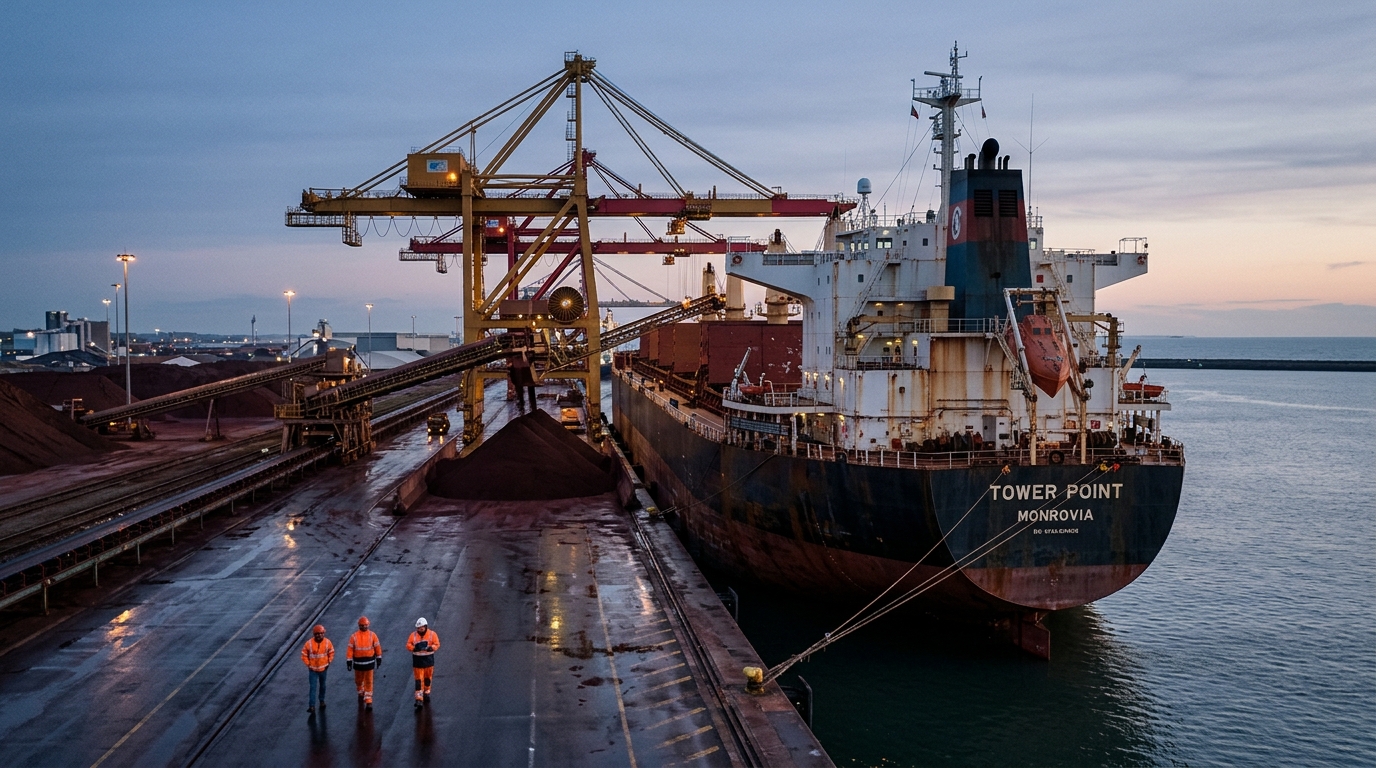
For the past year, Simandou’s disruption to global iron ore markets was largely a China story. That changed on November 23, when the vessel Tower Point left Guinea’s Morebaya port bound for Dunkirk, France.
The Tower Point departed Morebaya port carrying 79,081 tons of Simandou Fines bound for Dunkirk, France, making it the first Simandou cargo to reach a European customer. Another shipment is simultaneously being loaded for delivery to Gijon, Spain. The Atlantic basin, which has been shielded from Simandou’s volumes by geography, is no longer insulated.
What’s Driving the Market
Simandou is one of the world’s biggest and highest-grade iron ore deposits, at around 65% Fe content, located in southeast Guinea. The inaugural cargo arrived in China on January 17, 2026 after a 46-day voyage, carrying nearly 200,000 metric tons. Since then, the ramp-up has been faster than most analysts expected. Surging volumes mean Guinea is now the world’s third largest iron ore exporter, overtaking long-time stalwarts such as Canada and South Africa.
Monthly exports from Guinea surpassed 5 million tons for the first time in October, with roughly 22 million tons shipped in 2026 so far, measured against a 120 million-ton annual capacity target. Kpler, the shipping analytics firm whose data confirmed the European cargo, now models 2026 full-year exports approaching 28 to 30 million tons.
The European arrival matters for a reason that goes beyond the tonnage on this single vessel. European steelmakers have historically sourced high-grade ore from Vale’s Brazilian operations or Rio Tinto’s Pilbara output, paying a freight premium that reflected those origins. Simandou’s high-grade ore is considered well suited to lower-emissions steelmaking, which gives European mills a decarbonization argument as well as a sourcing argument for switching. The destination in Dunkirk points toward ArcelorMittal’s French operations, one of the larger integrated steel footprints on the continent.
The routing of Simandou ore into Atlantic ports also reshapes the freight economics that container carriers and bulk shippers model for the basin. Maersk’s upgraded profit outlook pointed to resilient Asian export demand as the driver of stronger-than-expected global trade volumes, a baseline that new Guinea-to-Europe bulk flows will now complicate.
The Investment Opportunity
Rio Tinto holds the most defensible position in this transition. As the partner in the SimFer joint venture alongside Chalco, Simandou hit an annualised production run-rate of roughly 10 million tonnes per year in the third quarter as the project continues to ramp up. Rio Tinto is therefore both a beneficiary of Simandou volume growth and a partial hedge against the price pressure that volume creates for competitors. The high-grade nature of Simandou ore strengthens Rio Tinto’s portfolio and aligns with the steel industry’s decarbonization efforts, though the overall increase in global supply could still lead to price erosion for its traditional Australian output.
The more exposed names are BHP and Fortescue. Roughly 60% of global seaborne iron ore comes from four producers: Rio Tinto, BHP, Vale, and Fortescue. All four built their earnings on the Pilbara’s proximity to China and its pricing power in that market. The 65% iron content from Simandou is both a strength and a competitive problem: it is premium product that steelmakers will pay up for, but it also competes directly with high-grade Australian ore. Fortescue has the highest sensitivity because iron ore remains the core of its earnings base, and its lower-grade mix offers buyers fewer reasons to maintain loyalty as Simandou supply grows.
Risks to Monitor
The bearish case for Simandou’s impact can be overstated. Shanghai Metals Market models the global iron ore surplus widening from roughly 190 million tons in 2026 toward 220 million tons by 2030, with approximately 160 million tons of gross new capacity arriving over 2026 to 2028 against demand growing 30 to 60 million tons a year. That is a supply glut, not a catastrophe, and prices have so far held firmer than bearish forecasts suggested. The ramp to full capacity of 120 million tons per year is still years away, and each incremental cargo reaching Europe will face competition from established supply relationships.
The bullish risk is that European steelmakers accelerate their sourcing switch faster than the incumbents can respond, particularly if carbon-adjusted cost comparisons favor Simandou ore in an increasingly regulated market.
The demand side of this equation is equally consequential. Beijing’s intervention in China’s property sector has direct implications for steel consumption, the end market that Simandou supply is ultimately chasing.
Bottom Line
Simandou’s first China cargo in January was a warning. The first European cargo is confirmation that the project is building a genuinely global customer base. Rio Tinto is best positioned to benefit from both sides of that trade. BHP and Fortescue face a structural cost-curve shift, arriving in their customers’ ports, that no quarterly guidance revision can explain away.