
The Federal Reserve will release its rate decision at 2:00 p.m. ET on Wednesday with very little room to say anything new. The October 27–28 meeting is a non-SEP gathering: the committee will not release an updated dot plot or fresh economic forecasts, which by itself raises the bar for a significant policy change. The September 15–16, 2026 dot plot stands until the next SEP in December (the December 15–16 meeting). Chair Kevin Warsh, who has not submitted a personal forecast to the dot plot since taking office, will face reporters at 2:30 p.m. with a shorter-than-usual toolkit for signaling what comes next.
Warsh dropped forward guidance earlier this year, arguing that this is not the moment for it. He also said before the blackout period that he does not prejudge rate decisions and offered no preview of whether the Fed would raise or hold. The result is a press conference that will be parsed for adjectives, not numbers. That is a deliberate construction, not a communication failure.
Prediction markets put a quarter-point hike at roughly 6% and a hold at 94% as of Friday, October 23. Goldman Sachs economist David Mericle has pointed to a possible pattern of quarter-point hikes in December and March 2027, which is where the real policy debate sits. The near-certainty of a hold on Wednesday does not settle the path beyond it.
Why the 10-Year Dropped 19 Points on Thursday
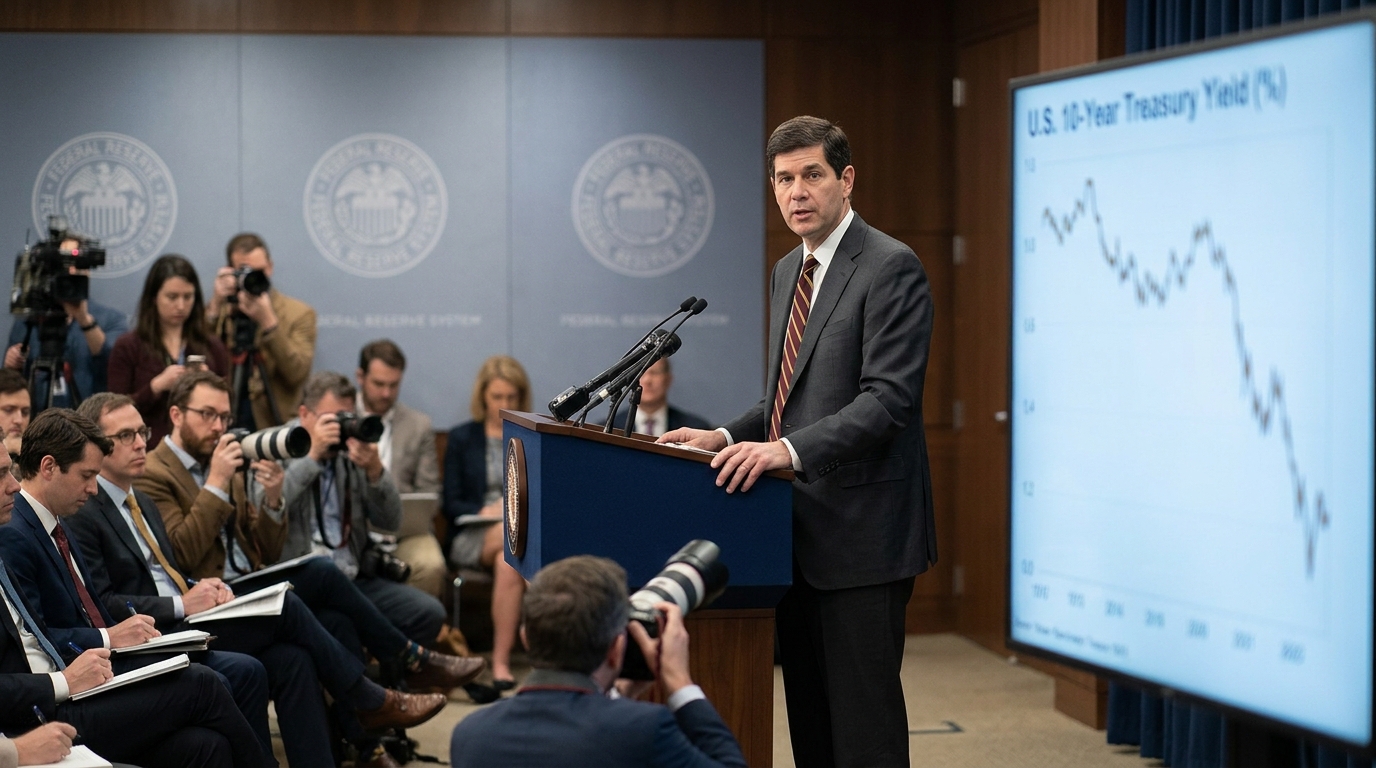
The bond market’s big move this week was not a Fed story. A sharp risk-off move tied to the selloff in AI-linked equities pushed the 10-year Treasury yield below 5% on Thursday, October 22, with the benchmark dropping 19.3 basis points to 4.952% in its largest one-day decline since the March 2023 banking shock, according to Dow Jones Market Data. The retreat reflected renewed demand for Treasuries as investors questioned whether technology companies’ enormous spending commitments would deliver sufficient returns.
CoreWeave became a focal point of the anxiety: shares fell about 10% Thursday and were down sharply for October. The bond-market stress around the AI buildout has been visible as well, with CoreWeave’s bonds trading at distressed yields (around the mid-teens in recent coverage). None of that reflects anything the Fed said. It reflects a crowded trade in AI-adjacent risk unwinding at the same time.
The 10-year yield reached about 5.13% late Wednesday, then closed around 4.95% Thursday. That round-trip was driven by equity positioning and a flight to safety, not by any new read on inflation or Fed intentions. Confusing the two obscures what the bond market is actually saying.
The Awkward Sequencing Problem
The most structurally unusual feature of this week is the calendar. September PCE inflation publishes Thursday, October 29, the morning after the Fed decision. The Fed votes Wednesday without seeing its own preferred inflation gauge for September. Consensus expects headline PCE up 0.5% on the month and 3.6% year-over-year, with core up 0.3% month-over-month and 3.1% year-over-year.
Brent crude finished last week at $116.72, after reports of attacks in Saudi Arabia including the Red Sea port of Yanbu. That price level was above $116 a barrel and the highest since June 2022. The Brent spot price averaged $114 per barrel in September, a figure that will feed directly into the energy component of the PCE release. If Thursday’s core number prints at 0.4% rather than the expected 0.3%, the odds of a December hike rise sharply, and the pressure on rate-sensitive stocks and AI-financing names intensifies.
What Warsh Can Actually Say
No forecasts. No dot. No forward guidance. There will be no updated SEP, the post-meeting statement is unlikely to change much, and analysts see little reason to think Warsh will offer anything in the way of guidance about what comes next. What he can do is describe the data as the committee sees it, defend the September hike as necessary, and decline to characterize December. That last part is the one worth watching: whether he frames December as live or merely possible is the only genuine piece of new information Wednesday can produce.
The October decision will likely hinge on whether inflation is cooling, whether the labor market is weakening, and whether borrowing costs and credit conditions are tightening or easing. All three questions get better answers Thursday than Wednesday. The sequencing is awkward by design or by accident, and Warsh will be asked about it at 2:30.