
Blane Markham here.
Alert!
If you still haven’t saved your copy of Options Trading Made Easy…
… do it right now before the download link expires.
We’ll be moving this book behind a paywall in the near future so grab it now while you still can.
You’ll thank me.
FREE: Options Trading Made Easy
To your success,
Blane Markham
Markham Trading Team
Reminder:
Grab your copy of Options Trading Made Easy before we move it behind a paywall.
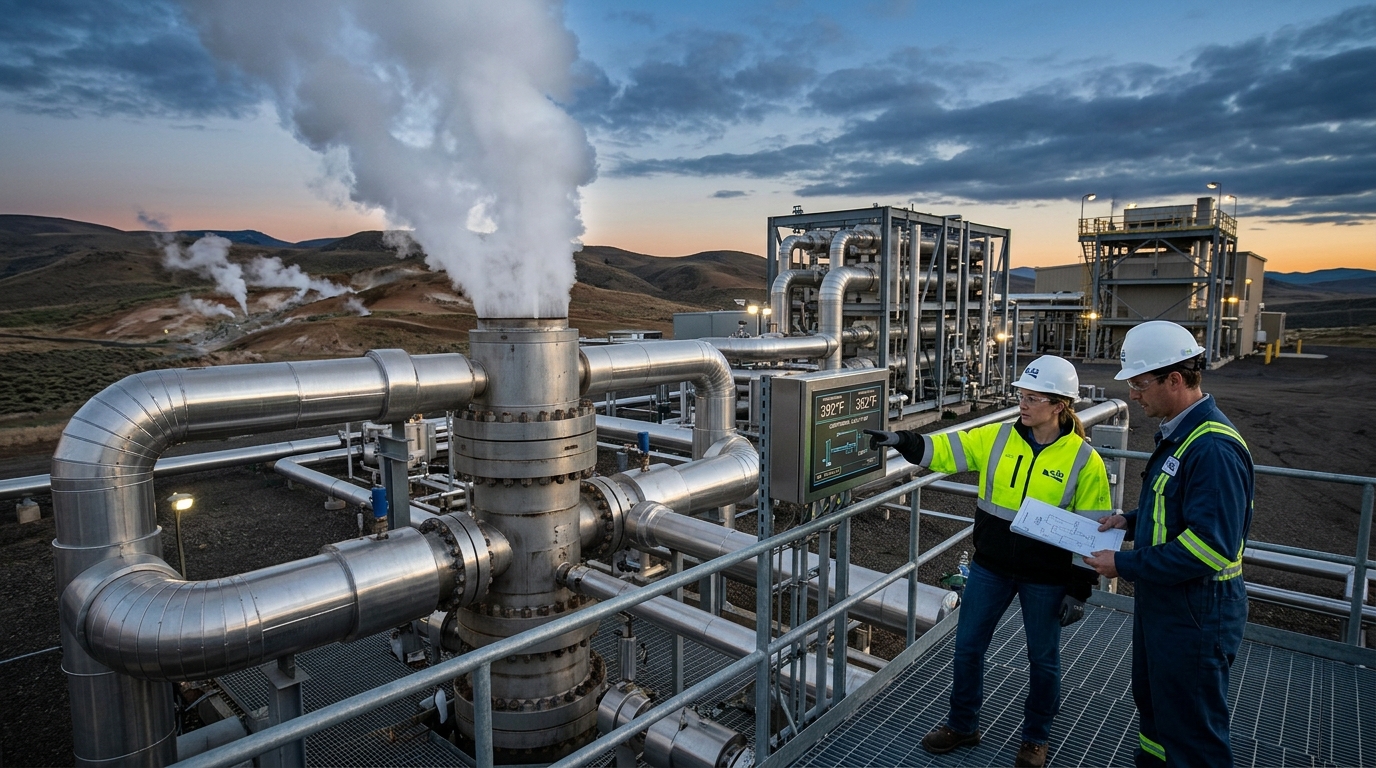
SLB’s Geothermal Fluid Tops Out at 392°F. The Wells Run Hotter.
SLB just posted third-quarter 2026 revenue of $9.45 billion, up 6% year on year, and the company’s core oilfield services business is grinding through a difficult cycle. Well Construction margins improved sequentially, not compressed, but they remain below last year. Middle East conflict-related disruptions clipped year-on-year revenue in the region and weighed on international results. The headline numbers are fine, but they are not the reason to pay attention to SLB this week.
The more consequential story is a chemistry problem buried inside the company’s new-energy ambitions, and it draws a hard line between what SLB can do today and what the geothermal industry actually needs.
What the Fluid Does
SLB’s geothermal drilling fluid, VeraTherm, is a high-temperature water-based system engineered to stay stable above 300 degrees Fahrenheit. An SLB technical report on a Middle East onshore well says it remained stable for seven days at 375°F, and that performance eliminated conditioning runs during wireline logging compared with conventional water-based systems. That performance matters because drilling fluid is not passive: it cools the bit, carries cuttings to surface, and controls formation pressure. When the fluid degrades under heat, the entire drilling program stops.
Drilling fluid performance is only one variable in SLB’s cost equation. Diesel crack spreads far above historical norms are compressing the economics of conventional oilfield operations that SLB’s legacy business depends on.
SLB does not publicly specify a 200°C (392°F) reservoir-temperature ceiling on the VeraTherm product page, and the company does not publicly substantiate the claim that VeraTherm has been deployed across more than 100 geothermal wells since 2015. What SLB does show, in its own case material, is stable performance at 375°F over multi-day exposure, which places VeraTherm solidly in the commercial high-temperature class but leaves the ultra-hot frontier unresolved.
Where the Ceiling Becomes a Problem
The next generation of geothermal targets sits well above that line. Supercritical geothermal resources are commonly described as conditions at or above water’s critical point, roughly 374°C and about 22 MPa, and some industry and government sources refer to superhot systems above about 375°C. Those conditions can, in theory, deliver an order-of-magnitude increase in power per well versus lower-temperature developments. Conventional downhole electronics and sensors also struggle in that regime. Research and industry sources often cite state-of-the-art electronics that perform reliably only to roughly 175°C, with higher-temperature operation possible but typically with sharply reduced life expectancy. Drilling fluid chemistry faces the same physics.
That is the frontier SLB is engineering toward. The company has filed and received patents tied to distributed temperature and acoustic sensing workflows for geothermal well planning and development, which is consistent with a push toward full-wellbore monitoring at higher temperatures. The draft’s claim that SLB is currently constructing Uzbekistan’s deepest high-pressure, high-temperature well at 7,500 meters cannot be supported as written. What is supported in public reporting is that SLB was awarded an integrated well construction contract in Uzbekistan that included drilling the country’s deepest HPHT well, targeting a total depth of 7,500 meters in the fourth quarter of 2025.
What This Means for Precious Metals Investors
The connection to gold is structural, not coincidental. A credible ultra-deep geothermal buildout requires the same kind of capital-intensive, decade-long infrastructure spending that historically tightens mine supply and pulls investment toward hard assets. Copper demand for geothermal plant construction is already well-documented. Less discussed is what a sustained geothermal drilling boom does to the oilfield services market: it pulls engineering capacity away from conventional extraction at precisely the moment when commodity supply chains are already stretched.
Copper demand is the most visible second-order signal from a geothermal buildout, but it does not stand alone. Uranium and copper are both running structural deficits driven by the same energy-transition capital cycle that a sustained geothermal drilling boom would accelerate.
SLB’s publicly described geothermal fluid chemistry is not yet shown, in its own materials, to be rated for supercritical conditions. Closing that gap is where the next several years of R&D spending will go. For a company navigating compressed margins in its legacy business, the new-energy segment is increasingly the argument investors are being asked to price in. The fluid temperature ceiling tells you exactly how far along that argument actually is.