
On Friday, Ukraine and Russia agreed on a localized ceasefire in the Russian-occupied town of Oleshky, brokered through U.S. First Lady Melania Trump, with President Zelensky confirming that peace negotiators would meet next month for new talks. Separately, Zelensky said negotiators from Ukraine, Russia, and the United States agreed to technical-level meetings in the first half of November in Abu Dhabi. For investors conditioned to treat every geopolitical headline as a potential price shock, the instinct is to ask what this means for gold. The more interesting question is why the answer is: very little.
What’s Driving the Market
Within hours of Russian President Vladimir Putin saying he agreed “in principle” to restart talks, Russia launched a deadly barrage of ballistic missiles and drones on Kyiv, according to wire reports. That sequence tells you everything about the credibility of this moment. While the Oleshky initiative raised hopes for future humanitarian missions, there were few indications that key positions had shifted. Russia continues to demand Ukrainian territory it does not fully control, while Kyiv insists any agreement must include guarantees against another invasion.
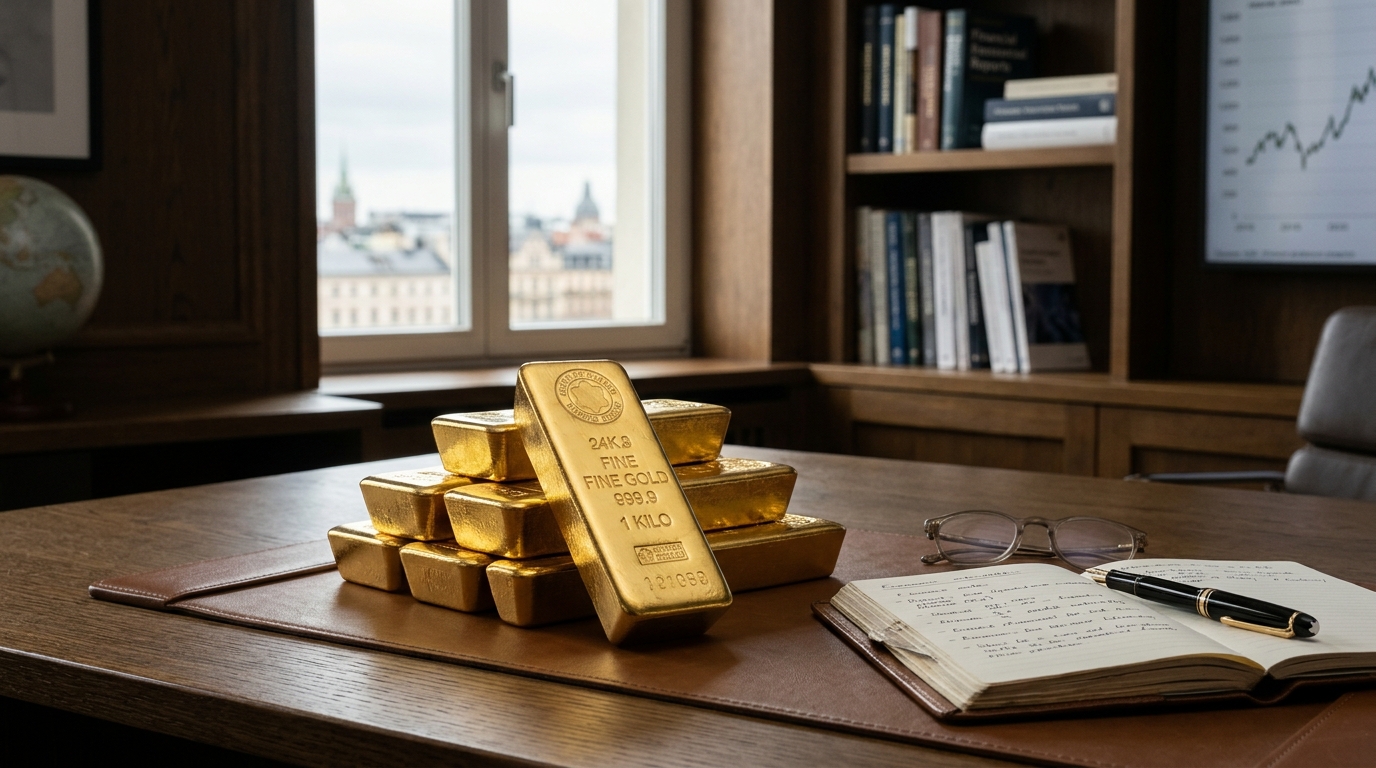
Markets have learned this lesson through repetition. Gold, by contrast, has remained largely anchored to a different set of drivers. Gold fell to roughly $4,024 per ounce on October 22. The metal is not being lifted by war fear. It is being held up by a structural shift in reserve management that predates and will outlast this conflict.
Goldman Sachs research published in October argued that central bank gold buying has remained elevated versus pre-2022 levels and has become a durable feature of the market. That is not a war trade. That is reserve diversification with a multi-decade time horizon.
The Investment Opportunity
Where the ceasefire headlines do create a live investment question is in European defense equities, where the Oleshky agreement is the first concrete de-escalation signal in months. Rheinmetall has been sharply lower year-to-date in 2026, depending on the share class and reference date. The sector entered this weekend already under pressure from procurement uncertainty and peace-talk sensitivity. A ceasefire that holds, or talks that advance materially in Abu Dhabi, would be a further headwind.
But the structural rearmament argument is not easily dissolved by a local ceasefire in Kherson. Goldman Sachs has argued that even a peace deal, if it ever materialises, is unlikely to meaningfully alter threat perception among European NATO members. It has pointed to large multi-year procurement backlogs, spending commitments agreed at the NATO summit in The Hague, and rising U.S. pressure on burden-sharing as structural tailwinds for the sector.
The divergence between peace-talk sensitivity and structural procurement demand is visible in individual names. Northrop Grumman trades 32% below its peak despite a record $105 billion backlog, illustrating how ceasefire headlines can disconnect a stock from its underlying order book.
For gold specifically, the more immediate pressure is not coming from diplomacy. The recent drop has coincided with higher oil prices and expectations that U.S. rates could stay restrictive, which tends to favor yield-bearing assets over non-yielding gold. The October 27-28 Fed meeting carries no updated projections; markets are focused on whether the Committee signals another move later this year, with the federal funds target range sitting at 3.75%-4.00% since the Fed’s September 16 hike. That, not Oleshky, is what gold investors need to watch this week.
The rate-versus-gold tension is not new, but the sovereign demand floor complicates the usual calculus. Goldman’s model estimates central bank purchases are far larger than official data shows, creating a floor dynamic that rate moves alone cannot easily break.
Risks to Monitor
Central to Russia’s demands is full control of four Ukrainian regions it illegally annexed: Donetsk, Luhansk, Zaporizhzhia, and Kherson, in addition to Crimea, which Moscow seized in 2014. Security guarantees being discussed range from NATO membership, which the U.S. administration has currently ruled out, to direct U.S. guarantees in what Zelensky has described as an “Article 5-like format.” The gap between those positions is wide enough to sustain the war indefinitely, and investors should weight any optimism accordingly.
On the gold side, the bear case is real. The Federal Reserve’s interest-rate outlook remains the more immediate market driver. Central bank accumulation could support bullion over the longer term, but it does not guarantee that gold has found its floor.
Bottom Line
The Oleshky ceasefire is not nothing. It is a localized agreement aimed at enabling humanitarian aid, and if the Abu Dhabi talks produce anything beyond a photo opportunity, European energy markets and defense equities will feel it faster than gold will. But investors who treat this as a fundamental shift in gold’s outlook are misreading the metal’s support structure. The World Gold Council reported that central bank net purchases surged in Q2 2026 to 289 tonnes, a record for a second quarter. That buying is not tightly correlated to a single battlefield headline, and it will not stop because of a local ceasefire in southern Ukraine. The prop under gold is not geopolitical fear. It is a generational realignment in how central banks manage reserves, and peace headlines will not change that calculus.