
October 11, 2026
Bonus Content: AI Is Finding Spectrum Nobody Knew Was There
Hey,
With the Fed hiking rates for the first time since 2023, I thought I’d share this free gift with you.

Hurry, you’ll want to put this strategy into action this week.
In your corner,
Dave Aquino
Base Camp Trading
AI Is Finding Spectrum Nobody Knew Was There
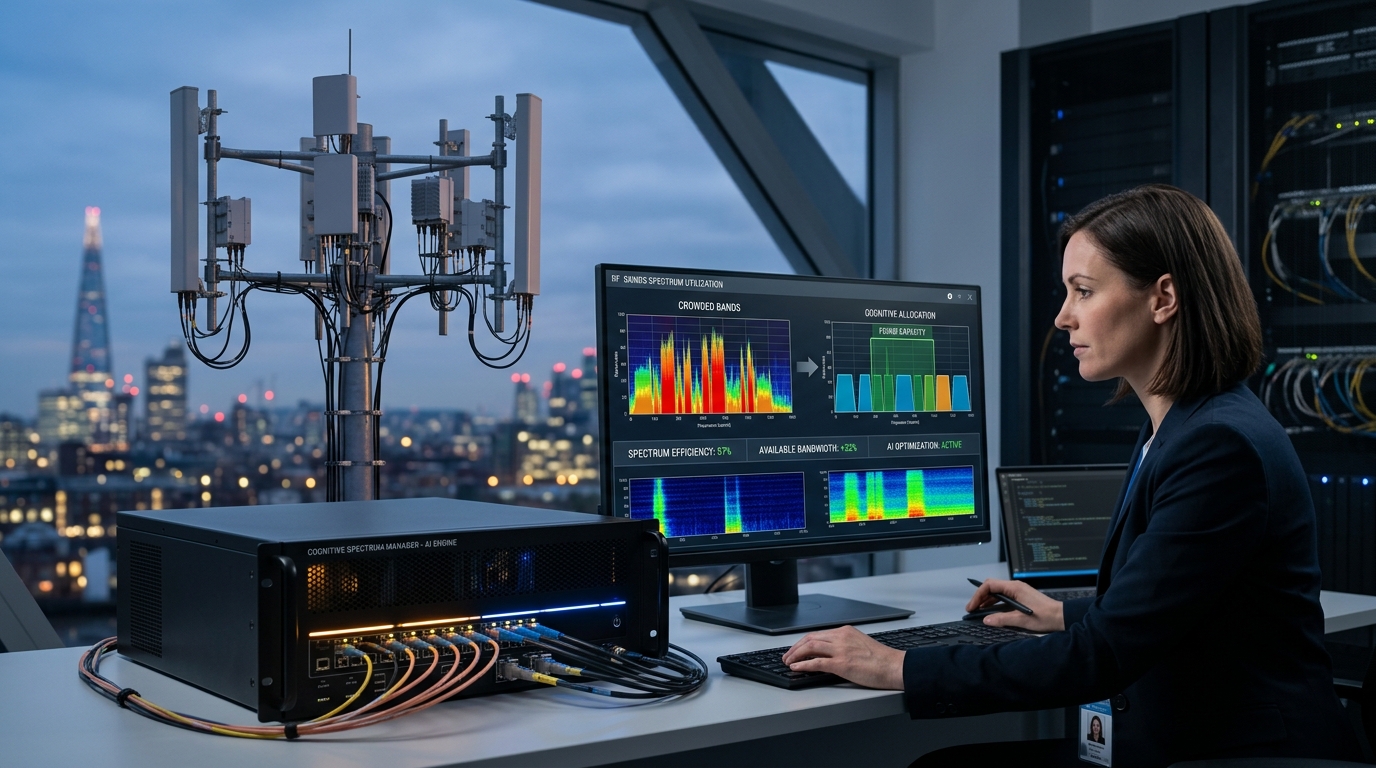
Wireless spectrum is not actually running out. Most of it is just badly managed.
That distinction matters enormously right now, because it reframes the entire investment case for the companies solving what looks like an infrastructure crisis. The cognitive radio market is projected to reach about $12.5 billion in 2026 and roughly $29.5 billion by 2032, implying roughly mid-teens annual growth as 5G densification collides with static frequency plans designed for a different era.
The core problem is one of waste. Traditional spectrum allocation assigns fixed frequencies to fixed users, which means large swaths of licensed bandwidth sit idle for hours at a stretch while neighboring bands choke under traffic. Studies of cellular utilization have consistently found that licensed bands run at well below full capacity on average, even in dense urban markets. The airwaves are overcrowded and underused at the same time.
AI-driven cognitive radio attacks that paradox directly. Machine learning models trained on historical network data can parse traffic patterns across multiple time scales and help forecast demand well enough to reallocate spectrum before congestion materializes. The practical objective is spotting millisecond windows of unused 4G capacity and sliding 5G packets into those temporal gaps, playing a form of Tetris at machine speed between generations of technology.
The most instructive commercial proof point right now is happening inside the U.S. Citizens Broadband Radio Service band at 3.5 GHz. Federated Wireless, a leading operator of Spectrum Access Systems for CBRS, said in June 2026 that its Spectrum AI platform can deliver up to fivefold gains in network capacity at existing sites and increase usable spectrum capacity by up to 50%, using machine learning rather than additional equipment. No new towers, no fresh spectrum auctions. The gain comes entirely from smarter arbitration of what already exists. The OnGo Alliance responded by forming an Applied AI Working Group, a signal that the industry views this as a structural shift rather than a single vendor’s product claim.
For investors, the hardware angle deserves particular attention. Reconfigurable transceivers and spectrum-sensing modules account for roughly 43% of cognitive radio component demand in 2026, the largest single slice, and hardware is also widely expected to be among the faster-growing segments. That is where the physical intelligence lives: the radio that can sense its environment, classify interference, and retune without human intervention. Software-defined radio architectures allow waveform flexibility and remote updates without frequent hardware replacement, which gives vendors with strong silicon and firmware stacks a durable edge over pure-software competitors.
The risk is regulatory lag. Dynamic sharing frameworks work only when rules keep pace with technology, and spectrum policy moves slowly in most jurisdictions. Priority Access Licensees in CBRS have less certainty than holders of traditional exclusive licenses because they must protect, and accept interference from, higher-priority federal incumbents. An operator building a private 5G network on shared spectrum takes on a category of interference risk that a licensed-band deployment does not. That uncertainty is priced into valuations, which is partly why the opportunity still exists.
The bottom line: spectrum scarcity is real, but AI is proving it is not fixed. The companies embedding cognitive capability into base stations and access systems are not solving a niche problem. They are rebuilding the foundation of how wireless capacity gets created.