
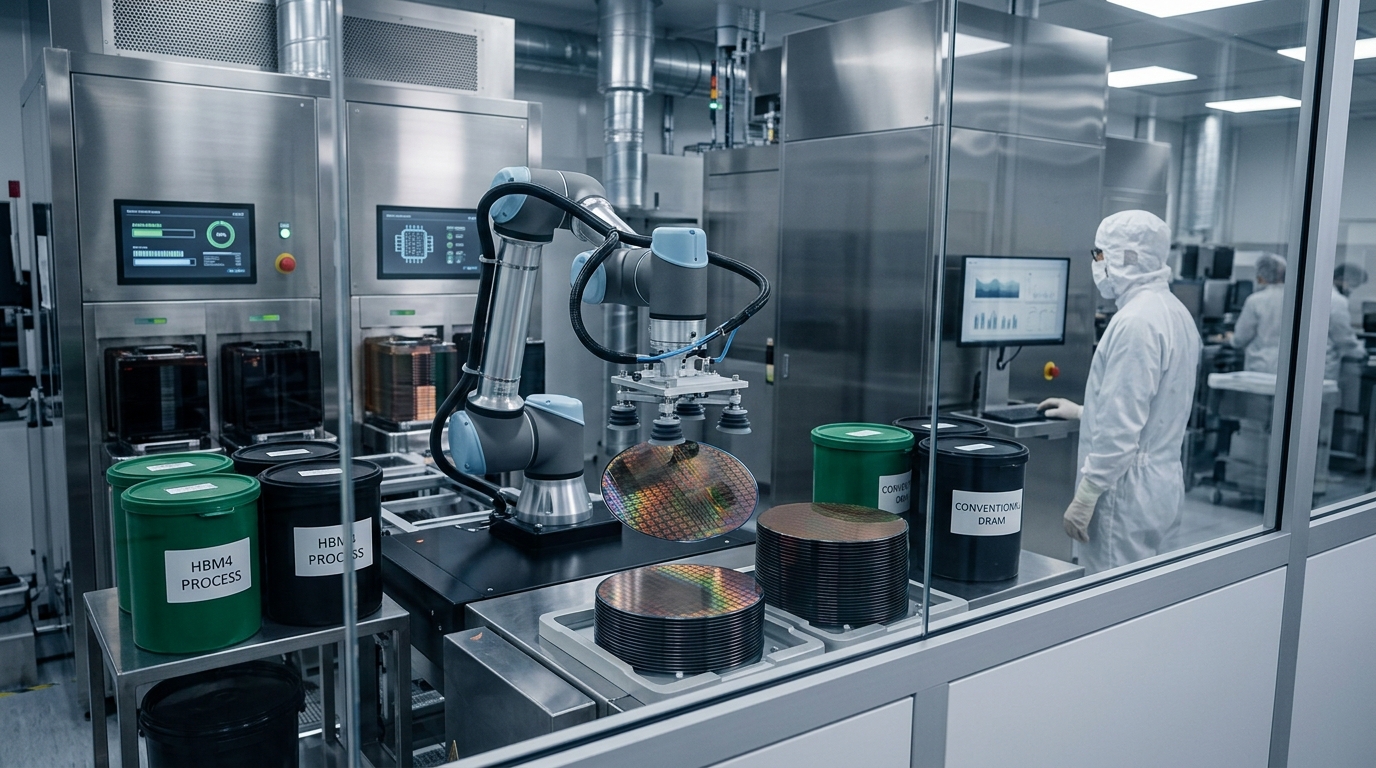
There is a useful mental model for understanding what Samsung and SK Hynix have become: think of them as tollbooths on the only road between silicon and intelligence. Every wafer they shift toward HBM4 removes three wafers’ worth of conventional DRAM from the consumer market. That arithmetic, attributed this week to KB Securities analyst Kim Dong-won, is not a temporary supply disruption. It is a structural reordering of who gets memory first, and at what price everyone else pays.
A research report released by KB Securities on September 7 said that Samsung Electronics and SK Hynix’s memory chip inventory has dropped to less than 10 days. For context, healthy inventory in semiconductor supply chains is typically measured in weeks, often cited as roughly 30 to 45 days of production output, enough to absorb disruptions in manufacturing, shipping, or demand without triggering supply failures at customers. The two Korean giants are now running at roughly one-fifth of that floor.
The mechanism matters more than the headline number. According to KB Securities, the production capacity required to produce one HBM4 wafer is equivalent to that of three general-purpose DRAM wafers. This means that for every step increase in HBM4 production, the available wafers for general-purpose DRAM are reduced by a factor of three. New capacity takes years to come online from the point a fab breaks ground, which is why analysts are not treating this as a 2026 problem. It is a 2027 and 2028 problem that is already showing up in prices today.
Industry revenues climbed to $154.73 billion in Q2 2026, marking a 59.5% jump from the previous quarter, based on analysis from TrendForce. Samsung maintained its position as market leader with DRAM sales of $60.98 billion, representing a 63.4% sequential increase, with its market share expanding from 38.5% to 39.4%. That revenue explosion is not coming from selling more chips. It is coming from selling the same chips at dramatically higher prices to customers who have no alternative supplier.
The device-cost consequences are already measurable. IDC says the memory shortage is striking hard in the second half of 2026, with smartphone shipments forecast to drop 27.2% year-on-year, and NAND and DRAM costs up over 300% year-on-year. IDC also expects memory prices to continue increasing until at least 2028. Memory as a share of smartphone bill-of-materials is rising sharply, but the widely reported range is lower and more segmented than the 30 to 40 percent claim: IDC has put memory at roughly 10 to 15 percent for high-end flagships and about 15 to 20 percent for mid-range devices, while other industry research has described a structural shift upward from prior levels.
Apple is not immune. Tim Cook told investors on the fiscal Q3 2026 call that “For September, we expect to pay even higher memory costs,” and flagged that the DRAM market has only three suppliers and that Apple’s sourcing flexibility is thin. Claims that Apple’s usual strategy to secure cheaper memory “failed” and that it is paying “unprecedented” prices go beyond what Apple disclosed on that call; what Apple did say is that memory costs are rising meaningfully and will rise again in the September quarter.
Samsung and SK Hynix both led a Korean market rally overnight, and Micron has said it expects supply-demand conditions for both DRAM and NAND to remain tight beyond calendar 2027. But the specific claim that the Roundhill Memory ETF jumped 3% against a falling broader market is too day-specific to leave standing here without the exact date and market context, so it should be treated as directionally illustrative rather than a precise datapoint. Separately, KB Securities said Samsung Electronics and SK Hynix shares had fallen 38% from their highs over the prior three months and were trading at about three times 2027 earnings. That combination, dominant pricing power at a single-digit earnings multiple, is exactly the kind of mispricing disciplined long-term investors study carefully.
This is not a cyclical shortage driven by a mismatch in supply and demand, but a potentially durable, strategic reallocation of the world’s silicon wafer capacity. For decades, the production of DRAM and NAND for smartphones and PCs was the primary driver for production. Today, that dynamic has inverted. The tollbooth is not going away. The question is whether the market has yet priced in how long the queue will be.