
September 22, 2026
Bonus Content: The RBA Is About to Follow the Fed. Gold Has to Survive Both.
Below is an important message from one of our highly valued sponsors. Please read it carefully as they have some special information to share with you.
Dear Reader,
A tiny $2 stock…
Quietly controls the largest gold deposit in the entire world…
Worth almost $1 TRILLION in total…
And I believe on September 30, they’re preparing to announce this historic discovery to the world.
Once that happens, the sky is the limit for early investors who get in now.
Click here to see everything you need to know.
Regards,
Jim Rickards
The RBA Is About to Follow the Fed. Gold Has to Survive Both.
Six days after the Federal Reserve raised rates for the first time since 2023, Australia’s central bank is lining up to do the same. The Fed lifted its benchmark by 25 basis points to a target range of 3.75%–4% on September 16, and the contagion was immediate. Just a few weeks ago, economists at Australia’s big four banks all predicted that rate hikes for 2026 were finished, and they were unanimous that cuts would begin in 2027. All four have since changed their view, with some now forecasting a hike as soon as this month.
Interest rate futures markets are currently pricing a high likelihood of a hike at the RBA’s September 29 decision. That is not a close call. ANZ now forecasts two 25 basis point hikes, one in September and another in November, which would take the cash rate to 4.85%. Westpac, which had previously expected November, brought its call forward to September. An appearance before the federal parliament by RBA Governor Michele Bullock and Deputy Governor Andrew Hauser has convinced many economists the bank will hike at the close of its two-day meeting on September 29, with some now forecasting a move that would take the cash rate to a peak of 4.85%, the highest since before the 2008 global financial crisis.
Speaking to a parliamentary committee on September 18, Governor Bullock indicated she now favours a more hawkish approach to bring inflation back to the RBA’s target range, citing global pressures including the ongoing Middle East conflict and resulting oil price spikes. Fresh data from the Australian Bureau of Statistics showed the Consumer Price Index rose 3.5% over the 12 months to July, while trimmed mean inflation, the RBA’s preferred underlying gauge, held unchanged at 3.6%, with both measures remaining above the 2–3% target.
For gold, this matters well beyond the Australian border. A renewed U.S. tightening cycle means a stronger dollar, greater pressure on currencies elsewhere and less room for other central banks to ease monetary policy. When the RBA joins that cycle rather than diverging from it, the carry trade unwinds differently: the Australian dollar firms, capital that had been rotating toward yield-seeking positions rebalances, and the broader impulse that drove gold from its January 2026 record near $5,600 faces another layer of resistance.
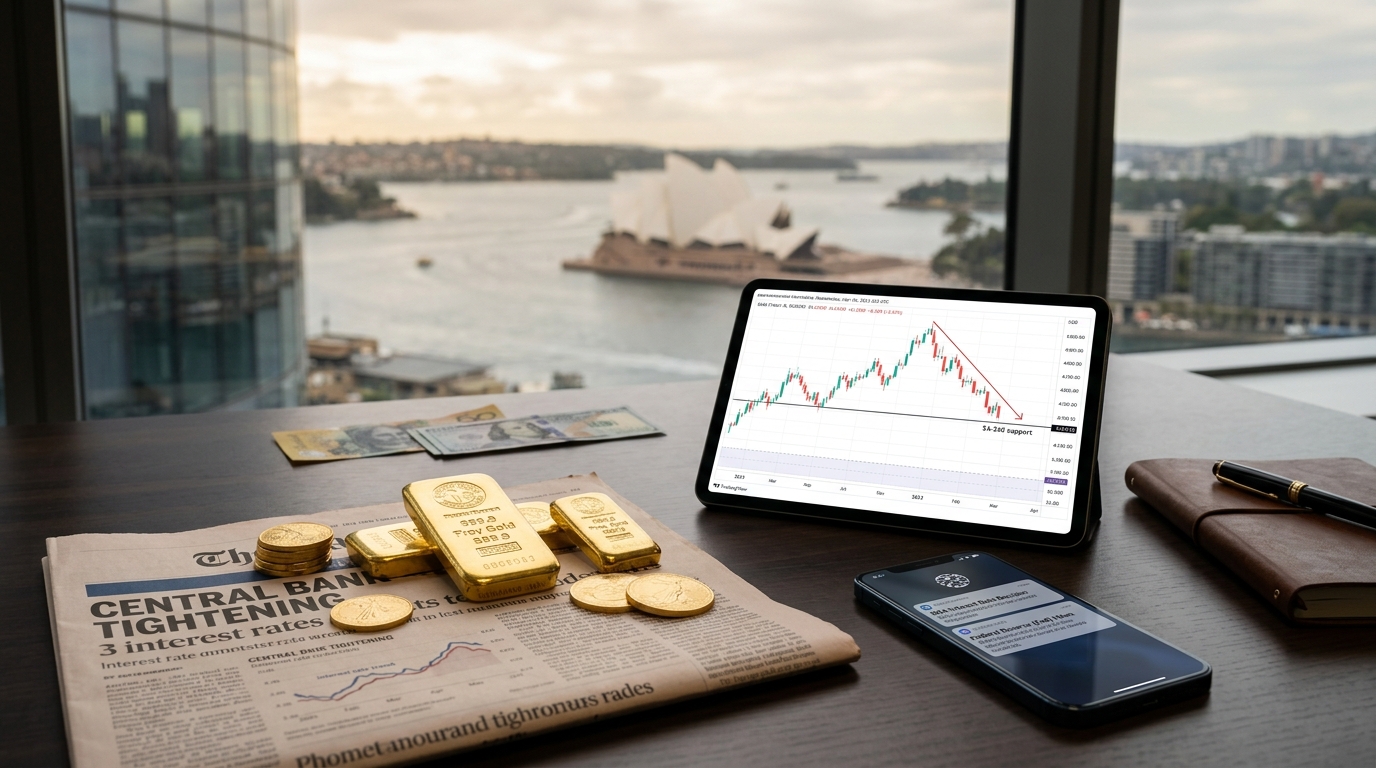
Gold has been testing the $4,350 area in recent sessions, driven largely by rising expectations that the Fed will persist in tightening monetary policy. Synchronised rate increases create a challenging environment for the metal: when interest rates and Treasury yields rise together, investors have less incentive to hold a non-yielding asset. The 10-year U.S. Treasury yield hit 5% last week, compounding that pressure.
The bullish case has not collapsed. Record central bank buying of 289 tonnes in Q2 and strong ETF inflows over recent months signal the gold correction is playing out inside a broader bull trend, not marking its end. Poland added 51 tonnes in Q2 2026 and China added 33 tonnes, neither of those reserve managers sells a position because two central banks moved 25 basis points in the same week. Goldman Sachs still holds a year-end target of $4,900 and JPMorgan’s Q4 target sits at $4,500.
The honest question for investors is whether this tightening wave is already priced. If additional rate hikes have already been incorporated into gold prices, the actual announcements may produce a more limited bearish reaction. Conversely, if the RBA or the Fed signals a longer or more restrictive cycle than markets currently expect, gold could face renewed selling pressure. With the RBA decision one week away and the Fed’s dot plot already pointing to at least one more hike, the near-term outlook for gold is neutral, with immediate support at $4,340 and resistance near $4,381. A clean break below $4,340 on a confirmed RBA hike would open the next test. A hold would say something important about how much structural demand has changed the metal’s reaction function.