
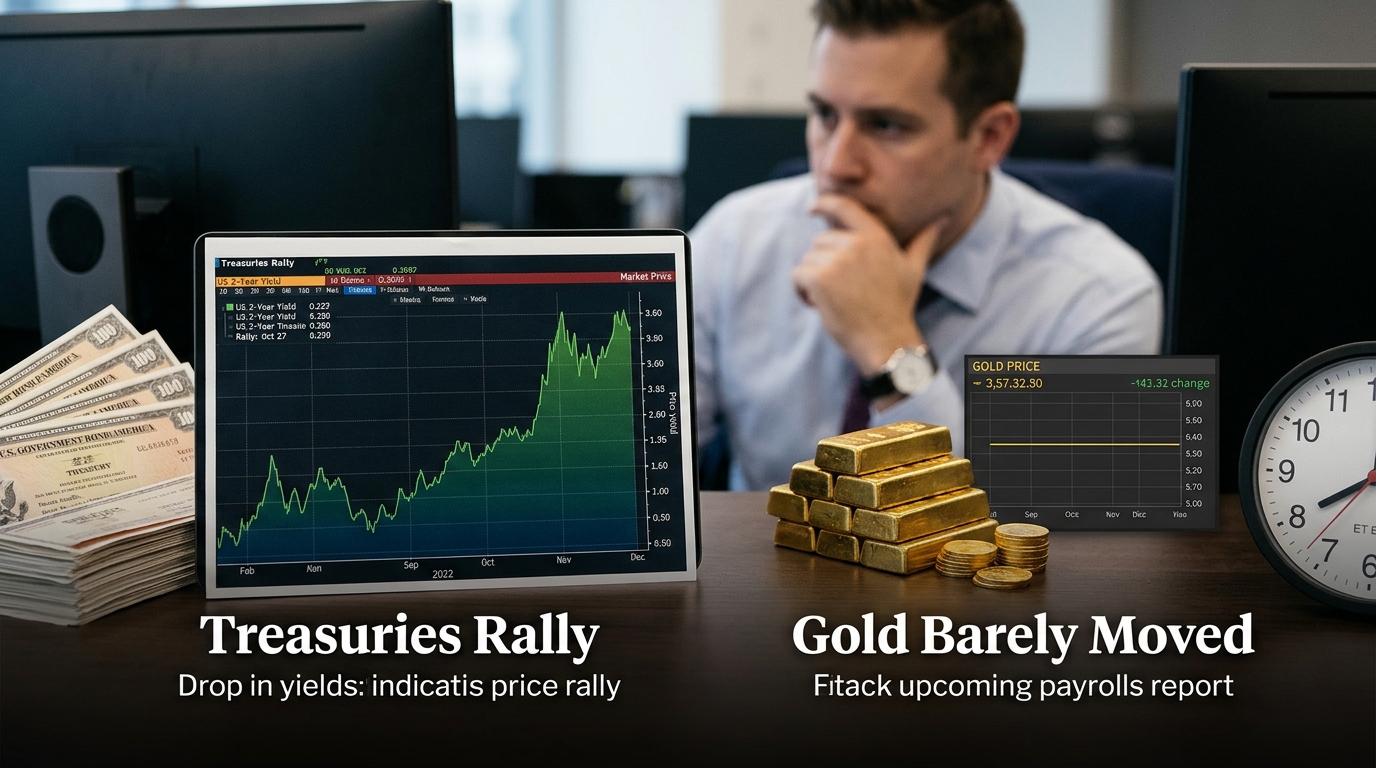
November 6, 2026
Bonus Content: Treasuries Rallied Thursday. Gold Barely Moved. That Gap Has a Price.
There is a monetary shift building that retirement savers will not see until it has happened.
Almost every retirement account in America is held in dollars.
But what your account is really worth is not the number on the statement. It is what that number can buy.
And since 1971 when Nixon cut the tie between the dollar and gold, this number is buying less every single year.
You feel it at the pump. You see it at the cash register.
Your savings have been running uphill against that erosion for more than 50 years.
Now Congress is taking a second look at the gold the government owns.
And a bill in Congress would require the Treasury to reprice the government’s gold on its books, at market value.
Here is why it matters to you.
The government values its own gold at $42 an ounce. Congress set that price in 1973 and never changed it.
Gold trades at over $4,000 today.
America holds more gold than any country on earth. On the books, it is worth about $11 billion. In the real world, more than $1 trillion.
That is a gap of about 95 times, sitting on the nation’s books, in plain sight.
And Washington has noticed. That is what the repricing bill is.
If that number is ever corrected, Washington books a trillion-dollar gain. From gold.
The Americans who already hold physical gold did not wait for Washington to notice.
More than 60 million Americans qualify to move a portion of their savings into physical gold right now. Tax-free. Penalty-free.
The 2026 Gold Guide walks through every step.
Takes 30 seconds to request.
Nixon made his move on a Sunday night. No warning.
If it changes again, the only question is which side you are standing on.

Treasuries Rallied Thursday. Gold Barely Moved. That Gap Has a Price.
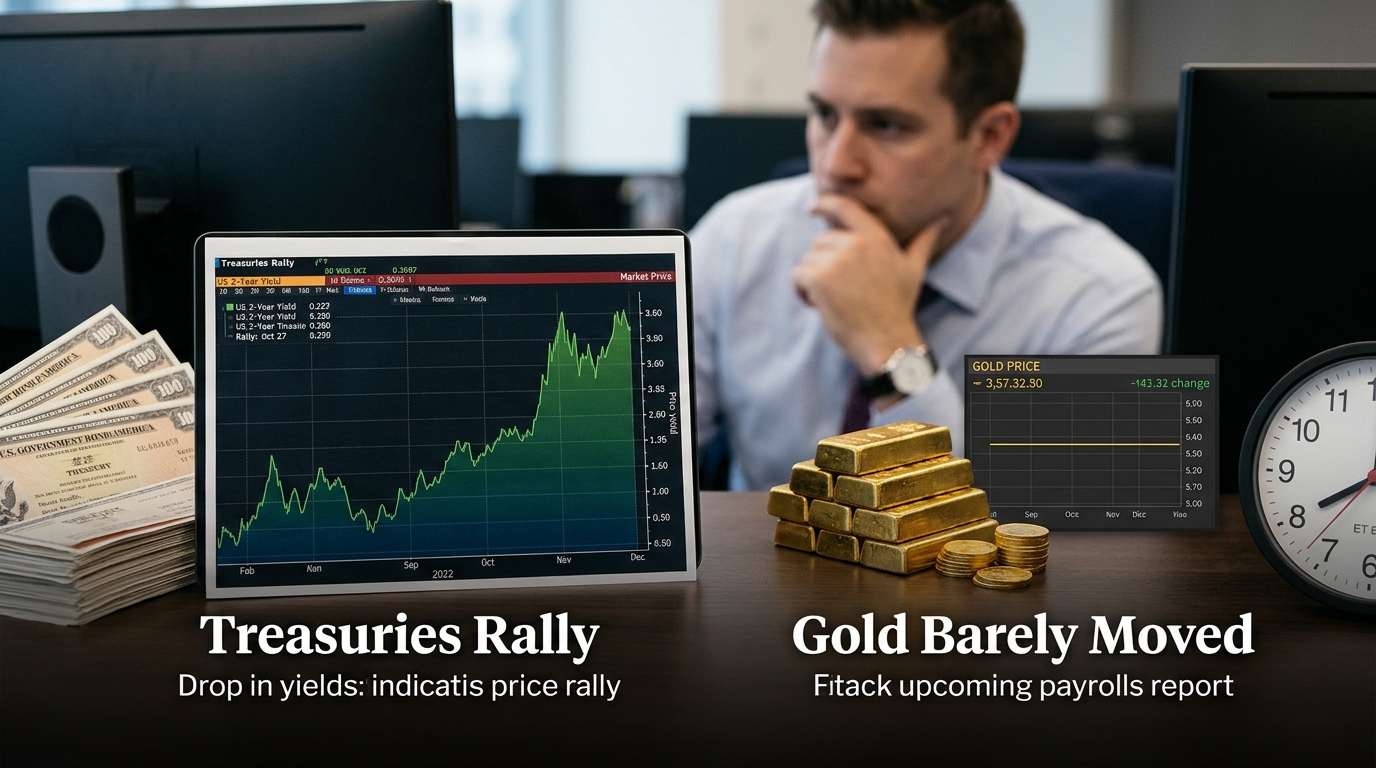
Thursday’s equity collapse was one of the sharpest single-session drops of the year. The Nasdaq fell 5.52% and the S&P 500 shed 4.36%. Investors wanted a hedge. What they got from Treasuries was real. What they got from gold was ambiguous.
The 2-year Treasury yield fell 12 basis points to 4.46%, its lowest since September 9, with the move driven mostly through real yields. December hike odds dropped to about 69% from roughly 85%. The 10-year dropped 6 basis points to 4.84%, its lowest since early September, widening the 2s10s spread to 38 basis points. That is a textbook flight-to-quality move: fast, clean, and large enough to actually cushion a portfolio.
Gold did rise. Spot gold closed near $4,088, a gain of about 0.69%, lifted by safety demand and lower yields. But relative to a 5.5% Nasdaq collapse, less than 1% is not a hedge. It is noise. Gold had already rallied before the main U.S. stock decline, so attributing the entire gain to the Wall Street selloff would overstate the evidence. The metal was already elevated from Wednesday’s post-election surge, and when equities broke hard, Treasuries absorbed the shock more directly.
The reason matters for how precious metals investors size their exposure right now. The Fed is not done. CME FedWatch put the probability of a December hike at about 69% late on November 5, down sharply from the prior day. That is still a majority probability. Liz Ann Sonders at Schwab put it plainly: “another pause is likely predicated on a much weaker jobs report.”
Which is precisely what arrives at 8:30 ET this morning. Economists are looking for a nonfarm payrolls gain of 59,000, a slight uptick from the 29,000 jobs produced in September, according to the Dow Jones consensus. The unemployment rate is projected to remain at 4.2%, while month-over-month average hourly earnings could rebound from 0.1% to 0.3%.
The read-through for precious metals investors is not simple. Low layoffs argue against the growth-scare story driving equities lower, leaving rates vulnerable if payrolls surprise higher. A firm report would rebuild December hike pricing, lift 2-year yields and the dollar, and compound pressure on high-multiple assets. That scenario is unfriendly to gold: a stronger dollar at 101.6 on the DXY is elevated, and real yields moving back up after Thursday’s compression would remove one of the metal’s key current supports.
The December hike debate is not new territory for gold. Real yields and Fed hike pricing in the days surrounding a hold decision have already shown how quickly gold’s floor can shift.
A weak report would validate the bond rally but deepen concern that the equity drawdown is cyclical rather than technical, widening credit spreads. In that world, gold’s safe-haven case strengthens more convincingly, but only if the dollar softens alongside the data.
The asymmetry here favors duration over gold as a pure hedge for the next 48 hours. Treasuries have already demonstrated they can move 12 basis points in a single session when the risk-off trade is genuine. Gold’s Thursday gain, while real, came alongside a dollar that barely budged. OCBC analysts noted that “falling US yields are blunting the dollar’s safe-haven appeal,” leaving other assets to absorb flows.
For gold holders, the message is not to sell. Central bank buying remains structurally bullish: the World Gold Council reported that central banks bought 321 tonnes in the third quarter, up 42% from a year earlier. That floor is real. But sizing a gold position as a short-term equity hedge into a Fed that is still debating its next hike is a category error. Treasuries are the hedge that worked Thursday. Gold is the position that works over quarters, not sessions.
The structural buyer behind that floor deserves a closer look. Central bank gold demand and ETF-driven Bitcoin inflows reveal two very different demand bases underpinning each asset’s long-term case.