
November 2, 2026
Bonus Content: France’s Debt Crisis Is Exactly Why Central Banks Keep Buying Gold
Silver and gold are crushing all previous profit records… right as capital rotates aggressively back into precious metals stocks.
And history is clear: the biggest gains won’t come from chasing the large caps. They’ll come from positioning early in select small-cap discovery stories before the market catches on.
One under-the-radar North American small-cap silver-gold stock – currently trading undiscovered below US$1 per share – is now entering that optimal window at its flagship project.
For generations, silver and gold were mined at surface across this newly-consolidated North American mineral district.
Fortunes were made. Yet, the deeper story was never told – not because the metals weren’t there… but because the district was fragmented and never explored as a unified system.
That has now changed.
For the first time in history, this entire historic silver-gold district has been fully unified under one small-cap Canadian operator… unlocking modern geology and drilling from surface-to-depth across kilometers of previously fragmented mineral-rich ground.
Phase-2 drilling is accelerating right now across key targets… setting up a near-term flow of potential needle-moving results as the discovery picture sharpens.
And that’s only part of the story…
Add in a second nearby district-scale gold-silver asset, and the exploration runway expands even further for this exceptionally well-run small-cap explorer.
In short, this is a classic early-stage discovery setup: district-scale, newly unified, and only now being tested properly for the first time via modern drilling.
Incredibly, shares are still trading undiscovered below US$1 creating a brief window to position early and low before Wall Street catches up.
We’ve put together a FREE online report with all the details – including an exclusive, in-depth interview with the company’s president & CEO – giving you a firsthand look at what initial results are already revealing and where this district-scale precious metals discovery is headed next.
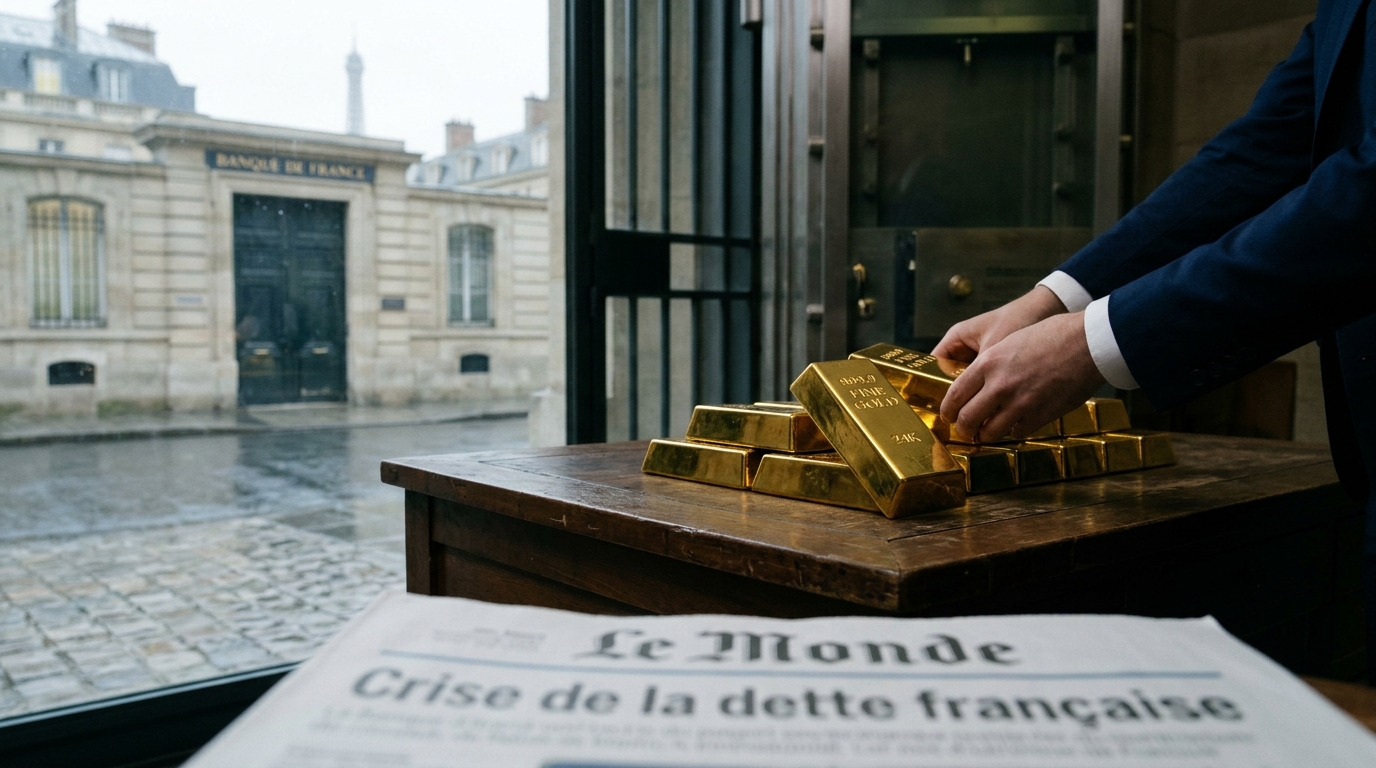
France’s Debt Crisis Is Exactly Why Central Banks Keep Buying Gold
France handed gold investors another data point on Friday. Fitch Ratings lowered its outlook on France’s A+ sovereign credit rating to negative from stable, pointing to widening fiscal deficits, escalating debt projections, and elevated borrowing costs. The agency took the additional step of issuing an unscheduled review, citing a material deterioration in the country’s credit profile since its previous evaluation in August.
The yield on France’s benchmark 10-year OAT slipped slightly to about 4.97% Monday, stepping back from the 5.14% peak struck last week, its highest level since 2002. That peak came after the French 10-year briefly pushed the spread against German Bunds to about 175 basis points before moderating. The spread was sitting closer to 60 to 85 basis points earlier this year.
The fiscal arithmetic is worsening fast. Fitch predicted that France’s debt level will rise from nearly 115.7% of GDP in 2025 to about 121% by 2028.
High-Grade Silver-Gold Hits Fuel Sub – $1 Discovery Stock
Silver and gold are at historically high levels as investors hunt for the next mining breakout. One overlooked small-cap Canadian explorer is reporting high-grade silver-gold drill results in a historic Mexican mining district.
Getting that budget passed is its own problem. The adoption of the text by a vote in parliament looks more than uncertain, given the lack of a majority in the National Assembly and the approaching presidential election. Prime Minister Lecornu used a constitutional clause to push through the 2026 budget without a vote in January 2026. Fitch described the post-election outlook for debt reduction as “uncertain,” noting that a credible fiscal strategy will be difficult to agree.
None of this is solely a French problem. It is the most visible current example of something that has been building across the developed world for years: the compounding cost of carrying debt loads that were manageable when rates were near zero and that become structural crises when they are not. That is precisely the dynamic that has driven central banks to accumulate gold at a pace not seen in modern financial history.
France is the most acute case, but it is not the only one. Britain’s 30-year gilt yield near 28-year highs tells the same story of developed-market fiscal credibility under pressure.
Central banks bought a record 289 tonnes of gold in Q2 2026, keeping up a four-year run near 1,000 tonnes a year. A record 45% of central banks plan to add gold in the next 12 months; 89% expect global holdings to keep climbing. The institutions buying are not trading momentum. In an environment where sovereign debt levels are at historic highs globally, gold’s zero-counterparty-risk profile distinguishes it fundamentally from every fiat-denominated asset class.
Goldman Sachs revised its central bank demand model earlier this year and now expects central banks to average around 60 tonnes per month through 2026, supported by continued diversification demand amid geopolitical uncertainty. That dynamic has contributed to gold’s move toward $5,300 in 2026, though spot gold sits near $3,909 this morning after a tech-stock liquidation wave pushed prices sharply lower last week. The selloff changes the price, not the argument.
France’s big three banks, BNP Paribas, Société Générale, and Crédit Agricole, carry substantial OAT exposure on their balance sheets and face rising funding costs alongside the sovereign. Fitch highlighted the resilience of the domestic banking sector, which maintains solid capital buffers that mitigate contingent liability risks for the state. That is a measured reassurance, not a clean bill of health. A sovereign with a rising interest bill is a sovereign with less capacity to backstop anyone.
The ECB sits in an awkward position. Rate cuts would ease OAT pressure but risk reigniting inflation; inaction lets spreads grind higher and compounds the fiscal squeeze. There is no policy path that resolves France’s debt trajectory quickly. That unresolvable tension is, structurally, gold’s opportunity. When the tools that are supposed to anchor confidence in sovereign debt become part of the problem, reserve managers reach for the asset that carries no government’s promise.
Bottom line: France’s Fitch outlook cut is not a crisis today. It is a confirmation that developed-market fiscal credibility is eroding in ways that are slow-moving, structural, and deeply favorable to gold as a reserve asset. The central bank buying data already reflects this. The OAT near 4.97% adds one more country to the argument.