
Mark November 10 on every supply-chain calendar. That is the published end date for China’s temporary pause on a 2025 expansion of rare-earth related export controls. As of today, Beijing has published no public legal text extending that pause beyond November 10, 2026.
Some officials and commentators have floated later dates. Buyers cannot plan off informal signals when the controlling published documents still point to November 10. The gap between what diplomats say and what China’s commerce authorities sign matters enormously when your supply chain touches Chinese-origin material.
What Actually Expires
The rules that were paused were part of China’s 2025 export-control expansion covering rare-earth related materials and technologies. The practical risk for foreign buyers is that the regime can be tightened quickly, and compliance questions can radiate through downstream products, not just raw oxides.
That reach is the operative threat. A motor magnet assembled in Germany using Chinese-origin dysprosium, sold into an American defense platform, can become a compliance problem for multiple tiers at once. If Beijing lets the pause lapse on November 10, contractors may not get a long runway to adjust.
The tariff side of the ledger has its own clock. The 178 remaining Section 301 product exclusions are scheduled to expire at 11:59 p.m. Eastern time on November 9, 2026, which is often described in guidance as expiring on November 10, 2026, absent an extension notice. If USTR does not extend them, entries after that cutoff lose the exclusions automatically, and the underlying Section 301 duties apply based on the product’s tariff treatment.
The regulatory clock compounds a procurement environment already under pressure. Defense budgets approaching historic highs have lengthened contractor backlogs and tightened sourcing requirements across every major platform.
The Price Gap Western Buyers Already Face
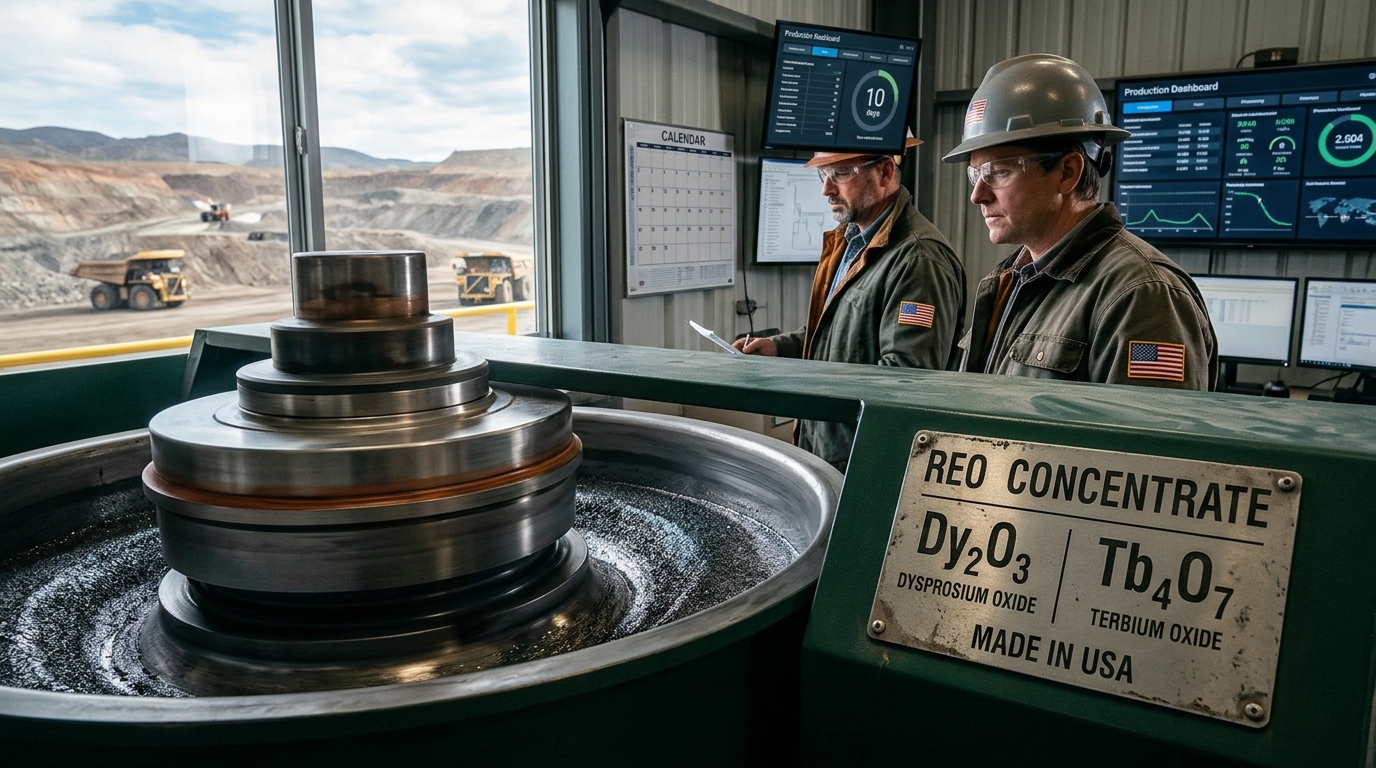
The heavy rare-earth market has been splitting into two incompatible price systems. Recent market reporting put dysprosium oxide outside China around $2,500 to $5,500 per kilogram in late October, versus roughly $200 per kilogram inside China. For terbium oxide, recent reporting has put ex-China prices in the $5,000 to $8,000 per kilogram range at points in October, while published China prices have been closer to about $900 per kilogram. Those spreads reflect access, not underlying geology. They also reflect what happens when the world’s only meaningful supply of separated heavy rare earths sits behind an export licensing regime that can be tightened in days.
If the paused provisions re-tighten on November 10, any supply chain with trace Chinese-origin content can face fresh licensing and documentation friction. The practical effect is a further tightening of already constrained ex-China supply, which pushes prices higher still.
Where MP Materials Fits
The company most directly positioned by this deadline is MP Materials. MP has long-term support tied to a Department of Defense partnership, including DoD’s $400 million preferred stock investment and related commitments, and the planned 10X magnet facility, which MP has said is expected to begin commissioning in 2028.
During the second quarter of 2026, MP Materials delivered magnets to General Motors for in-vehicle qualification testing and said it expects to begin commercial shipments in the fourth quarter of 2026, followed by a steady production ramp. MP has also described work to commission its heavy rare earth separation circuit at Mountain Pass. Any meaningful Dy and Tb separation capacity outside China matters precisely because it is one of the few ex-China avenues with plausible near-term scale.
Ford and Lockheed Martin carry analogous exposure from the demand side. Both rely on NdFeB magnets in platforms subject to DFARS sourcing rules. Two clocks are about to collide: the China pause ends November 10, 2026, and a U.S. defense restriction on covered material from China takes effect January 1, 2027, 52 days later. Companies caught between those two dates with unqualified supply face both a sourcing problem and a compliance problem at the same time.
Risks on Both Sides
The bullish case for Western rare-earth producers rests on a specific scenario: Beijing lets the pause lapse, enforcement tightens, and buyers rush to qualify ex-China material at whatever price it takes. That can lift realized pricing for any credible ex-China Dy and Tb output and strengthens the strategic logic behind Washington’s domestic-capacity push.
The bearish case is that Beijing renews the pause, the diplomatic channel holds, and the spread between Chinese domestic prices and ex-China premiums narrows as buyers who pre-bought at elevated levels sit on excess inventory. November 10 may come and go without a definitive answer, leaving buyers in the same planning limbo they are in today.
Bottom Line
Nine days is not enough time to build alternative supply. It is enough time to understand that the price gap between Chinese domestic heavy rare earths and what Western buyers actually pay is not a temporary distortion, it is the market’s verdict on who controls the molecules. Whether November 10 becomes a genuine inflection point or another extended deadline, the structural argument for producers like MP Materials that can separate dysprosium and terbium outside China does not change. The deadline just makes it impossible to ignore.