
October 4, 2026
Bonus Content: Amazon’s $1B Data Center Deal Signals an Energy Price War That Reaches Metal Refiners
Editor’s Note: Jeff Brown is the former tech executive who picked Nvidia in 2016 before it jumped 37,000% higher. He’s now recommending another AI stock that’s the same size Nvidia was 10 years ago. He calls it “Elon Musk’s One Stock Retirement Plan” because he believes Elon Musk is about to create massive demand for this company’s patented technology. Click here to see the details or read more below.
Dear Reader,
Sometimes you come across an opportunity so explosive…
That it has the potential to turn a small stake…
Into a six figure and in some rare cases even a seven-figure nest egg…
Like it happened when I picked Nvidia in 2016.
It jumped high enough to turn $5,000 into an entire retirement nest egg of $1,895,000.
And while I can’t guarantee you’ll become a millionaire…
I think this little-known AI stock is one of those opportunities…
Which is why I call it “Elon Musk’s One Stock Retirement Plan.”
Now, if this idea of retiring with a single stock sounds crazy to you…
You should know that some of the best investors in the world believe that the idea of diversification is a little overrated.
Stanley Druckenmiller said…
“You don’t get rich by diversifying into 50 mediocre assets. You get rich by finding two or three asymmetric home runs.”
I believe this stock is an asymmetric home run.
Or listen to legendary investor Peter Lynch. He said…
“I would own one stock if I can find one great stock.”
Even Warren Buffett said…
“Diversification is protection against ignorance. It makes little sense if you know what you are doing.”
Click here now and I’ll show you why I believe this stock might be the only one you need to retire.
Jeff Brown,
Founder & CEO, Brownstone Research
P.S. If I could buy only one stock, this would be it… it might just be the perfect tech stock.
It’s a leader in an AI breakthrough that’s protected by 150 patents…
It’s a small company, unknown to most people… still in the initial phase of exponential growth…
Plus, it has a near term catalyst that could send shares skyrocketing… starting November 11.
Amazon’s $1B Data Center Deal Signals an Energy Price War That Reaches Metal Refiners
Amazon’s announcement Friday that it will spend more than $1 billion over five years in communities hosting its data centers is getting plenty of attention as a public-relations maneuver. The program, called “Built Together,” will fund free community college, job training, energy upgrades for homes and schools, and other local projects. For precious metals investors, the community-investment angle is secondary. The more consequential detail is buried in the power economics that made the program necessary in the first place.
What’s Driving the Market
AWS CEO Matt Garman noted that more than 100 data center moratoriums are being considered across the country, driven by concerns about electricity costs and water use. Garman argued that allegations data centers are “responsible for driving up all the energy rates” are false or misleading. The data, however, tells a different story for industrial power consumers.
The Independent Market Monitor for PJM reported that data center load growth is the primary reason for tight capacity market conditions, with current and projected data center demand increasing capacity costs by $9.3 billion, or 174%, for the 2025-26 delivery year compared with a scenario with no data center demand. Those costs flow directly into industrial electricity bills. Data centers are playing a particularly disruptive role in the PJM market, which covers 13 states plus the District of Columbia. The cost to secure power supplies in PJM has risen sharply, with $23.1 billion attributable to data centers for June 2025 through May 2028, according to watchdog Monitoring Analytics. These costs get passed down to consumers.
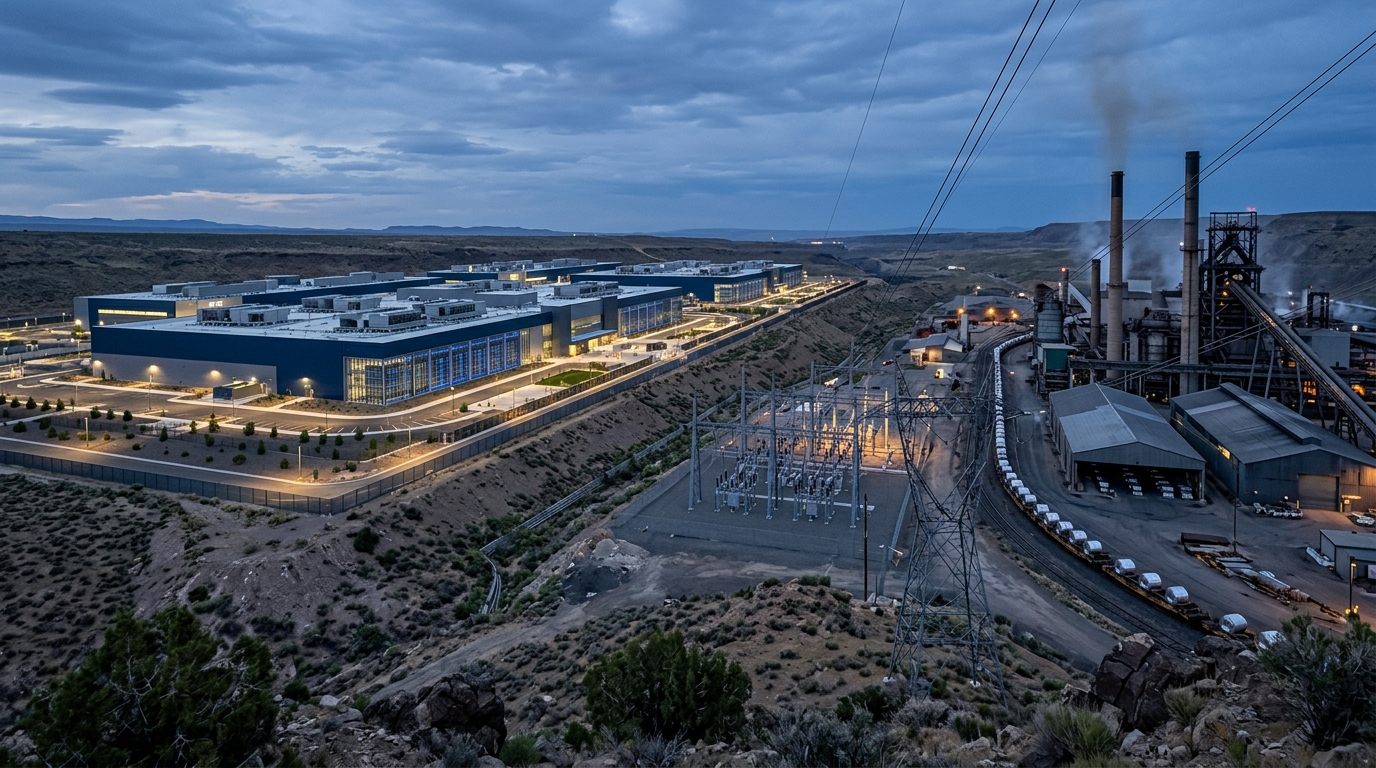
The strain extends beyond PJM. A domestic aluminum smelter requires a 10-to-20-year contract with electricity costs around $40 per megawatt-hour to remain globally competitive. Technology companies are currently committing prices that analysts and industry reports often place in the roughly $70 to $115 per megawatt-hour range for power tied to data center demand, depending on structure and location. That gap is not theoretical. Technology companies building data centers are willing to pay premiums for electricity, increasing costs for aluminum smelters. Industry analysts say these pricing pressures are causing some U.S. aluminum smelting companies to consider idling plants or even selling their locations to data center developers.
The Investment Opportunity
The power-hungry hyperscalers are reshaping where energy gets allocated, and the winners are the utilities positioned between the two sides of that trade. Vistra (VST) has moved decisively to lock in that position. In January 2026, Vistra announced 20-year power purchase agreements with Meta, supplying a total of 2,609 MW of carbon-free power and capacity from its PJM nuclear plants. In September 2025, Vistra also announced a 20-year PPA (with options to extend) with Amazon Web Services to supply 1,200 MW of carbon-free power from Comanche Peak in Texas. Constellation Energy, the leading operator of nuclear power plants in the U.S. with about 55 gigawatts of total generation capacity across its fleet, is pursuing similar deals.
The precious metals connection runs through the supply side of aluminum and copper. Aluminum smelting operations face energy cost pressures limiting domestic production capacity. Smelting requires approximately 12 to 15 megawatt-hours per tonne, with electricity representing 30 to 40 percent of smelting economics. Rising electricity prices have forced smelter closures in high-cost regions, constraining supply even as data center metals demand accelerates. Tighter domestic supply of these industrial metals historically supports prices for refined metals broadly, including the electrical components that miners and refiners depend on. Gold and silver refiners are not immune to industrial power market dynamics either.
Risks to Monitor
Amazon’s $1 billion community pledge could blunt some legislative momentum. President Trump has embraced the building of more data centers, but there is growing wariness from voters. Data Center Watch counted 843 opposition groups spread across 49 states, and about 30 statehouses have introduced or adopted rules covering data center siting, electricity use, or water consumption. If moratoriums proliferate despite Amazon’s concessions, the AI buildout slows and the power-price pressure on industrial manufacturers eases. Conversely, if Amazon’s outreach succeeds and construction accelerates, the electricity squeeze on metals producers intensifies further.
The Federal Reserve Bank of Dallas has estimated that with data center demand expected to surge over the rest of the decade, wholesale power prices could rise dramatically in high-utilization scenarios, by as much as 50%. That is the scenario where smelter economics become genuinely untenable in high-cost states.
Bottom Line
Amazon’s community investment program is a political document as much as a philanthropic one. The underlying energy competition it is trying to defuse is real, and it is already altering the economics of domestic metals refining. Precious metals investors should watch industrial electricity markets not as a headline risk but as a slow-moving constraint on refined metal supply. When the cost of producing aluminum crowds out smelters from the grid, the downstream effects eventually reach every corner of the metals complex.