
New Digital System Threatens Your Money

The biggest financial shift in 50 years just accelerated.
If you have not seen how people are preparing for this, you should.
137 nations – nearly the entire world economy – are building digital currencies to replace the U.S. dollar.
China’s digital yuan processed $986 billion.
India’s digital rupee grew 334%.
The UAE’s Digital Dirham goes live this year.
Russia follows next year.
The most dangerous part is already active:
Project mBridge – a digital payment network that bypasses SWIFT and settles global transactions in seconds.
It cuts out the dollar.
It cuts out U.S. banks.
It cuts out America’s influence.
26 central banks are joining.
This is not a debate.
This is a replacement.
When the dollar loses demand…
markets shake.
purchasing power drops.
retirements take the hit first.
If you have not seen how people are shielding their savings, do it now.
The only assets not tied to this new digital system?
Gold and silver.
You can legally move part of your retirement into physical metals – tax and penalty free.
Here is the quickest way to get ahead of this:
Download Your Wealth Preservation Guide >>

This shift is already happening.
Do not let your savings be the last thing to adjust.

Congress Can’t Agree on Who Pays for AI Power. Your Electric Bill Might.
On September 30, the Senate blocked the Ratepayer Protection Act in a 57-43 procedural vote, three short of the 60 needed to advance. The bill had passed the House on September 16 by an overwhelming 417-3 bipartisan vote. For precious metals investors, the defeat matters less as a political story than as a signal: the question of who funds America’s AI-driven electricity buildout remains unanswered, and the costs are already landing somewhere.
The legislation would have directed states to consider adopting federal standards to ensure that the cost of electrical-grid upgrades prompted by data centers are carried by the large-load customers needing the extra power, companies like Microsoft and Amazon. The bill stopped short of mandating anything. State regulatory authorities would be required to begin formal consideration of the standard within one year of enactment and complete that consideration within two years, but the bill directed states to consider and decide whether to adopt the standard, rather than mandating that they do so. That voluntary architecture is precisely what sank it.
Democrats said the legislation does not go far enough to protect consumers from soaring electricity bills. Sen. Martin Heinrich introduced the competing GRID Savings Act, which would direct the Federal Energy Regulatory Commission to issue rules requiring data centers and other large-load electricity customers to pay for grid upgrades tied to their projects, a mandate rather than a suggestion. Republicans blocked that measure in turn, leaving both bills dead before the midterm recess.
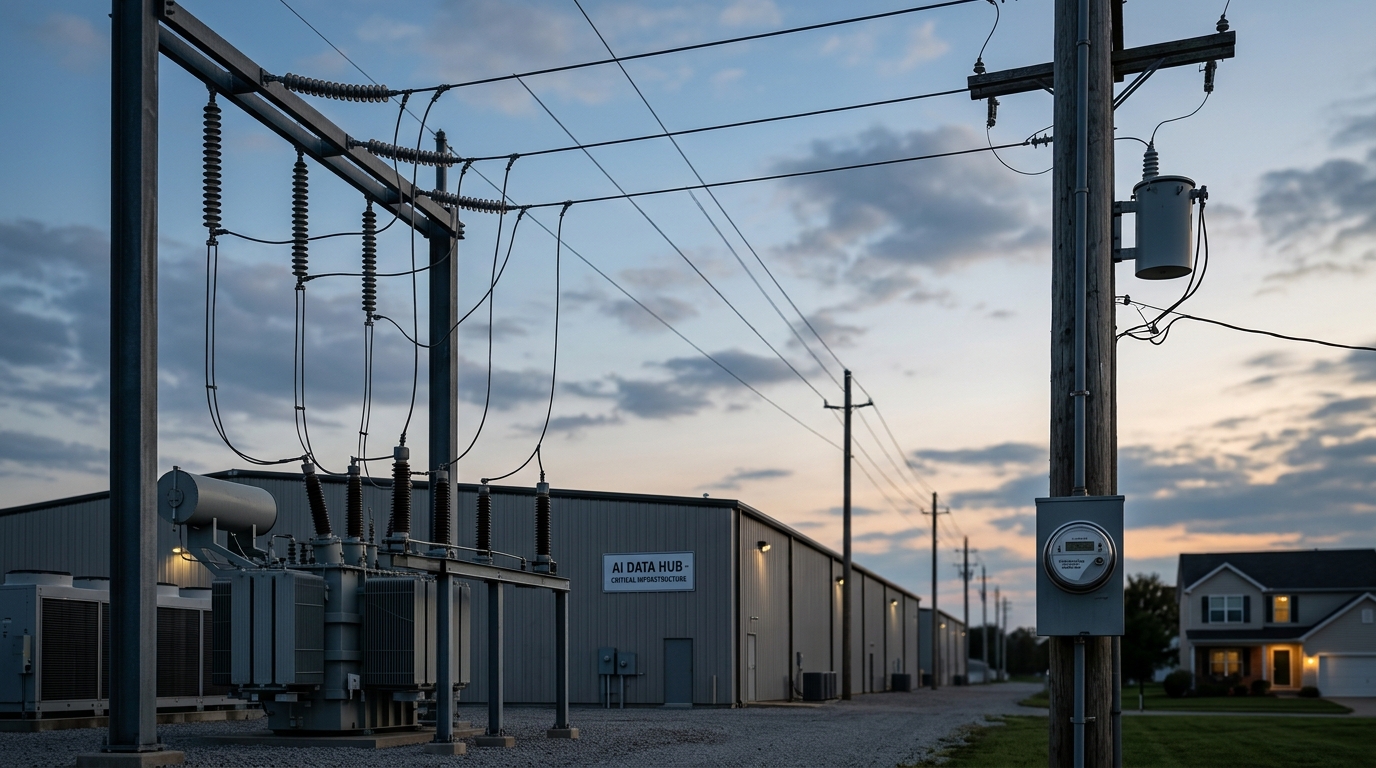
The stalemate arrives as grid costs are already rising sharply. A recent modeling study cited in a 2026 Congressional Research Service report found projected growth in data centers and cryptocurrency mining could increase national average electricity costs by 6% to 29%, with some regions facing up to 57% higher rates by 2030. To meet data centers’ energy demands, utility companies are pouring billions of dollars into building expensive new grid infrastructure, which is often funded upfront by utilities and later recovered through rates, spreading costs across customers in the region.
Utilities are not waiting for Congress. AEP’s Ohio utility pursued a specialized data center tariff that requires new large data centers to pay for at least 85% of their contracted capacity even if they use less, and the Public Utilities Commission of Ohio adopted a settlement in July 2025. In Virginia, the State Corporation Commission approved Dominion Energy Virginia’s 2026 rates that lift the average residential bill by about $11.24 a month, while also creating a new rate class for the biggest electricity users, including data centers. In Pennsylvania, PPL Electric reached a settlement in its rate case that regulators later approved in June 2026, and local reporting described it as the first time a Pennsylvania utility agreed to shield the average ratepayer from data center costs.
State-by-state patchwork is the predictable result when federal legislation collapses. For mining operations connected to the grid in data center-dense regions, that patchwork matters: a 2026 Federal Reserve Bank of Dallas paper found existing data centers have already increased wholesale power prices by roughly 3% to 5% nationwide on average, with much larger effects in corridors with heavy concentration, and it modeled scenarios where prices rise further as buildout continues. Energy is already the largest operating cost for most gold and silver miners connected to domestic grids, and a structurally higher rate environment compresses margins regardless of where metal prices trade.
The political calendar offers little relief. The Associated Press reported that Senate Republicans scheduled the vote to highlight the issue before leaving Washington to campaign. With both parties now pointing at the other’s bill as insufficient, the issue will land in the next Congress at the earliest. Until then, the burden-shifting question gets resolved utility commission by utility commission, state by state. That is a slower and less uniform outcome than either side claims to want.