
September 24, 2026
Politics turned a stable fertilizer supply chain into a commodity risk.
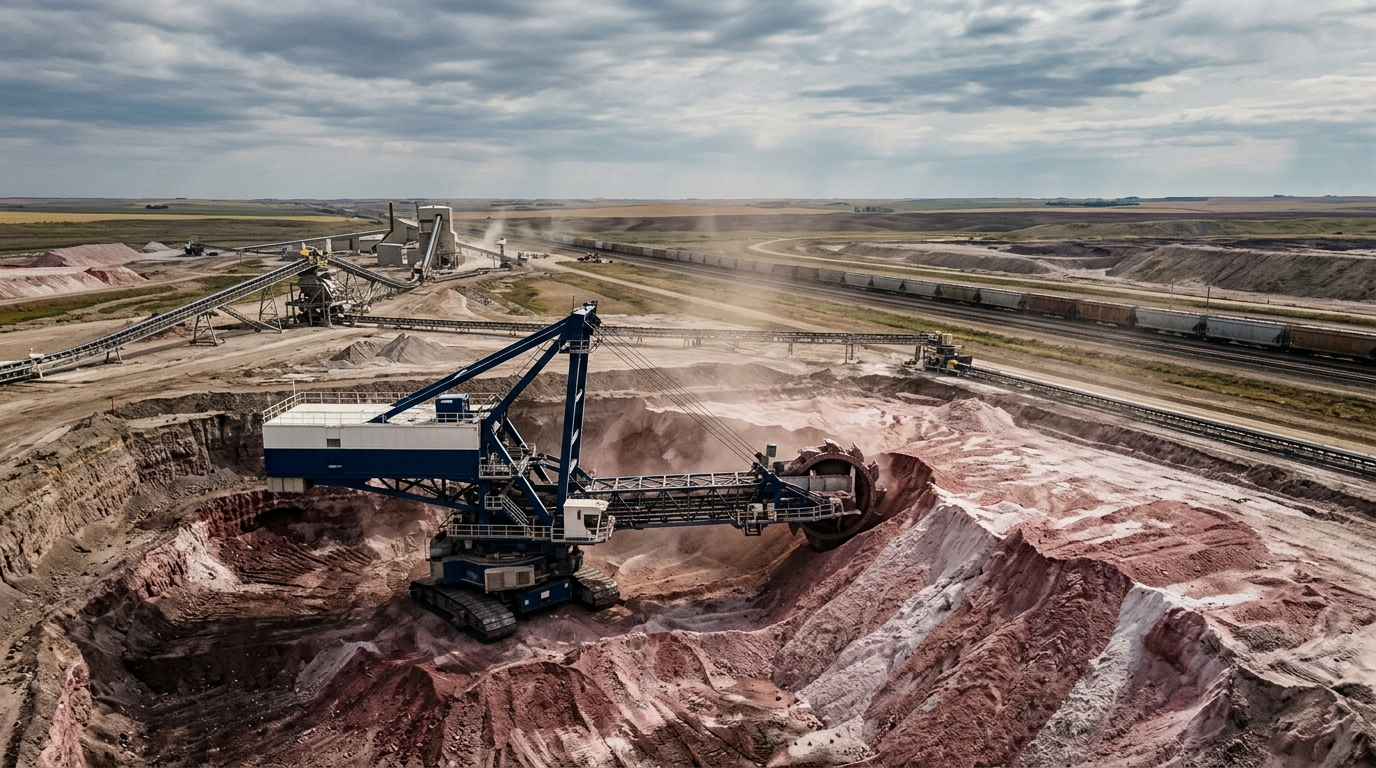
Potash has spent most of 2026 as the quieter corner of the fertilizer complex, spared the worst of the supply shock that hammered nitrogen and phosphate after the Iran war pinched Gulf logistics. That changed Monday when President Trump posted on Truth Social that the United States is working on a “massive Deal” to buy potash from Belarus at prices “substantially less” than it is currently paying Canada. Nutrien fell more than 3% that afternoon. Mosaic dropped more than 5% at one point before partially recovering. The market moved on a social media post, not a signed contract, which tells you something important about how politically exposed this commodity has become.
The Playbook Every Options Trader Should Have!
Do you dream of retirement but it seems like an impossibility? Wish you knew the best moves to get you there sooner?
It’s closer than you think and you won’t have to work overtime to get it!
Hi! I’m Dave Aquino, expert options trader and my e-book, “How To Master the Retirement Trade” has helped thousands reach their goals!
Follow the link to get your copy and see what you’ve been missing!
Canada supplied roughly four-fifths of U.S. potash imports in recent years, and the U.S. remains heavily dependent on imported potash overall. Domestic U.S. potash production is limited, and industry and policy analyses have said building meaningful new capacity typically takes years, not months. That structural dependence is what gives the White House leverage over Ottawa, and it is also what makes any quick Belarus substitution implausible on purely physical grounds.
Belarusian President Alexander Lukashenko has signaled interest in expanding economic ties with Washington, but public reporting has also noted the basic constraint: Belarus cannot quickly redirect large volumes to the U.S. while serving existing customers. In 2022, sanctions and the loss of the country’s main export route through Lithuania sharply disrupted Belarusian potash shipments. Belarus has since leaned more heavily on rerouted logistics, including shipments through Russia and increased focus on Asian demand, but those routes are longer, more expensive, and politically exposed.
Even though the United States has eased sanctions affecting Belarus’s potash sector, the European Union has not. Lithuania has repeatedly said it sees no reason to allow Belarusian potash to resume transiting through Klaipeda, the major port that historically served as Belarus’s main export corridor. Without that Baltic corridor, Belarusian tonnes bound for the U.S. Gulf Coast face more complex and politically sensitive logistics.
SpaceX S-1 Filing Reveals Elon’s Hidden AI Master Plan
Wall Street completely missed the most important part of the largest IPO in history.
Buried inside the S-1 filing is something that could be worth far more than the entire rocket business – unlike anything we’ve seen before.
Rob Spivey – whose institutional research is followed by Goldman Sachs, JPMorgan Chase, BlackRock, and Fidelity – just went on location at SpaceX’s Starbase HQ to reveal everything he has discovered about Elon’s hidden master plan.
The last time Wall Street missed a story this big, early investors had the chance to turn every $1,000 into $14,000.
Get the name and ticker of the No. 1 stock at the center of it FREE (not Tesla or SpaceX).
This is where the parallel to sanctioned metals markets becomes instructive. When market access is constrained by policy, the market often adjusts on uncertainty before volumes move. Russian palladium, which accounts for roughly 40% of global mine supply, has repeatedly shown how concentration and geopolitical risk can swing prices quickly. Potash is following the same political logic: because supply is concentrated and demand is inelastic at planting time, even modest tariff shifts can ripple through fertilizer prices, farm budgets, and commodity markets.
Trump’s proposed “massive” potash deal with Belarus rattled fertilizer stocks, but analysts have said limited supply and costly export routes make Belarus an unlikely threat to Canadian producers. Belarus could resume supplying some potash to the U.S. as relations between Washington and Minsk thaw, but those tonnes would likely trade near prevailing market prices rather than at deep discounts, analysts have said. The first 30,000-tonne Belarusian cargo expected at New Orleans in October is a sliver of annual U.S. imports.
Trump’s push to tout U.S. talks with Belarus underscores the pressure from American farmers, who have been hit by higher diesel and fertilizer costs linked to the Iran war. A Farm Bureau survey in April 2026 found that 70% of farmers said fertilizer was so expensive they would not be able to buy all the fertilizer they needed, a figure that captures the political stress even if the Belarus supply solution is not.
5 Little-Known Stocks Behind Today’s Defense Tech Shift
Behind the headlines, a major transformation is underway.
Modern warfare is being driven by AI, autonomous systems, and next generation technology. A handful of lesser known companies are helping power this shift.
This report uncovers five stocks quietly playing a critical role in the future of defense.
For precious metals investors, the relevance is direct. Gold has repeatedly benefited when commodity supply chains fracture along geopolitical lines, as capital rotates toward assets that sit outside the reach of sanctions and retaliatory tariffs. Potash prices remain well below the crisis highs of 2022. If the Canada-U.S. trade fight deepens and Canada escalates with measures that directly affect fertilizer flows, the inflationary shock to farm input costs could arrive alongside already-elevated diesel and nitrogen-related costs.
The Belarus potash deal is almost certainly more leverage than logistics. Reuters reported that, asked Tuesday at the United Nations about the potential deal, Trump said the U.S. would continue buying from Canada but that Belarus would like to sell at a lower price. That clarification did not erase Monday’s stock declines. When sanctions and politics set the price of a commodity that farmers cannot skip at planting time, the price of hard assets that governments cannot decree away tends to follow.