
September 24, 2026
Bonus Content: Utilities Are Making Data Centers Pay. What It Means for Investors.
Dear Reader,
Billionaire Sam Altman recently made an extraordinary admission.
“I basically just took all my liquid net worth and put it into these two companies.”

This was not a casual investment.
Altman, CEO of OpenAI – creator of ChatGPT – placed nearly everything he could readily access behind a new, emerging field…
A new fusion with AI and another branch of science…
One Elon Musk himself said is capable of “Jesus level miracles.”
See, Elon was not finished with Space X. He has been quietly building yet another company – in this field…
And like all other investments before it…
Tesla, OpenAI, SolarCities, and PayPal…
Elon enters a new space…
Then capital floods in and new investment opportunities appear around him.
Former Fox Business analyst Matt McCall calls this pattern the “Musk Stampede.”
Elon innovates…
Capital floods in…
And dozens of new opportunities are created.
So what is Elon building now?
And how could ordinary investors take advantage of the opportunity developing around it?
Matt recently sat down with former Fox anchor, Corrina Sullivan, to share his findings.
Click here for the full presentation.
To your wealth,
Stephen Prior, Publisher
Monument Traders Alliance
P.S. A fast approaching catalyst beginning November 14th could bring this emerging field much closer to the mainstream.
Utilities Are Making Data Centers Pay. What It Means for Investors.
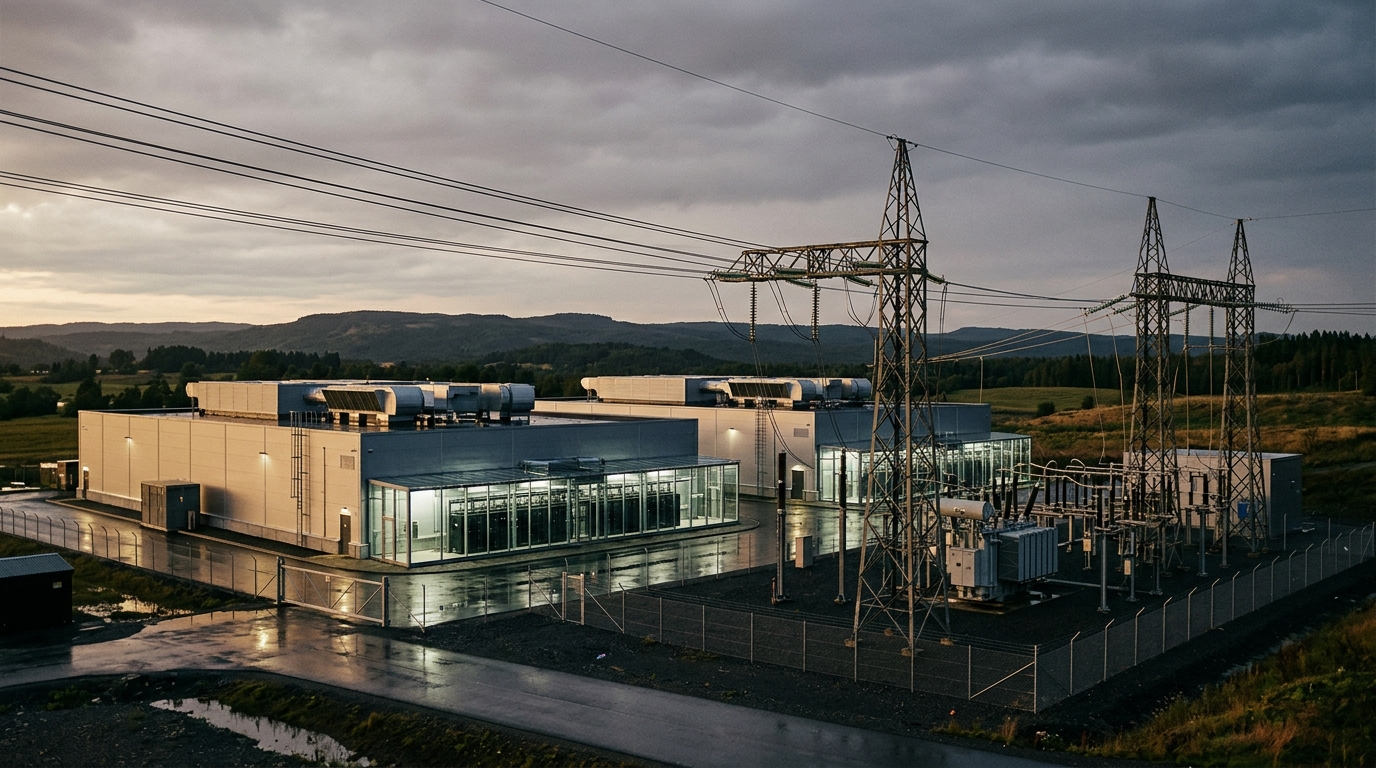
A question that has shadowed every large utility’s earnings call for two years is finally getting a regulatory answer: who pays when a data center doubles a grid’s load? This week produced two concrete templates, and they matter far more to energy investors than any single quarterly result.
Pacific Power, Oregon’s second-largest investor-owned electric utility, is in an Oregon Public Utility Commission proceeding that is still working through how the state’s POWER Act will apply to PacifiCorp’s Oregon customers. The broad direction is narrow but pointed: Oregon’s monopoly electric utilities must create a separate rate class for large energy users such as data centers so other customers are not subsidizing the massive energy demand from the server farms.
The context behind that designation is hard to ignore. Portland General Electric customers’ bills are up nearly 50% over roughly the last five years, according to analysis cited by Oregon Public Broadcasting. In that same period, data center load has surged, and recent reporting has put operating data centers at roughly 23% of statewide retail electricity sales in 2025. That combination, rising bills for households alongside explosive growth from a single sector, has made cost allocation the defining political fight in utility regulation across the country. Oregon just drew one of the clearest lines yet.
That line is also being enforced through contract structure. Oregon regulators have emphasized tools that protect other customers from stranded-cost risk when very large loads come and go, and the Commission has been explicit that large-load issues are now central to multiple investigations. The takeaway for investors is not one particular contract term, but the direction: the state is building guardrails so large-load customers are less able to socialize the costs of growth onto everyone else.
Pacific Power is a subsidiary of Berkshire Hathaway’s PacifiCorp. The Oregon process lands in the same week that Southern Company’s Georgia Power subsidiary and Google announced an agreement tied to nuclear uprates at Plants Vogtle and Hatch. Georgia Power said Google’s subscription under a new NU-1 tariff would support uprates on Georgia Power’s owned portion of those nuclear units that add about 96 megawatts of capacity to the grid, and that the arrangement is expected to produce approximately $900 million in projected customer benefits over the life of the units. Georgia Power also said the deal is subject to approval by the Georgia Public Service Commission, and that the structure is designed to shield non-participating customers from the incremental costs of the uprate work.
Two deals, two structures. Oregon is pushing toward full cost attribution via a separate rate class for large data centers. Georgia is using a subscription tariff where the hyperscaler funds the upgrade and receives the zero-emission credits tied to that incremental nuclear output. Neither model is identical, but both point in the same direction: large-load customers bear their own infrastructure costs. That removes a major regulatory risk hanging over utility capital programs tied to AI demand.
For investors, the implications run across the sector. Utilities with large data center pipelines and jurisdictions moving toward cost-of-service ring-fencing, think American Electric Power, Dominion Energy, Constellation Energy, and Vistra, face a cleaner regulatory path to earning returns on new generation and transmission investment. The overhang was always whether regulators would allow cost recovery. Oregon and Georgia just showed two ways that they might.
The Oregon Public Utility Commission has active dockets related to Pacific Power’s POWER Act compliance and large-load pricing, and timing depends on those case schedules and orders. The Georgia agreement still requires Georgia PSC approval. Neither outcome is certain. But the regulatory direction is clear enough that utilities building generation capacity to serve AI load are now arguing from a stronger position than they were six months ago.
The energy demand story and the precious metals story converge in one place: copper. Every gigawatt of new generation, every mile of transmission built to serve these facilities, requires copper wiring, transformer windings, and busbars. A regulatory framework that accelerates utility capital spending is, at the margin, a demand signal for industrial metals. Investors tracking the broader commodity cycle should keep one eye on how quickly these deals replicate across other states.