
For two decades, the conventional wisdom on Google was simple: it earned its 90% search market share by being the best product. That story turns out to have a second chapter that regulators have now forced open.
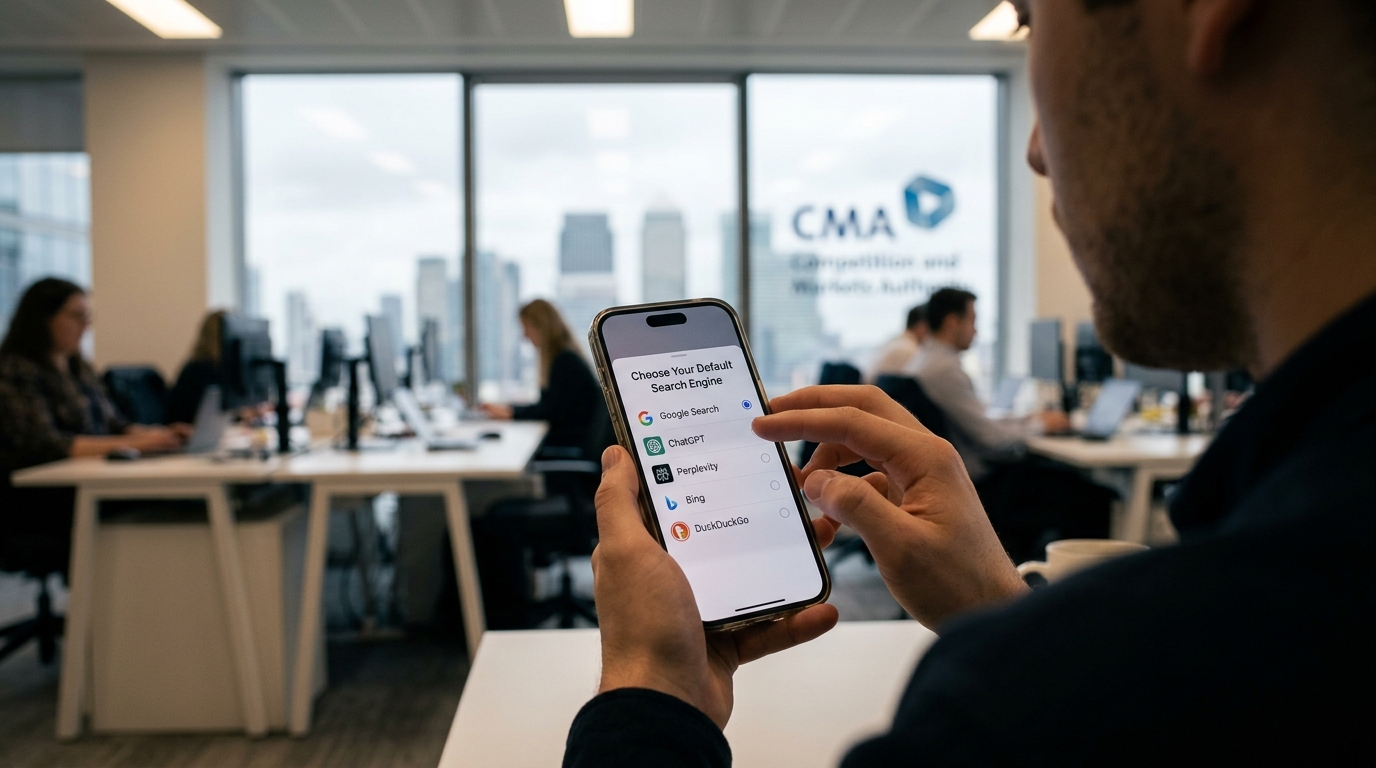
The UK’s Competition and Markets Authority published strengthened proposals on September 23, 2026. The rules would require Google to show users a choice of search providers when they first set up an Android phone or open Chrome, prompt them once a year to pick a default, and allow AI-based services that meet technical and security criteria to appear on those screens. Products such as ChatGPT and Perplexity, which today have no slot on the Android or Chrome choice surface where Gemini sits, would qualify if they meet the regulator’s criteria.
The market answered immediately. Alphabet fell 3.73% on September 23. In the same session, Meta rose 1.99% and Microsoft added 0.34%. That divergence is instructive. Investors were not selling “big tech”; they were selling the specific piece of big tech whose economics depend on users never being asked to reconsider their defaults.
Here is the question every long-term investor must now sit with: was Google’s moat ever really about search quality, or was it always about being the answer before the question was asked?
Chrome commands about two-thirds of global browser market share and Android holds roughly 70% of the smartphone OS market, feeding first-party data into Google’s targeting infrastructure. The structural risk sits in the distribution agreements: if Google can no longer secure default placement on iOS or Android OEM devices, the roughly 90% all-device search market share held together partly by those deals begins to erode. The CMA’s annual re-prompt is a direct hit to that mechanism, not in the US yet, but regulators coordinate, and the UK precedent rarely stays local.
The revised draft is notable for how it redraws the boundary of what counts as a search service. The regulator says the line between conventional search engines and AI-based services is now increasingly blurred. That framing matters enormously. For years, Google argued that ChatGPT was not a search competitor. The CMA just disagreed in terms that would carry force in the UK if adopted.
The yearly re-prompt matters most because defaults tend to stick, and people never revisit them without a prompt. An annual nudge gives users a regular moment to switch without digging through settings. That behavioral mechanic is precisely what Google has monetized. In Alphabet’s Q2 2026 results, Google Search and other revenue was $63.3 billion out of $119.8 billion in total Alphabet revenue, about 53% of the company. An erosion in query volume does not need to be dramatic to be devastating to margins, because search advertising is a high-fixed-cost business where incremental queries are nearly pure profit.
The competitive pressure arrives as Alphabet directs record capital into data centers, raising its 2026 capital expenditure forecast to between $195 billion and $205 billion. Consumer agents capable of executing tasks directly challenge the ad auction model that generates the bulk of operating profit, and any indication that personal assistants can divert traffic from traditional query boxes forces investors to discount the margin profile of that massive spend.
None of this means Google collapses. In Q2 2026, Google Search and other revenue grew about 17% year over year. The business is generating cash at a rate that would have seemed fictional ten years ago. But the annual re-prompt is a structural change, not a cyclical one. It transforms Google’s Android and Chrome surfaces from a private distribution channel into a regulated utility, one where OpenAI and Perplexity can compete for attention on the same screen once a year, every year, so long as they meet the CMA’s criteria.
The consultation closes October 9, 2026 with a final decision expected by year-end, building on the strategic market status designation granted on October 10, 2025. Between now and that decision, the most important question is not whether Google’s search engine is better. It almost certainly still is. The question is whether “better” wins when the default is removed.
History suggests it does not always. The greatest moats are invisible until a regulator makes them visible. This one just became very visible.