
Tuesday’s ISM number settled one argument and started a worse one. Manufacturing activity expanded in August for an eighth consecutive month, with the PMI registering 54.6. The Chicago PMI scare was a false alarm. The relief lasted about an hour.
The Prices Index held at 71.1, matching July exactly, while New Orders fell to 53.7 against an estimate of 56.8, and Employment dropped to 51.2 from 52.8. A headline that says “expansion” is not wrong. But it hides a sub-index mix that is pointing in the wrong direction on every dimension the Fed cares about: costs rising, orders softening, hiring decelerating.
Then Fed Governor Michael Barr showed up. In a March 26, 2026 speech at the Brookings Institution on the economic outlook and monetary policy, Barr said the Fed should be prepared to act if inflation does not cool, though the prepared text does not include the quoted line, “If inflation appears not to be moderating sufficiently, then I think we should act decisively to raise rates.” As a governor, Barr is a permanent voting member on the rate-setting Federal Open Market Committee. That is not a dissenter warning; that is a principal.
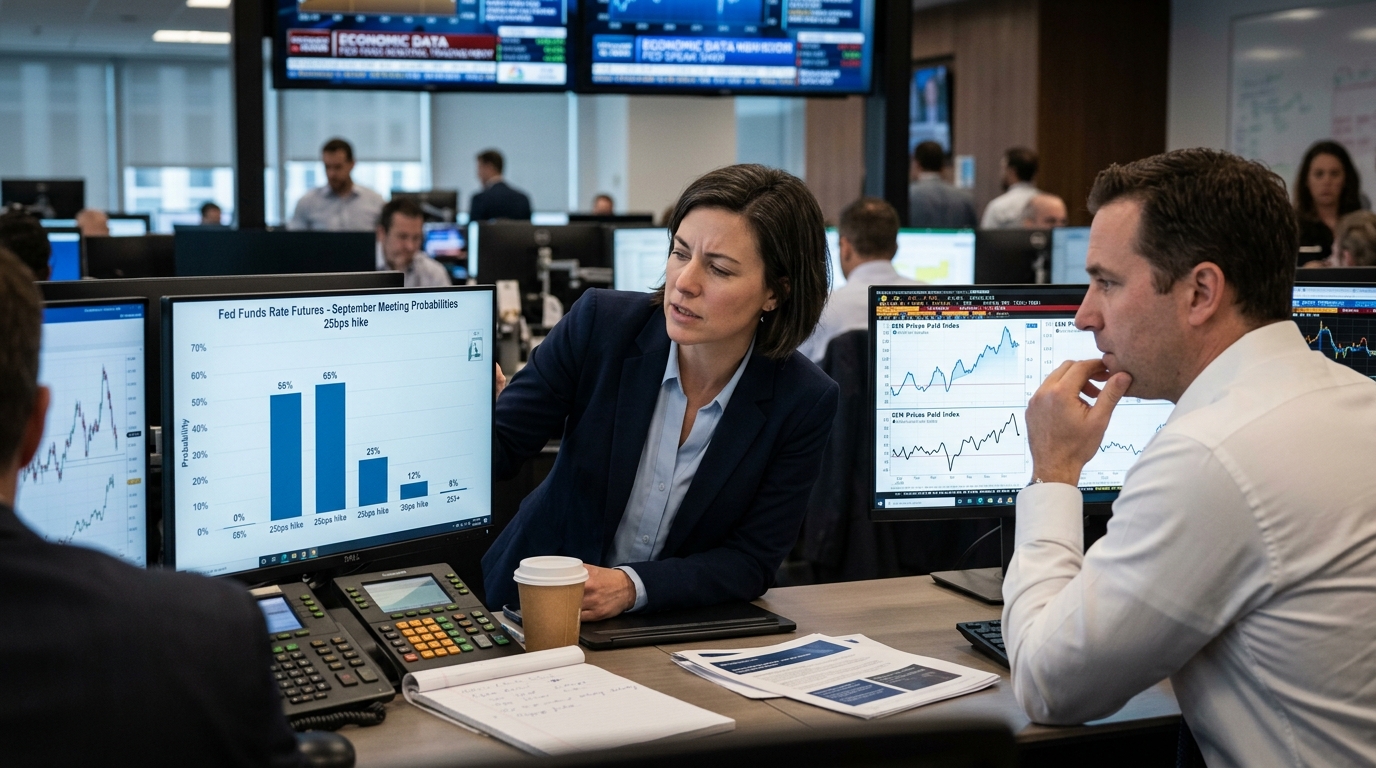
Market odds of a September hike moved to about 66%, up from about one in three before Chair Kevin Warsh’s Jackson Hole speech on August 28. The Fed will get two more readings on consumer and wholesale inflation before the September 15-16 meeting. Unless those data points arrive cold, the market is not going to walk those odds back.
What the Rate View Means for Cyclicals
This is where traders need to be honest about positioning. Progress on inflation from a peak above 7% in 2022 had stalled in 2025, driven by tariff pass-through, conflict-driven energy costs, and the rapid AI investment buildout. The Fed’s preferred gauge, PCE, stood at 3.7% year-over-year in July 2026, with core PCE running at 3.3% annually. A Prices Paid index of 71.1 that refuses to move tells you the pipeline is still full.
The sectors that feel a rate hike first are the ones most leveraged to cheap debt and consumer borrowing. Financials are highly sensitive to interest rate changes, and interest rate cuts were more widely expected at the start of 2026, but expectations have recently shifted toward a potential rate hike. The softening in consumption introduces a more challenging environment for sectors sensitive to household spending, and the risk is now skewed toward delayed rate cuts, limiting support for rate-sensitive, cyclical sectors such as Financials and Real Estate.
The Industrials Problem
XLI deserves a close look before anyone adds to it here. Powered by GE Aerospace and Caterpillar, which together comprise roughly 13% of XLI, the sector has traded lower intraday in nine of the last 10 sessions. That deterioration was already visible before Barr’s remarks landed.
Caterpillar is the complication. The stock has seen a massive valuation gain as the market priced in potential sustained sales tailwinds tied to artificial intelligence, pushing it from a relatively low-risk blue chip to far more growth-dependent valuation levels. The company anticipates full-year 2026 tariff costs of around $2.2 billion, after previously flagging a higher range. A rate hike compresses the multiple on a stock already priced for perfection and simultaneously raises its customers’ borrowing costs on equipment financing. That double squeeze does not resolve quickly.
The Trading Plan
Two CPI and PPI releases arrive before September 16. Those readings, not today’s ISM detail, will determine whether Barr votes to hike. Barr has stressed a data-dependent approach and has not tried to pre-commit to a specific September move. That gives traders a narrow window.
The thesis for avoiding XLI and rate-sensitive cyclicals strengthens if core CPI comes in above 0.3% month-over-month. It weakens materially if both inflation reads surprise to the downside. Do not own the cyclicals that depend on cheap financing into that binary. The ISM was not the problem. The 71.1 that sat unchanged beneath it is.