
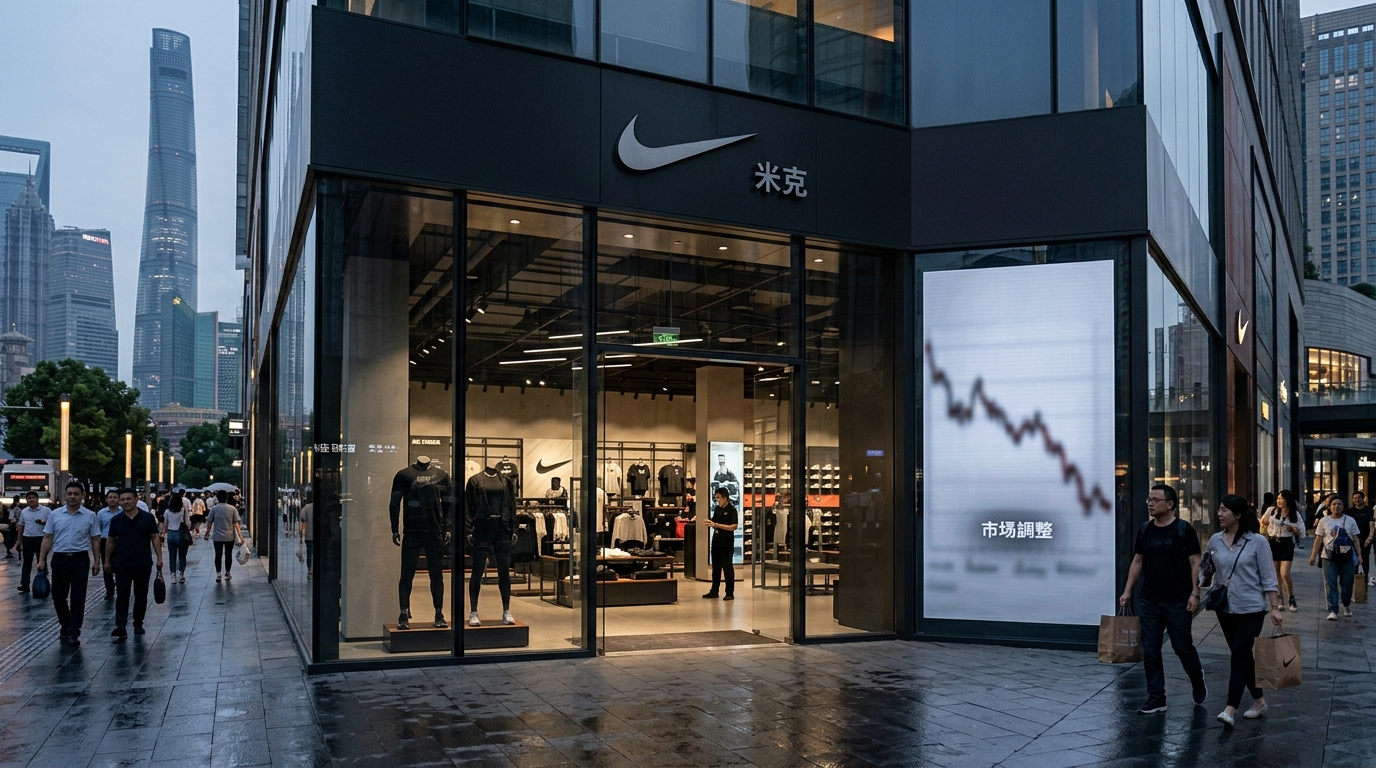
Today Nike hit a fresh 52-week low. The stock closed below $40, a level it last traded at in September 2024, and is now down roughly 78% from its 2021 all-time high. The trigger was weak guidance from On Holding. The real problem is older, deeper, and frustratingly familiar.
The Big Question
Institutional investors have spent the better part of two years debating whether Elliott Hill can execute a turnaround. That debate has been framed largely around timing: how many quarters until China stabilizes, when does Converse find a floor, when do North American margins recover. The question almost nobody is asking is whether the turnaround itself is structurally sound, or whether Nike is importing the same distribution logic that caused the original collapse into its fourth-largest market.
Why Wall Street Cares
Nike is down about 30% year to date as of late July 2026, and down roughly 43% year over year. That underperformance is not noise. Over the past year, NKE has fallen about 43%. For a stock that carries the weight of the Dow Jones Industrial Average and sits in virtually every consumer discretionary fund, that gap is increasingly hard to explain as cycle timing.
The earnings picture confirms the pressure. Nike’s Q4 revenues were $10.7 billion, flat on a reported basis, while NIKE Direct revenues were $4.1 billion, down 7% on a reported basis and down 9% on a currency-neutral basis. The headline gross margin looked strong at 49.2%, but a tariff recovery benefit drove essentially all of that improvement.
The Bull Case
The bull case is not imaginary. Nike Running delivered its fifth consecutive quarter of double-digit growth, adding roughly $1 billion over the past five quarters. Wholesale revenues grew 4% in Q4 fiscal 2026. CEO Elliott Hill bought about $1 million of Nike stock on the open market, the kind of signal that commands attention at any price.
Morningstar’s discounted cash flow model assigns a fair value of $94 per share, implying the stock could roughly double if the firm’s long-term assumptions on margins and revenue growth play out. The firm maintains a Wide Economic Moat rating on Nike, arguing that brand intangibles and global athlete relationships remain intact even if execution has faltered. At below $40, the patience-buyers see a franchise that survived far worse dislocations and emerged dominant.
The Bear Case
The bears are not just pointing at China. They are reading the China playbook and recognizing it.
Nike will terminate online sales of Nike products in mainland China through many partner-operated digital storefronts effective January 1, 2027, consolidating digital sales to Nike-owned channels and Nike flagship storefronts on Tmall, JD.com, and Douyin. Topsports, Nike’s largest Chinese retail partner, said the termination would have a significant negative impact on near-term results.
BNP Paribas analyst Laurent Vasilescu was direct: the China move echoes Nike’s earlier pullback from North American wholesalers, which contributed to a loss of market dominance in that region. Nike spent years unwinding that DTC-first mistake in the U.S. Now the company is running a variation of the same logic in a market where the competitive threat is arguably more durable. Anta and Li-Ning are not budget knockoffs. They are culturally native brands that have won the affection of younger consumers.
The numbers behind the China deterioration are severe. Greater China generated $5.85 billion in revenue for fiscal 2026, with sales down 11% as reported. Within the Greater China segment, sales through NIKE Direct were down 11%, and footwear unit sales dropped 14%. The company has guided to continued pressure in fiscal 2027 as it works through assortment and channel actions, with management indicating these efforts will be a drag on revenue through fiscal 2027.
The Evidence
The pattern deserves careful scrutiny. In North America, Nike’s DTC-first pivot of the early 2020s pulled products from wholesale partners and concentrated distribution through owned channels. Nike’s DTC retreat created a vacuum. The athletic footwear market rewards incumbency and shelf space. The brands that filled Nike’s vacated shelf space built genuine consumer loyalty, strong sell-through data, and retailer prioritization that is now hard to displace.
The competitive damage is measurable. On Holding and Hoka have taken meaningful share in U.S. running and lifestyle, especially in premium price points. In Piper Sandler’s teen survey, On Running has climbed in footwear rankings and overtook HOKA in recent reads, signaling ongoing momentum with teens, including upper-income cohorts. At the New York City marathon finish line, Elliott Hill was there to meet the winners, but neither the men’s nor women’s race winner was wearing Nike. They were wearing Adidas and On.
Converse is a second front of deterioration with its own decision-point approaching. More than a year into Hill’s attempt to revive Nike, the Converse brand remains in free fall, with sales headed toward a 15-year low. Revenues for Converse in Q3 were $264 million, down 35% on a reported basis from $405 million in the same quarter a year earlier. Authentic Brands Group, the owner of Reebok and Champion, has expressed interest in acquiring Converse if Nike were ever to sell, though Hill has publicly rejected that path.
The Mavens’ View
Sophisticated investors are split in a way that reflects genuine uncertainty. On the bullish side, the running category momentum, North America wholesale recovery, and gross margin trajectory before tariff distortions are real. Those are not accidents. Hill’s wholesale rebalancing in the U.S. is working as intended.
The skeptical camp keeps returning to one concern: timeline. Efforts to clean up Nike’s assortment in China and drive full-price sales are expected to continue as a drag on revenue growth through fiscal 2027. That means the China headwind has at minimum a 12-month runway from today, and channel resets of this scale historically take longer than management guides. Goldman Sachs, JPMorgan, and Bank of America all downgraded the stock after the Q3 report, citing the dragging turnaround, growing headwinds, and dwindling patience.
Despite its underperformance, the consensus among analysts covering NKE is still a Moderate Buy, with a heavy concentration of Hold ratings. That distribution reveals a Street that believes recovery is possible but has no conviction on when.
What Investors Are Missing
The overlooked implication sits inside the China channel reset itself. Nike is betting that consolidating online distribution around its own platforms will restore pricing integrity and margin quality. That logic is defensible in isolation. But the underlying China demand problem is not primarily a pricing or channel problem. Nike’s Greater China revenue fell 11% in fiscal 2026 amid intense competition from Anta and Li Ning. Removing distributor access does not generate consumer desire for the product. In North America, pulling shelf presence cost Nike years and meaningful share losses before the wholesale rebuild began. The China operation is starting from a weaker brand position than North America had in 2021.
The adidas recovery is the analog worth studying. Adidas has described a multi-year reset in China after prior declines, with a renewed emphasis on local relevance and distribution discipline. The lesson from that experience is not that channel resets work automatically. It is that they work only when paired with genuine product relevance and local cultural credibility. Nike has five consecutive quarters of running momentum. It does not yet have evidence it is winning back the younger Chinese consumer who has migrated toward local brands.
The second underappreciated risk is what happens to Nike’s earnings base if Converse requires restructuring charges beyond what management has already outlined. BNP Paribas analyst Vasilescu wrote that the hope for $3 in earnings per share by fiscal 2028 looks increasingly unlikely. If that EPS path is impaired, the DCF math supporting Morningstar’s $94 fair value collapses. The $39 level starts to look less like a floor and more like a transit point on the way lower.
Stocks to Watch
Nike (NKE) is the center of the debate. The bull case requires Hill’s Sport Offense framework to deliver North America product wins in the back half of fiscal 2027, Greater China to stabilize, and gross margins to normalize once tariff-related benefits roll off. The next major read is Q1 fiscal 2027 earnings, likely in late September or October. Any deterioration in the China stabilization timeline will test whether $39 holds.
On Holding (ONON) is the immediate beneficiary of Nike’s structural weakness. On Holding’s results and outlook were cited broadly as a read-through for premium running demand, and any guidance disappointment tends to drag the category. On’s guidance miss dragged the entire athletic category lower, but the firm is still taking running share where margins are strongest.
Deckers Outdoor (DECK), parent of Hoka, is growing running revenue at double digits while Nike’s DTC channel contracts. Hoka’s position in both performance and lifestyle running has benefited directly from the shelf space Nike vacated during its DTC years. The stock is nearly flat year to date while NKE is down about 30% year to date, a relative valuation gap increasingly difficult to ignore for sector investors.
Topsports International is the least-discussed stock in this entire situation. Shares of Topsports fell sharply on the news of Nike’s China channel restructuring. If the reset works, Topsports recovers its offline franchise with improved product quality and pricing integrity. If it fails, Topsports is the collateral damage of a strategy error it had no role in creating. That asymmetry is worth tracking over the next two quarters.
Authentic Brands Group, were it ever to acquire Converse, would represent the most interesting optionality in this story. For Authentic Brands, Converse would fit into a model based on acquiring global brands and reactivating them through licensing, operating partners, and new commercial agreements, the same logic applied to Reebok when acquired from Adidas. Nike is not selling today. But at some price, in some quarter, that calculus may change.