
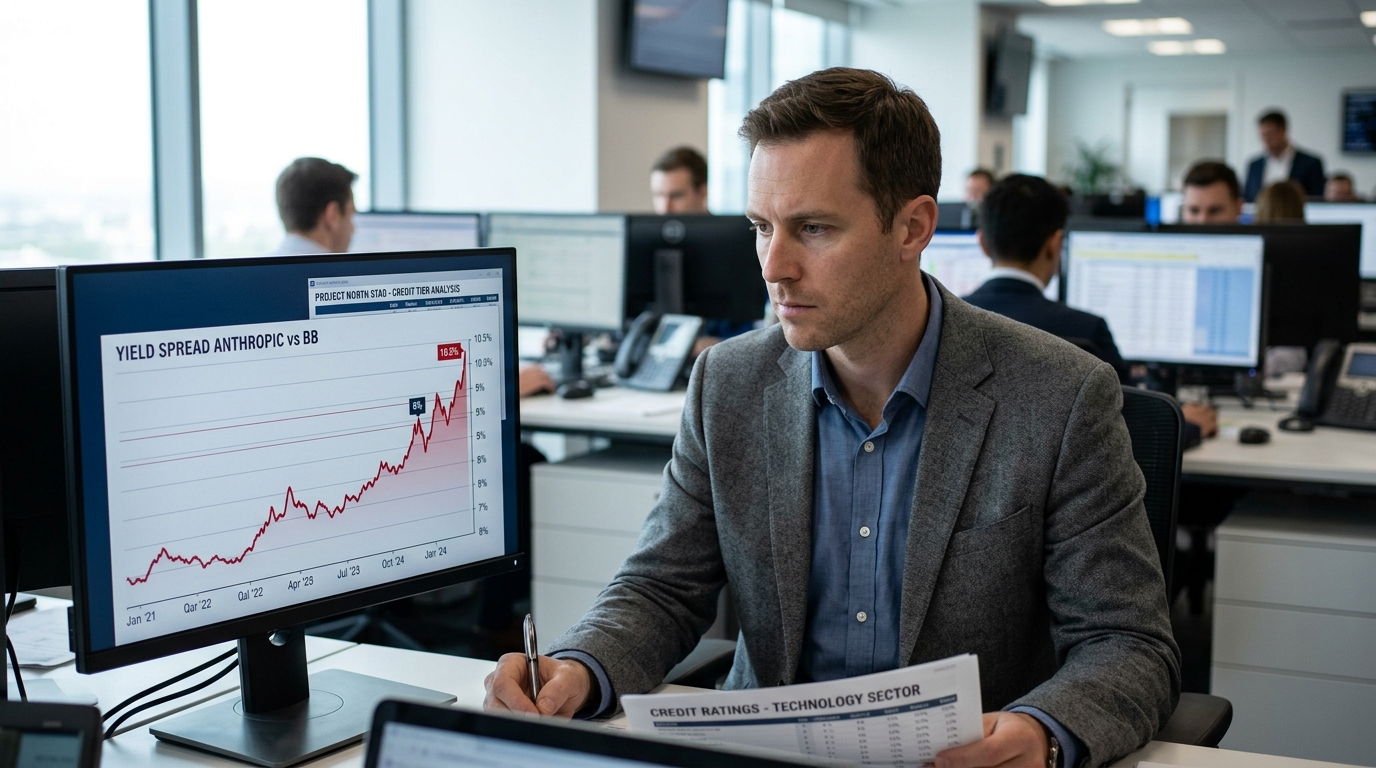
The headline number from Friday night’s Financial Times report is $60 billion. The number that matters more is three: the percentage points separating what Anthropic is paying today from where it wants to be.
Anthropic has offered Blackstone a coupon above 10% on $9 billion of the $18 billion junior tranche in its Project North Star chip financing, the Financial Times reported, citing people familiar with the negotiations. The $42 billion senior tranche covers roughly one-third of the $125.2 billion Anthropic has committed under a five-year Google TPU lease, with about 3.5 gigawatts of capacity expected online starting in 2027.
That 10% figure is not just a negotiating datapoint. It is a pricing trail that reveals exactly how much Anthropic’s BB+ credit rating is costing it in real money.
Three Deals, Three Prices, One Direction
The earlier $35 billion chip financing led by Apollo raised about $4.5 billion in junior debt exposed to Anthropic credit risk at an 8.5% coupon, with senior debt carrying a 5.75% coupon, according to deal terms reported at the time. Similarly rated issuers in the public market pay around 7%, based on the ICE BofA BB US High Yield Index. Project North Star’s junior tranche is now coming at 10%. In four months, Anthropic’s private market borrowing cost on subordinated debt has climbed about 150 basis points while the public BB index has stayed roughly flat. The direction is wrong for a company trying to build toward investment grade.
The private credit market governing these rates is itself under strain. Rising default rates and widening spreads in direct lending are pushing private lenders to demand more premium on subordinated debt.
The transaction highlights the challenge for the five-year-old company as it works toward an investment-grade rating. An investment-grade rating can lower borrowing costs and allow a company to raise funds from a wider set of institutional investors, including life insurers and pension funds. Those buyers generally cannot touch BB+ paper. They represent the lowest-cost capital available at scale, and Anthropic is currently locked out.
A Rating Built on Incomplete Disclosure
KBRA used a risk score rather than full financial models; Anthropic supplied Q1 2026 revenue, adjusted operating income, annualised run-rate, and an internal Q2 forecast, but not free cash flow or EBITDA, so analysts estimated those. For a borrower raising tens of billions, that is a thin disclosure file. The stable outlook on the BB+ rating signals KBRA sees a path upward, but a path is not a guarantee, and every quarter that Anthropic runs sub-investment grade is another quarter it pays a premium over where it wants to be.
Investment banks that support Anthropic and rival OpenAI have sought to persuade major credit rating firms to grant investment-grade ratings once the two companies list, according to reporting published this week. An IPO reportedly targeted for mid-November would force the kind of full financial disclosure that KBRA never received, and that disclosure is the fastest route to a rating upgrade. But the IPO has not closed yet, and Project North Star needs to be funded now.
Where Broadcom, Apollo, and Blackstone Sit
The structure extends an AI XPV partnership that Broadcom, Apollo, and Blackstone struck in June, which launched with an initial $35 billion transaction and the stated aim of enabling more than 20 gigawatts of AI compute deployments through 2028. Broadcom’s role as both chip architect and senior-debt guarantor gives it structural leverage that no other party in the transaction holds. Anthropic’s prospectus flags potential conflicts of interest in Broadcom acting as both chip supplier and financing partner.
Broadcom’s position in this structure is not incidental. Broadcom designs purpose-built accelerators for the world’s largest AI spenders and collects on both the compute layer and the network fabric.
The remaining $9 billion of the junior tranche is expected to be placed with a wider range of investors in coming months, potentially on less onerous terms, meaning the 10% Blackstone anchor rate may be the ceiling, not the floor, for the rest of the syndication. That is the one data point that could shift the cost trajectory.
Bottom Line
Compute is Anthropic’s competitive moat. But financing compute at junk-bond rates while chasing an investment-grade upgrade is a tension that compounds with every new tranche. The roughly 150-basis-point jump from June’s deal to today’s offer is not noise. It reflects private market lenders demanding more premium to sit behind Broadcom’s senior guarantee in a structure that is still expanding. Until Anthropic crosses the IG threshold, each successive chip deal sets a new and higher floor on what access to scale actually costs.