
Start with a number. Not a stock price. A distance.
Eight meters.
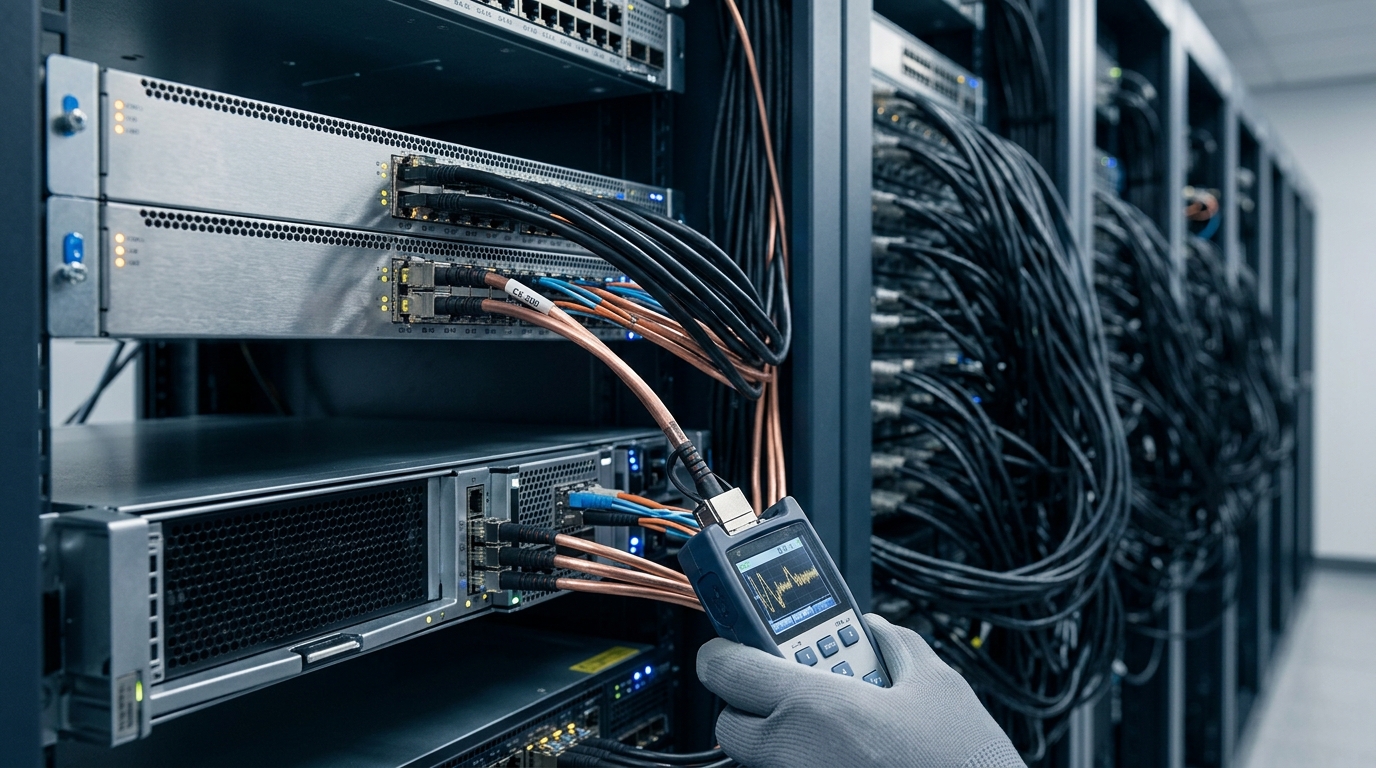
That is approximately how far a copper cable can carry data at 200 gigabits per second before signal integrity collapses. At 200 Gb/s per lane, copper’s physics becomes the limiting factor — traditional passive copper can no longer span beyond a single server rack and sometimes even within a rack at these speeds. Eight meters. In a data center that covers the footprint of three football fields, eight meters is almost nothing.
Here’s why that number matters right now.
The scale of AI training clusters is expanding at a breakneck pace, requiring an ever-increasing number of power-hungry GPUs. The GPT-3 model released in 2020 was trained on roughly 10,000 interconnected GPUs. Today, the industry is gearing up for clusters featuring hundreds of thousands or even millions of GPUs. Every one of those GPUs needs to talk to every other GPU. Constantly. At terabit speeds. And copper, the material that built every data center ever constructed, cannot do that job anymore.
This is not a software problem. It is not a chip design problem. It is a physics problem.
As generative AI models scale rapidly, the primary data-center bottleneck is shifting from transistor performance to interconnect bandwidth and latency. Jensen Huang’s widely cited framing argues that compute can compound through process scaling and 3D packaging, but chip-to-chip I/O does not scale at the same rate, creating an “I/O wall.”
The solution is light. Literal photons. Glass fiber instead of copper wire. Lasers instead of electrical signals.
This drives a structural transition: optics must move closer to the compute and switching silicon to reduce loss, power, and reach constraints. That shift has a name — co-packaged optics, or CPO — and it is moving from lab demos to actual deployments this year. High-speed Ethernet port shipments are projected to climb from 70 million in 2023 to more than 240 million in 2026. Modern GPU clusters now specify 200 terabits per second of east-west bandwidth, translating into installations that exceed 3,000 fibers per fabric link.
The scale of that number is almost hard to process. Three thousand fibers. Per single fabric link. In a cluster that has hundreds of such links.
The Part Nobody Is Talking About
When most investors trace the AI spending chain, they stop at the familiar names. GPU designers. Memory makers. Power transformers. Even water infrastructure has gotten its moment.
What rarely comes up is the company that makes the lasers and transceivers that actually carry the data — the photons moving between those hundreds of thousands of GPUs. The surge in optical module stocks reflects a deeper shift in AI infrastructure: the bottleneck is no longer computing power alone, but how that power is connected.
Slight tangent, but it matters: AI-focused hyperscale data centers require approximately 36 times more fiber than traditional CPU-based racks, according to STL’s CEO of Optical Networking. That multiplier is not a projection. It is an engineering requirement driven by how GPU clusters are physically architected. The fiber has to exist. And something has to generate the light that travels through it.
That something is an indium phosphide laser. And there is one company that makes more of them than almost anyone else on earth.
The Company
Coherent Corp (NYSE: COHR) does not have a household name. It does not make GPUs. It does not build data centers. What it does — quietly, in a factory in Sherman, Texas and elsewhere — is manufacture the optical components that allow AI infrastructure to function at scale.
Coherent develops, manufactures, and markets engineered materials, optoelectronic components and devices, and laser systems. It operates through three segments: Networking, Materials, and Lasers. The Networking segment offers transceivers, systems, subsystems, modules, components, optics, and semiconductor devices for datacenter and communications applications.
The business has been accelerating. In Q3 fiscal 2026, Coherent reported revenue of $1.81 billion, up 21.0% year-on-year. Datacenter and Communications segment revenue was $1.4 billion, up from $1.0 billion in the prior year period. Non-GAAP operating income was $366 million, up 31.1% year-over-year, and non-GAAP operating margin expanded 163 basis points. Non-GAAP net earnings were up 55.9% year-over-year, with diluted EPS of $1.41, up $0.50 year-over-year.
The forward picture is even more interesting. Revenue is forecast to grow 81% over the next two years. Earnings are forecast to grow 315% in the same period.
And then there is the NVIDIA signal.
NVIDIA and Coherent announced a multi-year strategic agreement to advance advanced optics technologies, including manufacturing capacity and research and development, to enable next-generation AI infrastructure. The agreement includes an NVIDIA multi-billion-dollar purchase commitment and future access and capacity rights for advanced laser and optical networking products. NVIDIA is investing $2 billion in Coherent to support research and development, future capacity and operations as Coherent builds out its U.S.-based manufacturing capabilities.
A $2 billion equity check from Jensen Huang is not a vote of confidence. It is a supply chain lock. NVIDIA needs these lasers. They need them at scale, for years, and they are paying to guarantee access.
The Backlog Nobody Is Reading Correctly
Coherent’s most recent quarterly report underscores durable momentum in AI datacenter optics, with bookings visibility extending through calendar 2026 and into 2027, and a rapid 6-inch indium phosphide manufacturing ramp that improves cost structure and supports a mix shift to higher-ASP 1.6 terabits per second products. Management pointed to sequential growth in the March and June quarters, alongside rising Optical Circuit Switch backlog and a landmark Co-Packaged Optics purchase order.
The company raised its view of the optical circuit switching market opportunity to more than $4 billion as use cases broaden across data center interconnect, scale-out, and scale-up networks. CPO remains a longer-cycle driver, with management sizing the incremental addressable opportunity at more than $15 billion.
That $15 billion CPO figure is not priced in. The market is still treating Coherent primarily as a transceiver company. The transceiver business alone is strong enough. The CPO transition is additive.
The Pull-Back Moment
Here is where it gets interesting. As of July 2, 2026, Coherent closed at $333.36. The all-time high closing price was $426.89 on June 2, 2026. That is a 22% drawdown in roughly a month — a stock off its highs on no fundamental deterioration, in a business posting accelerating revenue growth and a 4x+ book-to-bill in its core datacenter segment.
JPMorgan analyst Samik Chatterjee noted that shares of optical suppliers Coherent and Lumentum are trading down nearly 20% from their early June highs on a “host of concerns.” JPMorgan maintained its Overweight rating. BofA raised its price target on Coherent to $400 from $365 and kept a Neutral rating.
What caused the drop? Sector rotation, valuation anxiety, and the kind of profit-taking that follows a stock that has delivered a 372% change over the past year. The fundamentals did not change. The thesis did not change. The copper wall is still there.
The Structural Case
The reason this opportunity exists is that most investors are still mapping the AI trade through familiar lenses. GPU counts. Hyperscaler capex. Power consumption. Those are all real. But the second and third-order effects of scaling AI clusters to hundreds of thousands of GPUs are still being discovered.
The binding limits on AI infrastructure deployment are no longer concentrated in finished chips. They sit in the specialty gases used to etch wafers, the films laminating chip packaging, the passive components managing power delivery, and the optical networking components connecting those chips at scale. Optical networking lead times had stretched to 36-56 weeks. That constraint has a price — and someone collects it.
Coherent also signed a letter of intent for up to $50 million in U.S. CHIPS and Science Act funding to expand its 6-inch indium phosphide semiconductor facility in Sherman, Texas, aiming to double manufacturing space, quadruple wafer capacity, and add more than 1,000 jobs. Government-subsidized capacity expansion on top of a $2 billion NVIDIA supply agreement. The supply question is getting answered.
Bull / Base / Bear
Bull: CPO adoption accelerates into 2027 as NVIDIA’s next-generation rack architecture standardizes fiber inside the rack. Coherent’s $15 billion CPO addressable market starts contributing revenue. Earnings grow 300%+ over two years as guided. The $440 high is retested and broken.
Base: CPO timelines slip modestly but transceiver demand stays robust. Datacenter and Communications revenue continues at 20-30% growth. The stock re-rates toward the BofA $400 target as execution proves consistent.
Bear: A broader AI capex slowdown hits hyperscaler optical budgets. CPO adoption delays push out to 2028. The premium valuation compresses. Sector-wide reset concerns and policy risks such as tighter controls on indium-related exports limit how much investors are willing to pay for that growth.
What to Watch
The next quarterly report is the critical checkpoint. Watch datacenter segment book-to-bill — anything above 2x sustains the thesis. Watch CPO revenue recognition timing; the first commercial shipments will be the market signal that moves estimates. Watch indium phosphide capacity utilization at Sherman once the expansion completes.
Also worth monitoring: whether the broader optical sector re-rates alongside Coherent. Ciena’s Q2 fiscal 2026 results showed 40% year-on-year revenue growth driven by AI-led demand, with the addressable market projected to double to approximately $50 billion by 2029. A rising tide in optical networking confirms the structural demand is real, not company-specific.
The copper wall is not going away. It is getting worse the more GPUs get deployed. And the company that replaces it — one laser at a time — just handed investors a 22% re-entry from its all-time high.
The question now is whether that window stays open.
For informational purposes only.