
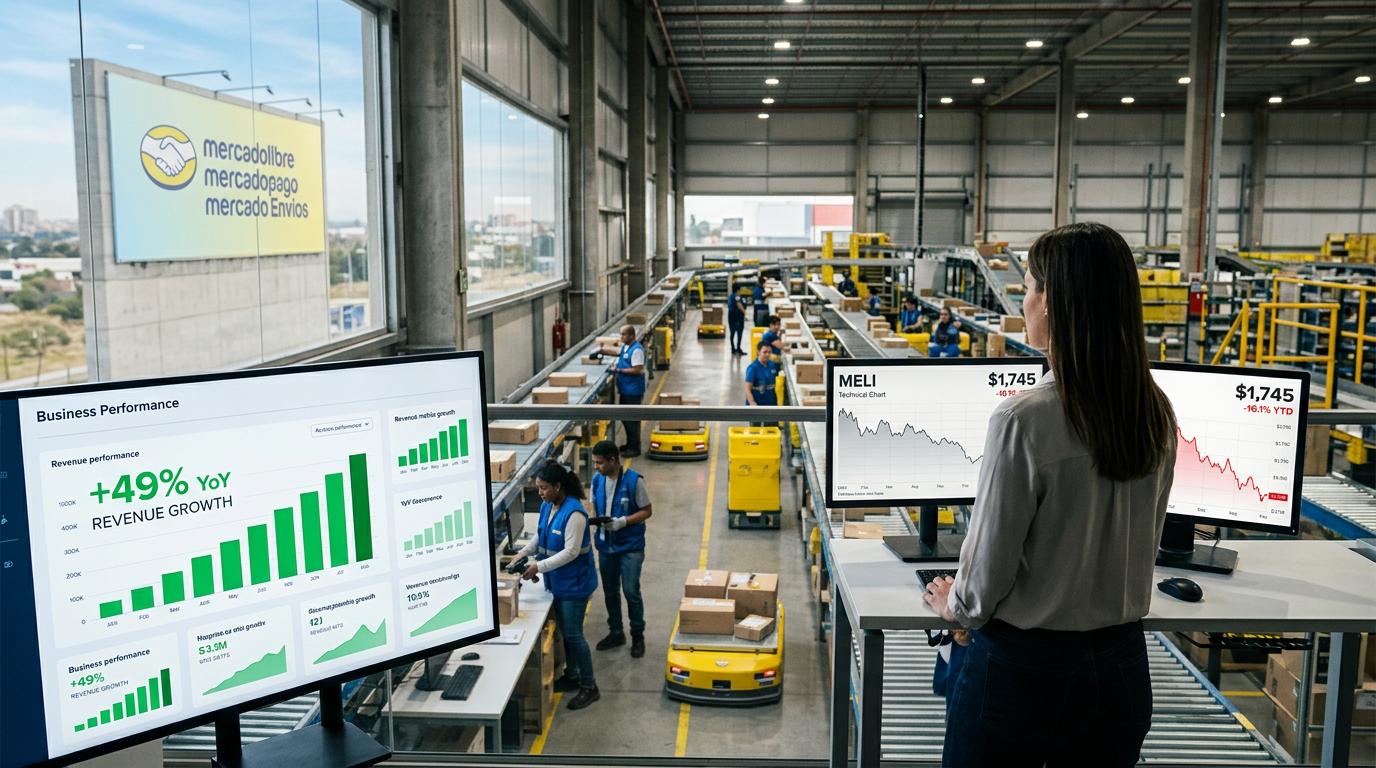
There’s a specific kind of market moment worth paying attention to. It’s when a business is doing its best work ever and the stock is going nowhere. Sometimes lower.
That’s exactly where MercadoLibre finds itself right now.
MELI is down roughly 16% year to date in 2026. Off about 35% from its 52-week high of about $2,615. Trading around $1,740-$1,780 as of early July. And sitting on Q1 earnings that showed 49% revenue growth year over year, the fastest pace of expansion in nearly four years.
Most companies would love that problem.
What the Numbers Actually Show
MercadoLibre reported Q1 2026 net revenues and financial income of $8.845 billion, up 49% year over year. Gross Merchandise Volume hit $19 billion, up 42%. Total Payment Volume through Mercado Pago reached $87.2 billion, up 50% year over year on a reported basis and 55% on an FX-neutral basis.
Brazil specifically is accelerating. FX-neutral GMV in Brazil grew 38% in Q1, up from 35% the prior quarter. The credit portfolio grew 87% year over year. Credit card monthly active users expanded 68% year over year. These aren’t metrics that suggest a business losing ground.
The stock got hit post-earnings because EPS came in at $8.23 versus the $9.37 consensus estimate – a miss of about 12%. Operating margins compressed to 6.9% as the company leaned into logistics spending, free shipping, credit card expansion, and promotional support in its core markets.
Management was clear about the trade-off. They’re choosing long-term market share over near-term margin. That’s a deliberate posture, not a sign of distress.
What This Business Actually Is
The part people often miss about MercadoLibre is that it’s not really a single company. It’s an ecosystem.
Mercado Libre is the marketplace. Mercado Pago is the payments and fintech platform. Mercado Envios handles logistics. Mercado Credito handles lending. Mercado Fondo handles investment products.
Each of these is growing independently. Together, they create a locked-in flywheel across Latin America’s most populous markets at a time when e-commerce penetration in the region is still materially lower than in North America or Asia. That gap is the opportunity.
Fintech assets under management grew 77% year over year in Q1. That’s not ad revenue. That’s financial infrastructure being built across markets where traditional banking has historically underserved large portions of the population.
The Valuation Dislocation
Here’s where it gets interesting. Over the past three years, MercadoLibre’s earnings per share has grown at roughly 35% annually on average. The stock has lagged that earnings growth significantly. Revenue is forecast to grow around 19% annually over the next three years, above the broader retail industry average.
The analyst consensus 12-month price target sits around $2,208-$2,216, implying roughly 25% upside from current levels. Benchmark maintains a Buy rating with a $2,380 target. Goldman Sachs has a Buy with a $2,100 target. The bears at UBS and JPMorgan have both trimmed targets but maintained relatively constructive ratings overall.
The near-term risks are real. Currency fluctuation across Brazil, Mexico, and Argentina creates earnings volatility. Margin compression may continue as the company keeps investing. Competition from global and regional e-commerce players is intensifying, especially in Brazil. And the earnings miss spooked short-term holders who had more optimistic expectations.
But here’s the part that sticks with me: a company growing revenue nearly 50% year over year and expanding its fintech footprint across a region of 650 million people doesn’t usually stay at a 35% discount to its recent high for long.
The stock is lagging the business. That kind of gap tends to close eventually. The question is whether you’re patient enough to be there when it does.
Full breakdown worth your time.
Disclaimer: This editorial is for informational purposes only and does not constitute financial advice or a recommendation to buy or sell any security. All data referenced is sourced from public filings, financial news, and market data as of July 4, 2026. Investing involves risk, including the possible loss of principal. Past performance is not indicative of future results. Always conduct your own due diligence before making investment decisions.