
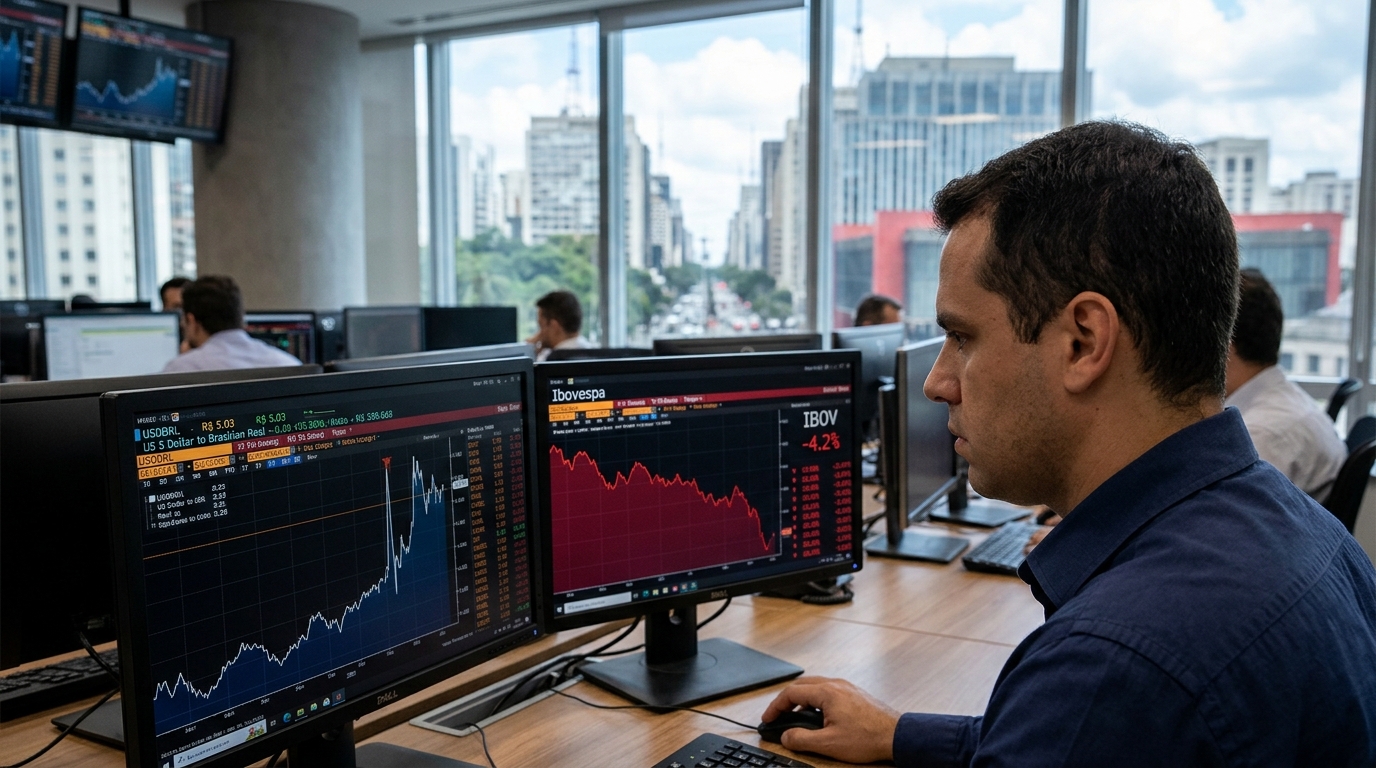
The most crowded trade in emerging markets just blew up. After losing the first round to Flávio Bolsonaro by 47% to 45%, Lula defied the odds to secure a second-round victory with 51.8% of the vote to Bolsonaro’s 48.2%. Prediction markets had priced the opposite. Dollar futures jumped about 10% and a Tokyo-listed Ibovespa fund fell more than 11% after Lula’s win was confirmed. By Monday morning, the real had closed Friday around R$4.97 per dollar and was still holding below R$5.00 in early Monday trading, a narrower dislocation than futures implied but still the most significant re-pricing of Brazilian assets since 2022.
What the Market Was Positioned For
This is not a normal election-night move. It is the unwinding of a consensus that had been building for three weeks. After the first round, markets rose assuming a Bolsonaro victory, so a large part of Monday’s sell-off reflects the desire to unwind positions taken for a Bolsonaro win rather than a fresh assessment of Lula’s policies. In a Citigroup survey of investors published Friday, most anticipated a Lula victory would cause the real to depreciate by at least 5%, and they expected swap rates to climb by more than one percentage point as traders unwound bets on interest-rate cuts that had gained momentum after Bolsonaro’s first-round lead.
Markets are specifically concerned that Lula’s return could delay improvements in Brazil’s fiscal health. Public debt has been running a little above 80% of GDP, heightening concerns over debt sustainability and pushing borrowing costs higher. The Selic rate, currently elevated to fight inflation, was expected to come down under a Bolsonaro government. That path is now in question.
The Annulment Wild Card
Bolsonaro announced his legal team will formally petition to annul the runoff, launching a scathing attack against the Federal Supreme Court over its decision to extend voting hours nationwide. The electoral court has already recognized the result, and both campaigns had requested an extension of voting hours, the very decision he is now criticizing. Bloomberg called the annulment bid a longshot. But the uncertainty is not costless: it adds political noise on top of a fiscal repricing, and that combination keeps risk premiums elevated for longer.
The Regional Read-Across
Zoom out and the political signal is as important as the market signal. Brazilian voters denied Latin America’s resurgent right its ultimate prize, snapping a streak of seven straight conservative presidential victories in 18 months. A Bolsonaro victory would have left Mexico’s Claudia Sheinbaum as the only progressive president among the region’s powerhouses.
That regional backdrop matters directly to precious metals investors because three major Latin American central banks are meeting this week. Chile’s board, which has held its rate at 4.5% through every 2026 meeting, announces Tuesday evening Santiago time. Traders have turned more sensitive to the risk of renewed tightening, reflecting inflation running near 4% against a 3% target. Chile is the world’s largest copper producer; any shift in its rate path moves the Chilean peso and, through it, the copper complex. Colombia, meanwhile, raised its benchmark rate to 12.25% on September 30, the first decision under the new government of President Abelardo de la Espriella. The next Colombian meeting is October 30. Mexico’s Banxico, currently at 6.50%, faces a more hawkish test after inflation came in above forecast in early October.
Chile’s rate decision lands against an already fragile copper supply picture. The Escondida shutdown removed roughly 3,455 tonnes of copper per day from a market with no restart timeline in sight.
Where the Opportunity Sits
For investors already holding Brazilian equities, EWZ is the fastest lens on Monday’s damage. Its top holdings include Petrobras at about 15.9%, Nu Holdings at about 8.6%, Itaú Unibanco at about 8.4%, and Vale at about 7.2%. Each of those names faces a distinct risk: Petrobras is state-controlled and subject to pricing interference under Lula; Vale’s iron ore revenues are largely dollar-linked while its costs are heavily real-based, so currency weakness can cut both ways; Itaú and Nubank face a steeper Selic for longer than they priced three weeks ago.
The harder question is whether Monday’s repricing overshoots. Brazil’s economy has shown real momentum since 2023, and unemployment has recently been running in the mid-5% range, around historic lows. Lula governs a country with genuine macroeconomic momentum, not a basket case. The fiscal problem is real but it was real before Sunday night too.
Risks to Monitor
The annulment petition keeps political uncertainty alive into December’s diploma deadline. A clean break above R$5.10 in USD/BRL would signal the spot market is pricing something more severe than an orderly transition. Watch the Selic swap curve: if two-year rates gap wider by more than 100 basis points at Monday’s open, the market is saying fiscal risk has re-rated, not merely re-priced. On the other side, any sign that Lula’s congressional coalition holds, Bolsonaro’s Liberal Party holds 121 of 513 Chamber seats, the most of any party, and that a centrist fiscal framework survives intact would argue the overnight move was the high-water mark for the sell-off.
Latin America’s left did not sweep this election cycle. It survived it. Whether that survival translates into policy discipline or spending expansion will determine whether Monday’s gap down in BRL, EWZ, PBR, and VALE is a buying opportunity or the start of something longer.