
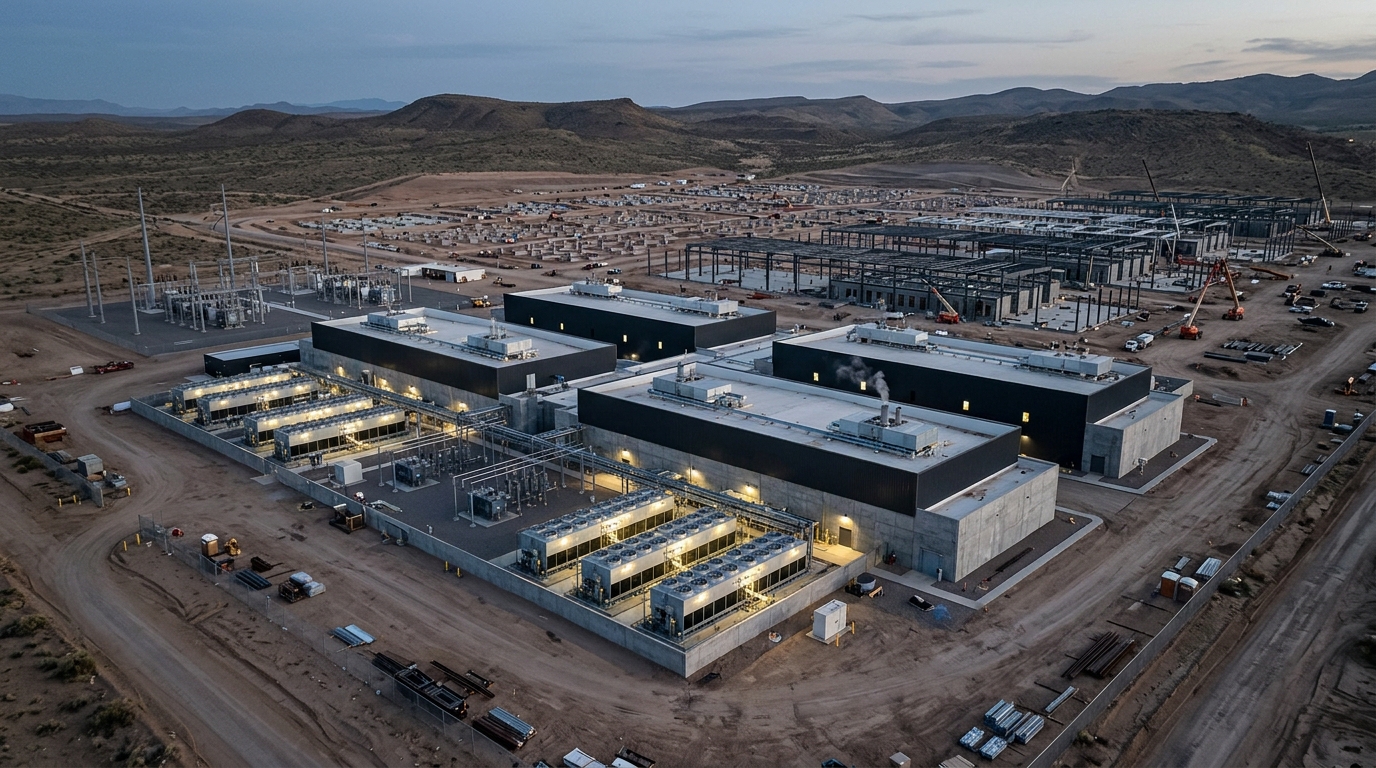
Here is the question that matters after Applied Digital’s fiscal first-quarter results: the company has leases for approximately 1.41 gigawatts of contracted AI capacity, but total live capacity at Polaris Forge 1 was 175 megawatts as of August 31, 2026, and reached 250 megawatts on October 1, 2026. It carries $6.26 billion of long-term debt (net) as of August 31, 2026. The gap between what is signed and what is generating rent is enormous, and that gap is where the investment thesis either gets proved or breaks.
Revenue hit $341.9 million, up 322% from the prior year, while net loss attributable to common stockholders from continuing operations came in at $221.0 million. The headline numbers look contradictory until you pull them apart. Adjusted net loss from continuing operations per diluted share was $0.01, compared with an adjusted net loss of $0.03 a year earlier. The reconciliation does not break the bridge the way it is described here. In the company’s reconciliation, major adjustments include stock-based compensation of $59.4 million, loss on change in fair value of derivatives of $49.5 million, and loss on change in fair value of investment of $11.4 million, along with items such as diligence and integration costs. Strip those away and the underlying hosting business looks far closer to breakeven than the GAAP loss suggests.
What Each Live Megawatt Actually Earns
HPC hosting revenue totaled $262.6 million, including $65.8 million in base rent, $183.5 million in tenant fit-out services, and $13.3 million in tenant recoveries. The fit-out revenue is largely a pass-through: construction costs for tenants that flow through the income statement and inflate the top line without meaningfully enriching the business. Base rent is the durable number.
Using $65.8 million of base rent and the company’s reported $58.8 million of Net Operating Income (an 89% NOI margin), the model is clearly capable of producing high incremental cash flow once facilities are ready for service. The structural problem is that the lit buildings are still a small fraction of the total contracted portfolio.
Polaris Forge 1 accounts for 400 MW and approximately $11 billion of base-term contracted revenue, Polaris Forge 2 for 200 MW and approximately $5 billion, Delta Forge 1 for 300 MW and approximately $7.5 billion, and Delta Forge 2 for 210 MW and approximately $5.2 billion. Polaris Forge 3 accounts for 300 MW and approximately $7.5 billion, bringing total base-term contracted revenue to approximately $36.2 billion across five campuses. The challenge: interest expense jumped $69.4 million, or 866%, to $77.4 million for the quarter, driven by the increase in debt arrangements. The math only closes when hundreds of additional megawatts reach ready-for-service.
The Path to Getting There
Applied Digital confirmed 250 megawatts of critical IT load were operating at Polaris Forge 1 on October 1, 2026, after the quarter closed, and expects initial operations at Polaris Forge 2 to lift delivered load across its North Dakota campuses to 300 megawatts by the end of calendar 2026.
Earlier this year, the company closed a $1.59 billion offering of 7.000% senior secured notes due 2031 to fund construction of a 150 MW HPC building at Polaris Forge 1 and to repay the $300 million bridge facility. Applied Digital also entered into a power purchase agreement with Base Electron for an approximately 1,200-megawatt natural gas-fired generation facility to be developed in North Dakota, intended to support future expansion.
Bull Case, Bear Case
The bull case rests on timing and contract structure. Leases are take-or-pay with counterparties including CoreWeave. Once hundreds of additional megawatts are live, the NOI profile implied by the company’s reported segment economics could move Applied Digital visibly toward the $1 billion NOI target management has described. The debt structure is intentionally long-dated, buying time for capacity to ramp.
The bear case is equally simple: management has previously estimated anticipated capital expenditures of $11 million to $13 million per megawatt of a major AI campus. The higher debt burden increases interest costs, while project assets add depreciation as facilities become operational. Any construction delay, financing disruption, or counterparty stress compresses the margin of safety against $77 million of quarterly interest charges.
What to Watch Next
The end-of-calendar-2026 delivery target for 300 megawatts across North Dakota is the nearest dated test. After that, the pace of leasing and financing at Delta Forge 1 and Polaris Forge 3 will determine whether the approximately $36 billion contracted portfolio converts into cash flow on schedule. Every quarter that interest expense outpaces live-megawatt NOI is another quarter the stock has to carry that gap on faith alone.