
September 3, 2026
Bonus Content: Canada Is Sitting on 3% Inflation and Won’t Fight It. Gold Is Taking Notes.
Editor’s Note: Marc Chaikin, the 60-year Wall Street legend who called Nvidia before it soared 45,000%, just came forward with a playbook for investing in an era of “Frontier AI.” Marc’s indicators found in every Bloomberg and Reuters terminal in the world – have identified a list of the biggest potential winners and losers for the world that comes after the tipping point that Elon Musk is calling for in 2026. Read his message below and then click to get the FREE stock names and tickers he says to buy and sell now.
Dear Reader,
“Frontier AI” is a point of no return when AI surpasses human intelligence and gains free will.
Elon Musk warns this tipping point could occur by the end of 2026.
And according to my research, that moment may have just occurred behind the glass and steel structure you see right here.

As Frontier AI makes its way from this Silicon Valley lab to a small group of hand-selected companies, it could soon cleave the stock market in half. Some stocks will ride this shift to 100X gains. Others could face a total wipeout.
That’s why I’m giving away a list of stocks to buy and sell absolutely FREE to help you position your money for a new world driven by Frontier AI technology.
Get my Frontier AI Hotlist – including six free trade ideas – right here…
Sincerely,
Marc Chaikin
Founder, Chaikin Analytics
P.S. If any of this sounds far-fetched to you, please understand something…
The AI tools you have access to are the equivalent of the Stone Age when you put them up against the AI that Silicon Valley is keeping behind locked doors.
And when this secretive version of AI leaves the lab, one of the first things that I predict will be heavily impacted will be the stock market.
And there’s only a small window of time to position your money before this “jump to lightspeed” in AI technology cleaves the market into two classes of stocks – winners and losers.
Canada Is Sitting on 3% Inflation and Won’t Fight It. Gold Is Taking Notes.
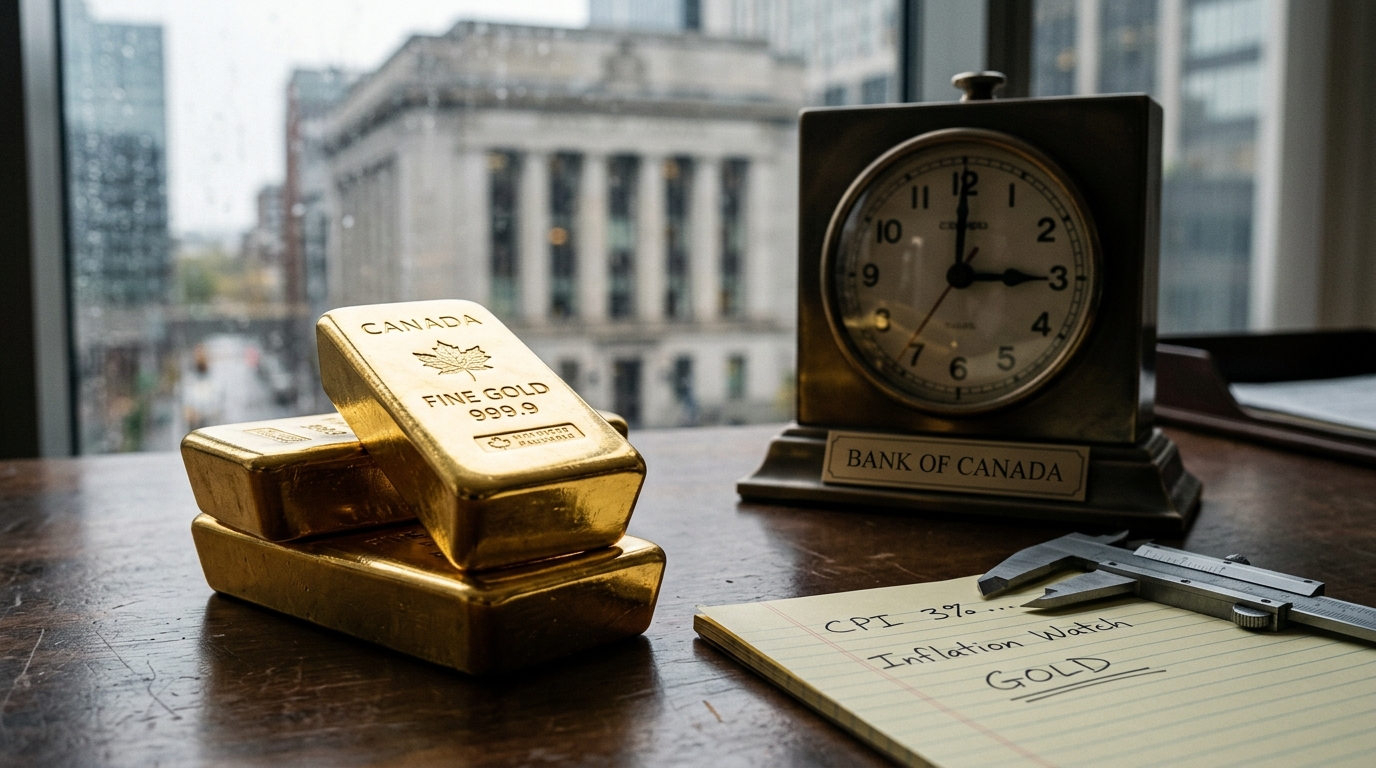
The Bank of Canada held its overnight rate at 2.25% on Wednesday for a seventh consecutive meeting. Most coverage treated this as a non-event. It is not.
The Bank acknowledged that uncertainty is high and new U.S. tariffs pose risks to the sustainability of Canada’s recovery, while CPI inflation has been hovering around 3% in recent months, mainly because of persistently higher gasoline prices. That combination, inflation already at the target’s ceiling and a central bank unwilling to move, is precisely the environment where gold earns its place in a portfolio.
What the Bank Actually Said
CPI inflation has been hovering around 3% in recent months, mainly because of persistently higher gasoline prices. The Bank also said upside risks to its inflation forecast have increased, while new tariffs make growth prospects more uncertain.
Reuters reported that benchmark Brent crude was trading around $90 per barrel, above the Bank of Canada’s July assumption of $75 for the third quarter. That gap matters. When the central bank’s own model undershoots the oil price by $15, its inflation projections carry real downside risk. Canada has also announced counter-tariffs effective September 8. Ottawa has described them as a dollar-for-dollar match to new U.S. tariffs, while multiple news reports put the countermeasures at roughly $20 billion in U.S. goods. Those pass-through costs have not yet shown up in CPI.
Scotiabank’s Derek Holt noted there is significant information to digest between now and October 28, and that the BoC “very clearly cracked open the door” to tighten as soon as the next meeting if conditions co-operate, as reported by Canadian media.
The Gold Angle Most Investors Miss
The mainstream reaction focuses on whether Canadians get mortgage relief. The precious metals question is different: what does tolerated inflation do to the Canadian dollar gold price?
When the Canadian dollar weakens, the gold price in CAD rises even if the global spot price is unchanged. Tariff uncertainty is generally negative for the loonie, because weaker exports and investment can slow growth and increase pressure on the currency. A softer CAD is a structural tailwind for gold priced in Canadian dollars, quite apart from whatever happens to USD spot.
Gold in Canada was priced at about C$6,070 per ounce as of September 2. That is well off the January 2026 peak near C$7,345 per ounce. The distance between those two points reflects months of dollar strength and gold consolidation globally. What re-closes that gap is exactly the situation Canada is now describing: inflation near 3%, a central bank that cannot hike aggressively because trade uncertainty threatens growth, and a currency under quiet pressure from both sides of the tariff dispute.
The Investment Opportunity
Canadian gold producers are the most direct beneficiary of this dynamic. Their revenues are priced in USD gold, while a meaningful share of their operating costs sit in Canadian dollars. Investors seeking broader exposure can access the sector through ETFs such as EWC, which tracks Canadian equities and captures the currency dynamic alongside sector positioning.
Risks to Monitor
The Bank’s statement carries a modest hawkish tilt, but core inflation remained close to 2% in July and the Bank continues to point to excess supply in the economy. That argues against reading the September hold as a clear signal of an imminent hike. If oil prices retreat as the Middle East conflict de-escalates, the inflation argument weakens alongside it. A stronger loonie, driven by a U.S. trade resolution, would compress the CAD gold price even if USD spot holds firm.
Bottom Line
What investors should understand today: the Bank of Canada is not fighting 3% inflation. It is waiting, watching, and hoping tariff and energy costs do not spread into core prices. That posture, sustained across seven consecutive meetings, is the definition of tolerated inflation. Gold denominated in Canadian dollars has a long record of acting as an inflation hedge, and when inflation rises and the purchasing power of the Canadian dollar falls, gold often appreciates in CAD terms. The next scheduled decision is October 28. Between now and then, the data, particularly on oil, tariff pass-through, and core CPI, will determine whether the Bank’s patience becomes a catalyst.