
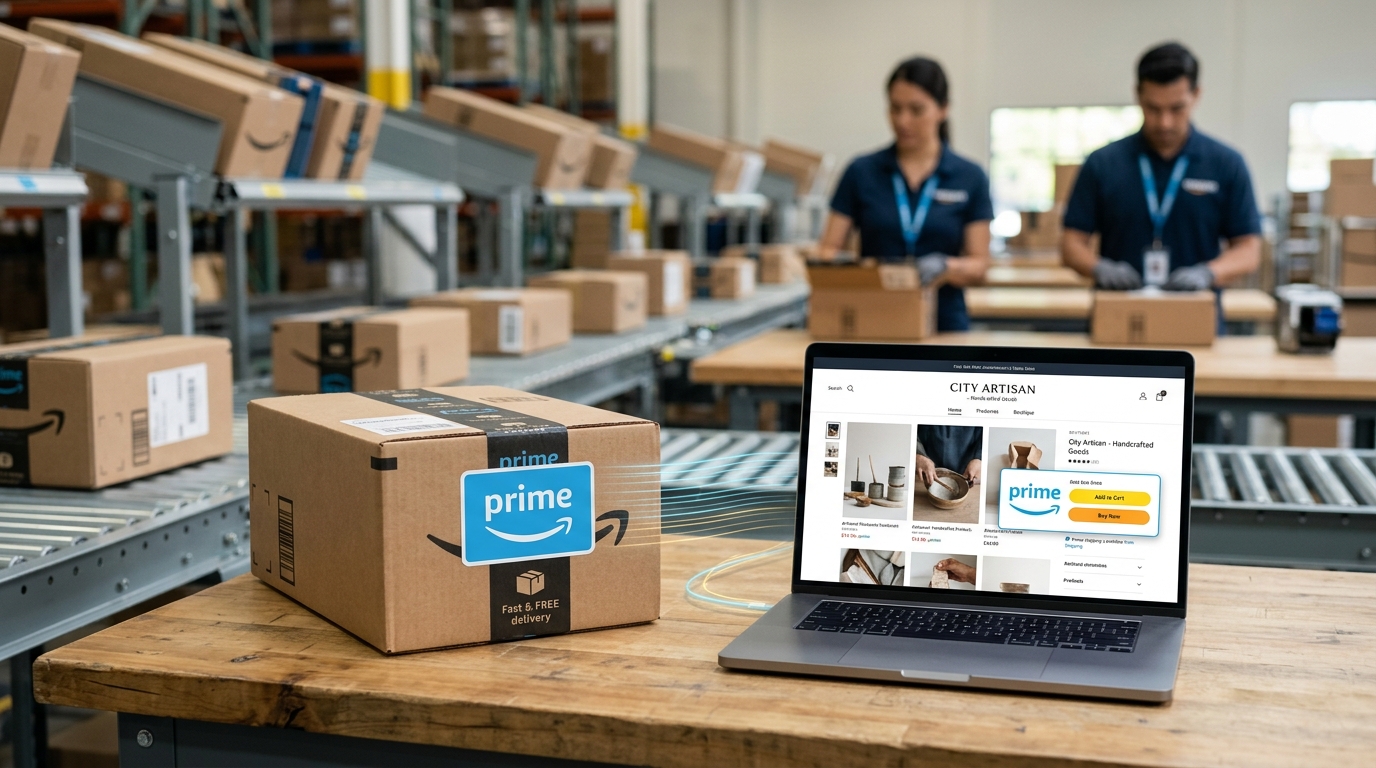
Two moves in the same week tell a cleaner story than either does alone. On September 21, 2026, Amazon blocked Meta’s Muse AI agent from shopping its site. Three days later, it invited merchants to add Prime delivery to their own storefronts and introduced a new discount program tied to its Multi-Channel Fulfillment (MCF) service. Read those together and the strategy is plain: Amazon has decided that owning the customer relationship matters more than owning the checkout page.
What Amazon actually announced
The new MCF Preferred Pricing Program allows eligible merchants to save up to 15% on MCF fulfillment fees and earn up to $1 in FBA credits per MCF unit shipped for up to 12 months, depending on usage and enrollment. That fee reduction is not a rounding error. For a merchant doing meaningful volume outside Amazon.com, it changes the unit economics of using a third-party logistics provider entirely. The move gives Amazon a larger role in transactions that take place outside its marketplace while giving merchants a way to put Prime’s delivery promise directly in front of shoppers. Shopify merchants can activate Prime delivery via the existing Buy with Prime app.
Amazon has highlighted early adoption, but it has not publicly substantiated a specific figure like “more than 40% of eligible orders on average” shipping with Prime delivery. What can be said with confidence is that the company is positioning Prime delivery as something merchants can surface directly on their own sites, and that it is trying to make MCF pricing more attractive for off-Amazon volume.
The Muse block is the other half
Amazon has blocked Meta’s Muse AI agent from browsing and making purchases on its site, escalating a dispute between the two companies over who controls the online shopping experience when AI acts on a customer’s behalf. Amazon’s public rationale has focused on transparency and consent, arguing that shopping agents should identify themselves and respect a provider’s decision about whether to participate. The framing of a terms-of-use violation is legally tidy, but the underlying concern is commercial: when an AI agent shops on a customer’s behalf, it can weaken Amazon’s ability to shape discovery and personalization inside its own shopping experience.
This is not an isolated reaction to Muse. Amazon won a preliminary injunction against Perplexity’s Comet shopping bot in March 2026. The pattern is consistent: Amazon will not let another company’s agent sit between it and the customer, even when that other company is also a commercial partner. Amazon products have been purchasable inside Facebook and Instagram through Amazon product ads since 2023, and Amazon and AWS announced an agreement with Meta in April 2026 tied to running agentic AI workloads on Amazon’s Graviton chips. The commercial relationship did not soften the block.
What this means for investors
For Amazon, the logistics expansion is the more durable growth lever. Amazon also announced it is investing another $1.9 billion in its Delivery Service Partner program, with the company framing that investment as aimed at safety initiatives and technology and at supporting higher pay levels for delivery associates.
For UPS and FedEx, this week was not a headline to dismiss. Every merchant that routes off-Amazon volume through MCF is a merchant that does not need to negotiate a contract with a legacy carrier. For Shopify and Global-E, the dynamic is more nuanced: Prime delivery on a Shopify storefront makes that storefront stickier for the consumer, but it also deepens the merchant’s dependency on Amazon infrastructure. Over time, that dependency is a competitive consideration Shopify’s management will have to account for.
The real insight here is about the nature of Amazon’s moat. A warehouse network that any storefront can plug into, a Prime badge that consumers already trust, and a last-mile operation reinforced by $1.9 billion in fresh capital: that combination is harder to replicate than any single marketplace. Amazon is not just defending its turf. It is expanding the definition of what its turf is.