
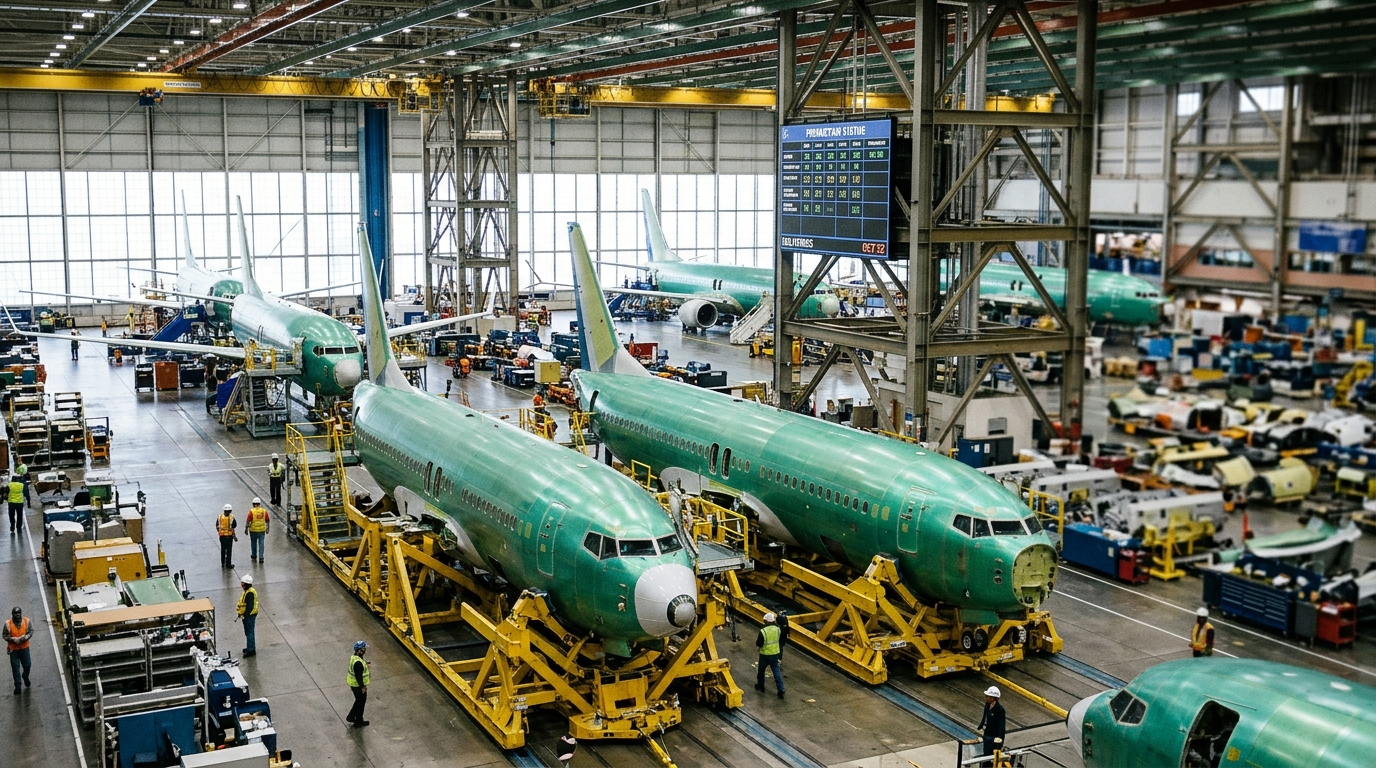
Two numbers landed in the same week and they point in opposite directions. On November 4, Avolon finalized an order for 140 Boeing 737-10 jets, the largest 737 MAX order ever placed by a leasing company, taking Avolon’s backlog to more than 240 unfilled orders. Two days later, Bloomberg reported, using Cirium data and a Jefferies note, that Boeing likely delivered about 32 of its 737 MAX jets in October, the fewest in almost a year and a blow to the company’s efforts to harvest cash and improve its finances.
The October figure compares with September’s 43 and would mark the smallest number since November of last year. That is not a rounding error. It is a 25% month-over-month drop in the program Boeing depends on most.
Delivery volume flows directly from monthly production rates and parts availability across the supply chain. The 737 MAX is Boeing’s main cash engine because each delivery triggers a large final payment, so the pace of handovers determines how much free cash flow the company books in a given quarter. With Boeing still running losses in its commercial division, every jet that sits in inventory rather than transferring to a customer is capital tied up and revenue deferred.
The Demand Side Has Never Been Stronger
Avolon’s order underscores exactly how fierce that demand is. Lessors placed firm orders for more than 230 737-10s in 2026, five times the lessor backlog for the largest 737 MAX variant at the end of 2025. The purchase came just weeks after the 737 MAX-10 was certified by the FAA, and lessors moved quickly. Boeing said lessors have ordered more than 1,450 737 MAX aircraft overall, accounting for about 20% of its backlog.
Boeing’s commercial airplane division now carries a backlog of more than 6,300 planes totaling $612 billion, according to the company’s third-quarter results. That is a generational order book. The constraint is not whether airlines and lessors want the jet. It is whether Boeing can build and hand over enough of them, fast enough, to convert that backlog into cash.
Where the Output Problem Lives
Boeing has been candid about where the production ceiling is. In an earnings call, CEO Kelly Ortberg pointed to 737 wing production as a key constraint on the path to higher output, and said the company expects to come in shy of its roughly 500-jet 737 delivery target for 2026. Nine-month 737 deliveries reached 367, the fastest pace yet, but still short of the about-500 target for 2026.
The reintegration of Spirit AeroSystems, which Boeing acquired in December 2025, adds another layer of complexity. Cutting down on traveled work at Spirit’s former facility in Wichita is critical for Boeing’s efforts to boost 737 MAX production rates. Boeing has made progress since closing the acquisition, but indications remain that traveled work is still a challenge for fuselage production. Every fuselage that arrives at the Renton final assembly line with open items creates rework that slows the entire sequence.
The gap between a record backlog and constrained output is not unique to Boeing. Northrop Grumman carries a $105 billion backlog of its own while the market discounts execution risk on its most complex program.
Boeing has said it expects to come in shy of its roughly 500-jet 737 delivery target for 2026. The company is still working toward a stabilized 737 production rate of 47 jets a month, and it has said the next step up to 52 a month is expected in the second half of 2027.
What Investors Are Watching
The bear case is straightforward: a 32-jet October heading into the fourth quarter, when Boeing typically needs to accelerate to meet annual targets, makes the year-end cash flow story harder to defend. The counterargument is that October can be noisy month to month, and should not be extrapolated across the full fourth quarter; the delivery slope in November and December is what will actually determine whether full-year cash flow targets are met.
Avolon’s record order confirms the secular demand thesis is intact. The 737-10, now FAA-certified and with more than 230 lessor firm orders booked in a single year, is clearly the aircraft the market wants. The question Boeing must answer through year-end is whether its factories can close the gap between that appetite and what actually rolls out the door.