
TITLE: SpaceX Went Exclusive With Nvidia. The Stock Fell Anyway.
SUBTITLE: A 92% revenue jump, an $18.4B capex quarter, and a Vera Rubin partnership, so why is SPCX down after hours?
BODY (HTML):
Hey there, bargain hunter. Tonight you got two stocks in one story. SpaceX (SPCX) just posted its first-ever public earnings and dropped the most consequential chip partnership announcement of the year in the same breath. Nvidia (NVDA) closed up nearly 3%. SPCX closed up 9.4%. Then the after-hours session opened and SPCX gave most of it back. The reason is worth understanding, because the real trade here is not SPCX versus NVDA. It is what an exclusive hardware commitment at gigawatt scale actually means for the chip stack underneath it.
Scoreboard
What happened, August 4, 2026 (after the close):
- SPCX closed at $125.33, up 9.43%. Musk told investors during the company’s first-ever earnings call that going forward, SpaceX will build its AI services exclusively on Nvidia’s systems.
- NVDA closed at $212.91, up about 3%.
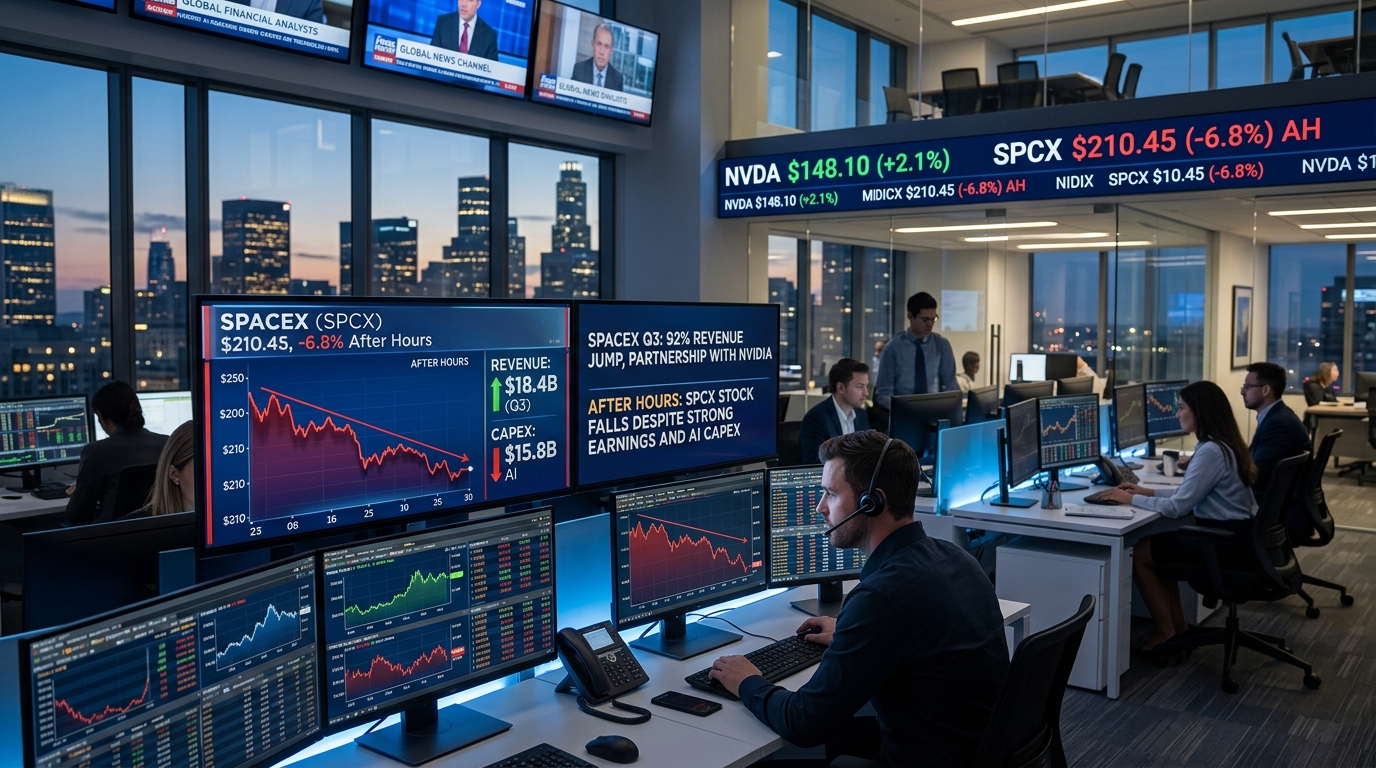
- After hours, SPCX fell to around $115 as investors weighed roughly $18.4 billion in quarterly capital expenditure against growth targets.
- Q2 revenue came in at $7.81 billion versus expectations around $6.9 billion. AI segment revenue rose 247% year-over-year to about $2.56 billion.
- The Q2 net loss was $541 million.
The surface read: a beat that got sold. The actual read: a capex number that scared the market more than a 92% revenue growth rate could soothe it.
The Real Reason the Stock Pulled Back
Revenue is not the problem. Capital expenditures jumped sharply year-over-year to about $18.37 billion in the second quarter. Most of that, $15.83 billion, went to AI. Management also cited analyst expectations that were meaningfully lower than the reported spend.
For context: SpaceX generated $7.81 billion in revenue but spent about $18.4 billion in one quarter. The market is not confused about the growth story. It is asking when the cash consumption curve bends.
CFO Bret Johnsen said the company sees increasingly favorable economics with each compute agreement signed, and that current economics have translated into a less than one-year payback on new capital deployments for compute. If that figure holds, the math works over a multi-year horizon. But a sub-one-year payback claim on nearly $16 billion of AI spend in a single quarter requires believing a very large share of that spend gets contracted out quickly at attractive margins. That is the bet the after-hours sellers are refusing to make tonight.
What SpaceX Actually Is Now
Most investors still picture a rocket company. The numbers tell a different story.
For now, most of SpaceX’s money still comes from Starlink and its traditional launch business. The company generated about $18.7 billion in revenue last year, including roughly $11.4 billion from connectivity services and about $4.1 billion from launches and other space-related work. Its AI segment contributed about $3.2 billion in 2025, and it was deeply unprofitable.
That was then. In Q2 2026 alone, the AI segment generated about $2.56 billion in revenue. SpaceX has turned Colossus into a commercial computing power platform, landing deals with Anthropic and Google. Add other customers over time, and the contracted compute revenue pipeline becomes the story.
Here is the contracted book, as publicly reported in filings and contemporaneous coverage:
- Anthropic agreed to rent essentially all capacity at Colossus 1, a facility described in reporting as roughly 300 megawatts and housing more than 220,000 Nvidia processors, paying $1.25 billion per month through May 2029.
- Google agreed to pay $920 million per month for AI computing capacity. The contract runs from October 2026 through June 2029 at the full monthly rate, with capacity ramping up earlier at a discounted fee.
- Reflection AI, an Nvidia-backed startup, signed a compute agreement with SpaceXAI for access to Nvidia hardware purchased and operated by SpaceX.
Deals with Google and Anthropic alone to rent out computing capacity imply more than $25 billion a year at the headline monthly rates. That is not rocket revenue. That is recurring infrastructure income, and it runs on Nvidia silicon.
The Nvidia Exclusive: What It Actually Means
Musk did not just announce a preferred-vendor relationship. He announced a hardware moat.
“We think the Vera Rubin architecture is the best architecture. We think it’s the best AI computer, and we greatly value our close cooperation and partnership on many levels with Nvidia,” Musk said. “So we’re exclusive to Nvidia.”
That is a public, investor-facing commitment. Every gigawatt of compute SpaceX builds from here runs Nvidia hardware. Musk said he expects to end the year with more than 2 gigawatts of compute and anticipates expanding to multi-gigawatt levels again next year, with a focus on electrical and cooling equipment rather than GPUs.
At that scale, SpaceX becomes one of the largest single compute operators on the planet. Every watt of that infrastructure runs Nvidia chips. No AMD. No custom silicon. No future pivot hedging.
The space angle is where it gets genuinely novel. SpaceX has discussed an orbital data center concept, now branded Starmind, and it has an FCC application on file for a system of up to one million satellites described as orbital data centers. The filing describes laser inter-satellite links at very large scale.
To be clear about scale: the constellation approach would compensate for per-satellite limitations through massive parallelism. If the program ever gets built as described, orbital buildout and terrestrial buildout could become one combined hardware demand curve. But the regulatory path and the engineering realities are still the gating items, not the hype.
The Business Model: How SpaceX Makes Money From Nvidia Hardware
This is the part most investors are getting wrong. SpaceX is not a chip buyer. It is a chip landlord.
The loop works like this: SpaceX buys Nvidia hardware at scale, assembles it into Colossus clusters, and rents that capacity to AI labs and hyperscalers under multi-year contracts. Nvidia invested heavily in Reflection AI, while Reflection will train models using Nvidia hardware purchased and operated by SpaceX. As a result, Nvidia simultaneously acts as an investor and an indirect technology supplier within the same ecosystem.
Google, which has spent billions building its own custom TPU silicon, is still renting Nvidia capacity through SpaceX. Alphabet has been investing heavily in its own custom silicon, known as Tensor Processing Units. Even so, this deal showcases how the company is still turning to Nvidia’s hardware at scale. That is the strategic signal the SpaceX-Google deal sends about where demand sits today relative to proprietary silicon.
SpaceX is funding its AI capital expenses in part via cloud services. CFO Bret Johnsen said the company continues to see robust demand, particularly in cloud services arrangements. Less than one-year payback on new compute deployments, if accurate, means the $18.4 billion capex quarter is not a cash bonfire. It is pre-sold inventory.
Data Section
SpaceX Q2 2026 by segment:
- Connectivity (Starlink): $4.29 billion revenue.
- AI Infrastructure: about $2.56 billion revenue.
- Space (launch): the remainder, with company-reported growth across the segment.
Other key numbers:
- Starlink reached 12 million subscribers at the end of Q2.
- Quarterly capex was about $18.37 billion, including $15.83 billion attributed to AI.
- Musk said SpaceX now expects to hit $1 trillion in revenue in 2030, pulled forward from 2031.
Nvidia today (August 4):
- During Tuesday’s session, NVDA reached a daily high of $213.06 and a low of $208.56.
- The all-time high NVDA closing price was $235.47 on May 14, 2026. The 52-week high is $236.54, about 11.1% above the current share price.
Is It Cheap?
SPCX is not cheap by any conventional metric. At the IPO price of $135, Morningstar placed fair value materially below the IPO valuation. After today’s after-hours decline to roughly $115, that gap still exists.
The honest framing: this is a business growing revenue at 92% year-over-year, signing compute contracts at enormous scale, and telling you it is sprinting toward a $100 billion annualized revenue run rate by end-2026. Even discounting that heavily, the contracted revenue visibility from Anthropic and Google alone is massive if the deals run to term.
NVDA is the cleaner valuation question. The 52-week high is $236.54, about 11% above today’s close. SpaceX just handed Nvidia a multi-gigawatt exclusive hardware commitment, and Nvidia’s next earnings will be the next clean data point on whether the market is properly reflecting that.
Morningstar notes the AI infrastructure opportunity is massive, and Nvidia has argued that trillions of dollars of annual AI infrastructure spending could arrive by 2030. SpaceX targeting multi-gigawatt compute capacity exclusively on Nvidia hardware is one real-world data point in that direction.
Bull / Base / Bear
Bull case (NVDA): SpaceX’s exclusive commitment removes near-term substitution risk at one of the largest new-scale compute operators. The terrestrial buildout plus any future orbital ambition create demand that extends well past Nvidia’s current product roadmap. Shares at $212 remain about 11% below the May 2026 high. The next earnings event becomes a reiteration event rather than a discovery event.
Bull case (SPCX): The company sees increasingly favorable economics with each compute agreement signed, and current economics translate into a less than one-year payback on new capital deployments. If that holds, $18.4 billion quarters of capex are self-funding through pre-contracted cloud revenue. Starlink at 12 million subscribers provides stable operating income while the AI loss curve narrows.
Base case: NVDA consolidates near current levels ahead of its next earnings. SPCX stabilizes in the $110 to $120 range as the market absorbs the capex reality and watches Q3 contracted revenue numbers. Both stocks re-rate upward if backlog converts to cash the way the company is signaling.
Bear case (SPCX): Management plans sustained heavy investment in Starship, next-gen Starlink satellites, and AI compute infrastructure. That level of spending on a $7.8 billion quarterly revenue base requires strong execution on contracted compute deals. Any slip in the Anthropic or Google relationships, or any renegotiation, blows the capex payback math open.
Bear case (NVDA): Nvidia’s customers are a handful of the largest tech companies in the world, and they all have an incentive to eventually diversify away from Nvidia to some extent. An exclusive with SpaceX is not a legal lock-in across every customer. The risk is concentration, not competition: if capex cycles compress, Nvidia’s largest buyers pause at the same time.
Action Plan
NVDA: The SpaceX exclusive removes one of the standard Nvidia bear arguments, large customers diversifying away from Nvidia hardware. For a bargain hunter, the setup here is patient accumulation. The all-time high sits at $236.54. Today’s close of $212.91 represents roughly an 11% discount to that level. For a conservative buyer, scale in with one-third of a target position today, another third on any pullback toward the $195 to $200 range, and hold the rest for the next earnings confirmation. Stop consideration: a close below $190 would warrant reassessment.
SPCX: The after-hours drop into the mid-$110s is not automatically a fundamentals signal. It is a capex shock reaction. The lock-up expiration on August 6, when 911.5 million insider shares unlock, creates a near-term overhang that has nothing to do with the Nvidia partnership or the revenue trajectory. For an aggressive buyer, the post-lock-up dip, if it materializes, is the entry. For a conservative buyer, wait for the dust to settle and watch whether cloud services revenue ramps the way management has described. A confirmed $100 billion annualized run rate by December would change the valuation debate permanently.
Cheap Investor Checklist
- SpaceX compute capacity: Management has talked about ending 2026 above 2 gigawatts and scaling materially from there. Track this quarterly. Every step up is incremental Nvidia demand.
- AI segment profitability trajectory: AI revenue is growing fast, but the segment is still loss-making. Watch the operating loss trend, not just the top line.
- Contracted cloud revenue backlog: Anthropic and Google alone imply enormous dollars. Watch for any customer renegotiation or early termination disclosures.
- August 6 SPCX lock-up expiration: 911.5 million insider shares unlock. Price action after the unlock is a cleaner entry signal for SPCX than today’s close.
- Nvidia next earnings: SpaceX is now a named exclusive customer. Watch for any quantification of the SpaceX revenue relationship in the data center segment.
- FCC Starmind ruling: SpaceX filed for up to one million orbital data center satellites. Any FCC movement on that application shifts the orbital compute story from speculative to procedural reality.
- Starlink subscriber growth: 12 million subscribers is the funding engine. Any sharp deceleration changes the funding math for the AI buildout.
- Google TPU substitution risk: Google is paying $920 million per month for Nvidia capacity through SpaceX even while building TPUs. Monitor any disclosure that shifts allocation back to proprietary silicon.
- Orbital data center hardware ship date: Space-based compute at meaningful scale has no clear public deployment timeline. Treat it as optionality until it shows up as a real capex line item and a regulator-cleared plan.
- NVDA 52-week high clearance: At $236.54, clearing that level with the SpaceX exclusive confirmed and fresh earnings in hand would constitute a full breakout. Use it as a target, not a buy signal on its own.
Bottom Line
If SpaceX’s sub-one-year capex payback claim holds, the $18.4 billion quarter is not reckless spending. It is pre-sold inventory. Every dollar of that inventory runs Nvidia hardware under an exclusive commitment Musk put on the record at the company’s first public earnings call.
The SPCX selloff tonight is a lock-up story wearing a capex costume. The Nvidia angle is cleaner: an exclusive, multi-gigawatt hardware commitment from one of the largest new-scale compute buildouts, announced today, and Nvidia still trades about 11% below its all-time high.
If the Starmind concept clears regulatory review and the AI operating loss continues to narrow over coming quarters, both of these stocks could look underpriced relative to the contracted revenue visible today. If capex spirals without matching revenue ramp, SPCX specifically carries real downside. The asymmetry on NVDA is more favorable for the bargain hunter who does not want to own the capex risk directly.
Watch August 6. Watch Nvidia’s next earnings. Both dates matter more than today’s close.
This article is for informational purposes only and does not constitute investment advice. Past performance is not indicative of future results. Always do your own due diligence before making investment decisions.