
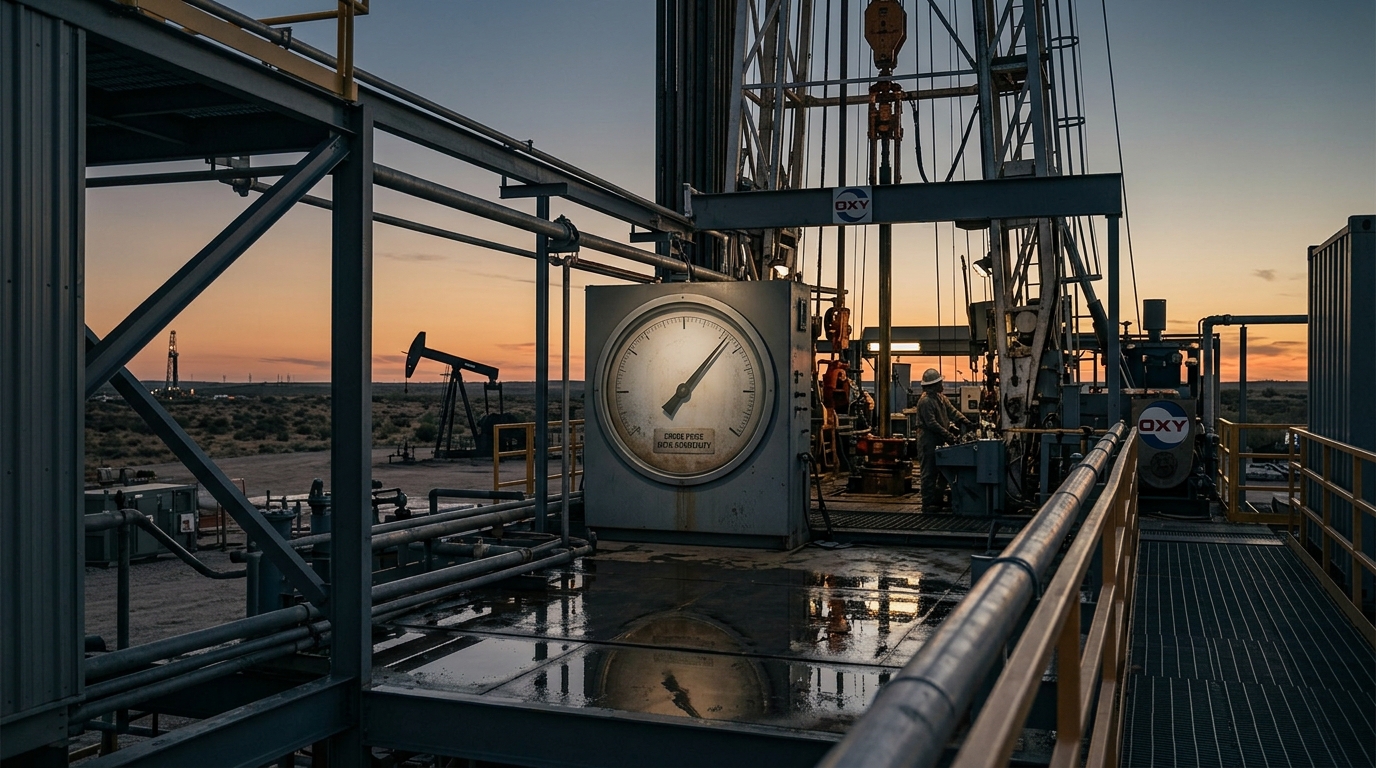
If you want to understand what oil does to a stock, just watch Occidental Petroleum for a few weeks.
This is one of the most oil-price-sensitive large producers in the United States. Not the biggest. Not the most diversified. The most leveraged to the direction of crude. Occidental is often described as a high-beta way to express a view on oil, which amplifies every move. Right now, that characteristic is either the entire bull case or the entire reason to wait.
Where the Stock Stands
As of July 26, 2026, OXY is trading at approximately $57.30. That’s well below its 52-week high. Yet the macro setup behind it has shifted dramatically in recent weeks.
Oil prices rose sharply in recent weeks as increased fighting in the Middle East threatened crude flows. Brent crude traded around $93 per barrel in late July. Then, on July 23, Brent topped $100. That is the number that rewrites the Q2 earnings story.
The Iran Factor Is Real
The Middle East conflict has meaningfully shaped oil pricing in 2026, largely through investor focus on shipping risk around the Strait of Hormuz—a key chokepoint for global crude flows.
The conflict has not resolved. The market keeps pricing in a quick end. The market keeps being wrong about the timeline.
For OXY specifically, the realized price backdrop for Q2 is now clearer. International oil realizations were $95.83 per barrel while U.S. oil realizations were $96.93 per barrel for Q2 2026, per the company’s July 10 SEC filing. Those are strong numbers. The earnings math at $96/barrel looks very different than the math investors were building models around six months ago.
The Q1 Setup and What Changes in Q2
Occidental reported Q1 2026 adjusted EPS of $1.06, materially exceeding analysts’ expectations around $0.59. That was a clean beat. The top-line miss—revenue came in at about $5.11 billion versus a Street consensus closer to the mid-$5 billion range—reflected, in part, hedging impacts and mix rather than operational weakness. Occidental has also said it will not add more oil hedges this year after volatility in crude prices tied to the Iran conflict led to lower realized prices in prior months. Going forward, that means more direct exposure to whatever oil does next. With WTI above $85 and Brent near $90, that exposure now works in OXY’s favor.
Management guided Q2 2026 output to 1,390 to 1,430 Mboed and full-year to 1,410 to 1,460 Mboed, signaling steady growth and disciplined capital use. Volume is steady. Price is the variable. And price cooperated.
The Leadership Transition Is Worth Watching
Longtime CEO Vicki Hollub retired on June 1, 2026, with COO Richard Jackson stepping in as president and CEO while Hollub stays on the board. New management, high oil prices, and a Q2 earnings report on August 5— that combination tends to produce either a clean reset or an unwanted surprise.
Jackson has not yet had to navigate a full earnings cycle as CEO. The August 5 call will be his first earnings report as CEO. The capital allocation framing he gives — dividend trajectory, share buyback pace, debt reduction progress — will set the tone for how analysts model the stock through year-end.
The Bear Case Is Not Gone
Look past the one-day headline, and the supply picture turns complicated. Even as the Hormuz situation lifted prices, OPEC+ approved another production increase for August, and Saudi Aramco cut its Arab Light price to Asian buyers by $11 a barrel. The market is still half-pricing in a quick conflict resolution. If shipping constraints ease and OPEC supply rises at the same time, OXY is the stock that corrects the hardest.
Analyst views on OXY are split: Raymond James holds an Outperform with a $75 target, while UBS and Truist trimmed targets to $65 and $57 respectively. That spread — $57 to $75 — tells you this is genuinely a two-sided debate.
Forward Scenarios
Bull: Oil holds above $90 through Q3, Q2 earnings on August 5 show EPS well above the consensus, and Jackson uses the call to announce accelerated debt reduction or a buyback expansion. Stock targets the mid-$70s range, toward or beyond the 52-week high.
Base: Q2 delivers a solid beat on EPS, guidance is maintained, and the stock drifts toward $62 to $67 as energy sector momentum holds. If oil rises above $100 again, Oxy’s stock could meaningfully re-rate; valuation multiples will depend on the market’s view of how durable the price move is.
Bear: A ceasefire materializes before earnings, oil drops back toward $75 to $80, and OXY’s unhedged position works against it. Stock re-tests the low-$50s.
What Investors Should Watch
- Q2 EPS vs. the consensus estimate
- Realized oil and gas prices — the July 10 filing already gave you the numbers, Q2 full results confirm them
- Jackson’s first comments on capital allocation priorities as CEO
- Debt reduction progress following the CrownRock acquisition
- Any update on Permian and DJ Basin production efficiency
OXY at $57 is a simple trade in complicated packaging. You are buying a highly oil-levered major in America ahead of what could be its best quarterly earnings in years, during an oil market nobody expected to see at $90+ this summer. The risk is just as clean — if the conflict ends, the thesis ends with it.
August 5 is when that ambiguity gets resolved.
For informational purposes only.