
July 28, 2026
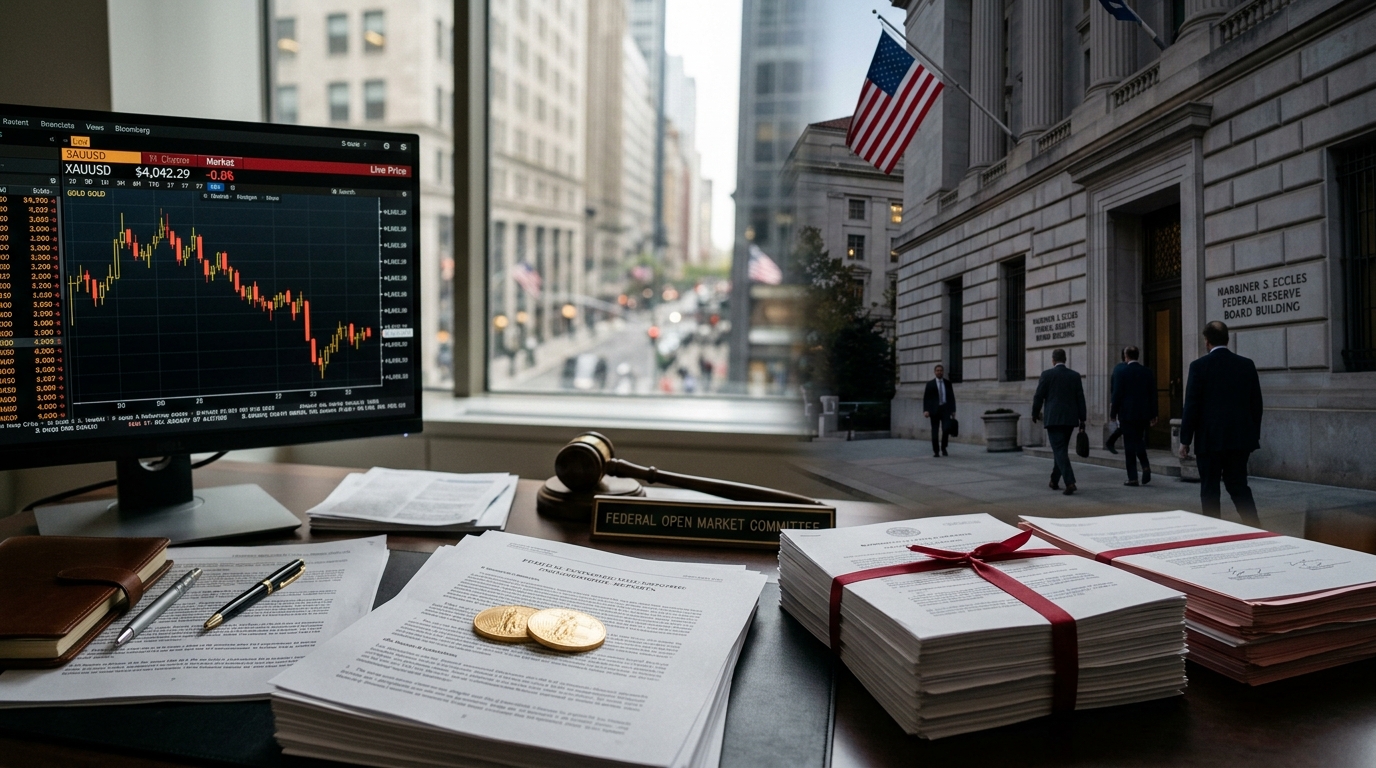
Gold Holds $4,000. The Fed Decides Tomorrow.
The vote count Wednesday matters more than the outcome itself.
First a note from Base Camp Trading
Hey Trader,
If you’re trying to profit from gold right now…
You might be looking in the wrong place.
Because the real opportunity isn’t in gold itself.
It’s in something that moves more aggressively…
Costs less to trade…
And tends to react faster when the market opens.
Most people never make this connection.
Which is why they miss the biggest part of the move.
I broke it down in a quick report.
Click here to lock in a free copy.
Once you see the relationship, it’s hard to unsee.
To a new way to cash in on the gold rush,
Thomas Wood
Lead Trader, Base Camp Trading
Gold Holds $4,000. The Fed Decides Tomorrow.
Tuesday, July 28, 2026
There is a number most people will ignore tomorrow. It is not the rate decision. It is the vote.
Gold retreated Tuesday, weighed down by a firming dollar, as investors positioned for the Federal Reserve’s policy verdict at the end of its two-day meeting. Spot gold fell 0.8% to $4,042.29 an ounce. That pullback is real. So is the context around it.
What Is Actually Driving This Market
A hold Wednesday is more likely than a hike. But the odds are closer than they have been in months. As of Monday, the CME FedWatch Tool placed hold probability in the 52 to 62% range, down from 85% just two weeks ago. That compression in confidence is the story. Not the outcome.
Oil’s surge past $100 a barrel pushed hike odds as high as 38 to 48% before Monday’s pause in Iran tensions eased them back. The geopolitical premium is doing two things simultaneously: supporting gold as a safe-haven asset while also threatening to keep inflation elevated enough to justify further tightening. That tension is why gold is stuck.
Core inflation is still running at 4.2%, well above the Fed’s 2% target, and that single fact is what makes Wednesday’s language far more consequential than the rate move itself. The number that matters most is the vote count. A unanimous hold and a dissenting hold are two completely different signals for September.
Fed Chair Kevin Warsh withheld his personal rate projection from the Fed’s quarterly dot plot, becoming the first Fed chair in 14 years to sit out the forecasting tool that has guided markets since 2012. He did not just skip a chart. He stripped away a layer of forward guidance the market had relied on for over a decade. That is an underappreciated shift in how this Fed communicates risk, and gold investors should not treat it as a footnote.
Wall Street is calling it the “Warsh Shock.” Here’s how to profit from it…
Nearly half of the world’s biggest money allocators are scrambling to reposition for what they expect to be the most volatile market in years.
Larry Benedict isn’t scrambling. He’s seen this before.
He says the Warsh Shock is setting up the most predictable wealth-building window he’s seen in 20 years… and there’s one ticker right at the center of it.
The Structural Case Has Not Moved
Here is what the short-term noise tends to obscure: the structural buyers of gold are not watching Wednesday’s FOMC statement.
The People’s Bank of China added 14.93 tonnes of gold to its reserves in June 2026, its largest single-month purchase since October 2023, extending its buying streak to twenty consecutive months. It did this during gold’s worst quarterly decline since the 2013 taper tantrum. That is a reserve policy decision on a multi-year horizon, not a reaction to a Fed meeting.
Zoom out further. Central banks purchased 863 tonnes of gold in 2025, a moderation from the extraordinary 2022 to 2024 period when annual purchases exceeded 1,000 tonnes each year. That figure still represents more than double the traditional purchasing pace of 400 to 500 tonnes annually. The rate of buying has cooled. The direction has not reversed. Eastern European and Asian central banks continue to dominate purchases, with both regions averaging 12 and 11 tonnes per month collectively over the past 36 months.
From 2021 to 2025, central bank gold purchases averaged 225 tonnes per quarter, roughly double the pace from 2016 to 2020. That kind of structural demand does not evaporate because of a single Fed meeting.
Where the Opportunity Sits
When gold prices sustain above $4,000, the operating leverage inside well-run miners becomes extraordinary. The numbers bear that out.
Agnico Eagle Mines (NYSE: AEM) reported Q1 2026 results showcasing record financial performance driven by gold prices. The company capitalized on a realized gold price of $4,861 per ounce, a 68% increase from the prior-year quarter, to deliver net income of $1.7 billion, more than doubling year-over-year results.
AEM’s first-quarter free cash flow climbed 23% year over year to roughly $732 million, backed by strength in gold prices and robust operational results. The company remains focused on paying down debt using excess cash, with total long-term debt reducing by roughly $950 million in 2025, bringing long-term debt to just $197 million at the end of Q1. It ended the quarter with a net cash position of roughly $2.9 billion.
Agnico Eagle maintains a strong balance sheet and high net margins by operating primarily in low-risk mining jurisdictions, including Canada, Australia, Finland, and Mexico. That jurisdictional profile matters in an environment where permitting risk and government intervention are live concerns in other mining regions. The company expects 20 to 30% production growth over the next decade, with recently announced proposed acquisitions in Finland marking a milestone in its next phase of long-term growth.
Newmont (NYSE: NEM) is equally worth watching on the cash generation side. Newmont has been converting higher gold prices directly into cash. It generated $3.1 billion in free cash flow during Q1 2026 and returned $2.7 billion to shareholders through dividends and repurchases, ending the quarter with a $3.2 billion net cash position.
The part people tend to skip over: at current gold prices, the spread between all-in sustaining costs and realized prices for both companies is wider than at almost any prior point in the cycle. The World Gold Council’s Gold Valuation Framework puts gold’s fair value at approximately $4,100. If the Fed holds Wednesday and guidance softens even slightly, that spread gets wider, not narrower.
Risks Worth Watching
When the Federal Reserve raises interest rates, it increases the return available on Treasury bonds and other fixed-income instruments. Because gold yields nothing, rising rates increase the opportunity cost of holding gold. That is the straightforward headwind. A surprise hike Wednesday, or a hawkish tone that locks in September hike expectations, would likely push gold back toward, and potentially below, the $4,000 level that has held as support since late June.
A stronger U.S. dollar would make gold more expensive for buyers outside the U.S., potentially reducing demand from international purchasers. Dollar strength and rate hike expectations tend to move together, which is why the positioning compression in gold has been so abrupt over the past two weeks.
On the mining side, Agnico Eagle faces risks associated with operating in highly regulated environments, which can lead to increased compliance costs and operational hurdles. Environmental regulations and potential permitting delays in Canada or Finland could affect production schedules or increase costs. These are slower-moving risks, but they are real and worth monitoring as the company accelerates its growth pipeline.
One more consideration: the World Gold Council has highlighted substantial unreported buying across the official sector. Around 57% of total central bank purchases in 2025 were opaque, meaning some institutions continue to add gold without immediate disclosure. That opacity cuts both ways. It supports the structural demand case, but it also means any reversal would not necessarily be visible until well after the fact.
Bottom Line
What should precious metals investors understand today?
Gold is not range-bound because the bull case has weakened. It is range-bound because two very large forces are pulling in opposite directions at the same time. A Fed that is genuinely uncertain about its next move versus a global reserve-management shift that has been accelerating for four years. One of those forces is decided at 2:00 p.m. tomorrow. The other does not care what the Fed does.