
Blane Markham here…
Quick heads up:
The special Black Friday deal on the breakthrough Alpha Oracle Signal trading system will not last much longer.
It’s just $7 if you order before the deal ends. Others paid nearly $2,000 to access this method so this is easily one of the biggest discounts we’ve ever offered.
Once you activate this trading system, you’ll see how to target a double-digit gain in just 5 days. Past examples of this style of trade include…
- A $4,120 (36%) winner on Caterpillar in just 2 days
- A $2,740 (30%) gain on Fedex in just 4 days
- $5,082 (41%) on RTX in 5 days
- And $1,764 (11%) on Corning Incorporated
Time is running out. Get it here before the Black Friday deal expires…
Alpha Oracle Signal On Sale For Just $7
In your corner,
Blane Markham
Markham Trading

Silver at $50: The Case for the Metal Is Breaking Down
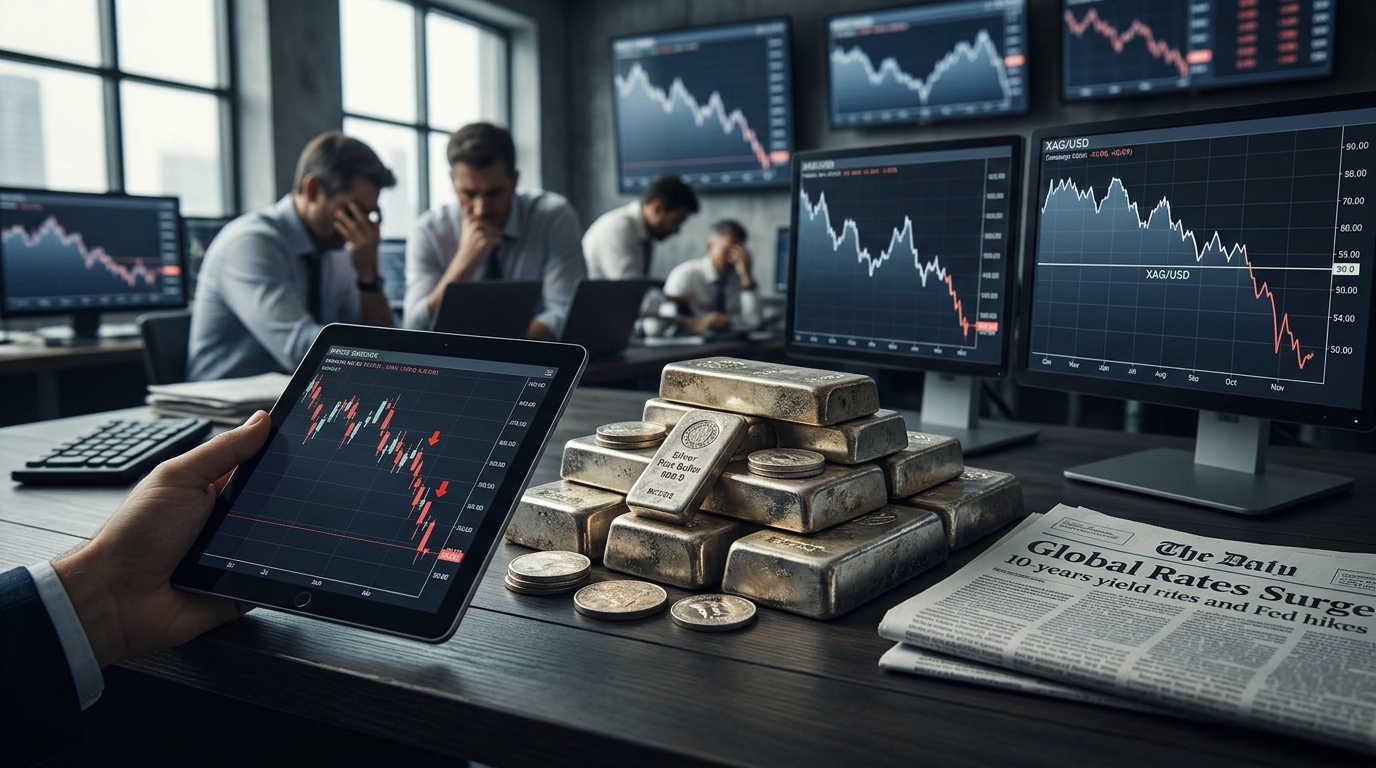
Silver crossed back below $50 on Thursday. That number carries weight: $50 is where the 1980 Hunt Brothers squeeze ended, where the 2011 rally ran out of air, and where the great 2025-2026 bull run began. The metal spent years trying to clear it. Now it has fallen back through it.
The spot price was around $50 an ounce on Thursday. That is down roughly 59% from the all-time record of $121.67 set on January 29, 2026. Gold, by comparison, sits near $3,900, roughly 30% below its own January peak. That divergence is the story the market is not telling loudly enough. Silver has not simply moved with gold in a metals rout. It has been destroyed twice as hard.
What Is Driving the Gap
The proximate cause this week is straightforward. October’s core CPI came in at 0.3% month-over-month, above the 0.2% forecast, with headline inflation up 0.4%. That pushed December Fed hike odds toward the mid-80% range in futures markets, lifted the 10-year Treasury yield through 5.1%, and sent the dollar index to its highest level since April 2025, trading near 103. A non-yielding asset priced in dollars takes hits from every direction when that combination lands simultaneously.
But the reason silver fell harder than gold runs deeper than a single inflation print. Silver carries two investment theses simultaneously: it is a monetary metal, and it is an industrial one. The industrial demand argument rested on solar panels, EVs, and AI infrastructure buildout. The monetary argument rested on a weakening dollar and falling real rates. Right now, the dollar is rising and real rates are firmly positive. Both theses are under pressure at the same time. Gold, stripped of industrial exposure, is simply taking the monetary hit. Silver is taking both.
The gold-to-silver ratio reflects this. It stood near 78 on Friday morning, up from roughly 46 at the January peak, when silver was outrunning gold on the way up. At 78, one ounce of gold buys 78 ounces of silver. The long-run average since 1971 is 60.5. That spread is the magnitude of silver’s underperformance compressed into a single number.
Physical Inventories vs. Paper Reality
Here is the uncomfortable paradox. While the futures market is pricing silver as though the bull case never existed, the physical market is structurally tighter than at any point in recent history. The Silver Institute projects a sixth consecutive annual supply deficit of 46.3 million ounces in 2026, 15% wider than the 2025 shortfall, bringing cumulative above-ground inventory drawdowns since 2021 to approximately 762 million ounces. COMEX registered silver stocks have fallen about 75% from their 2020 peak.
That divergence between paper pricing and physical reality is not new, but it has rarely been this wide. The interest rate cycle currently dominates. When futures traders see a 5.1% 10-year yield and odds of another hike in the mid-80% range, they sell silver contracts. Physical buyers and industrial users are not setting the marginal price today. Rate expectations are.
The mechanism suppressing silver is the same one that has been repricing every non-yielding asset since January. Real TIPS yields above 2.87% explain why gold itself sits 25% below its all-time high despite every traditional buy signal flashing.
The Investment Question
Pan American Silver (PAAS) illustrates the equity damage precisely. Shares fell 4.1% to $37.72 on Thursday, putting the stock down 26.5% year-to-date and 17.5% over the past month. The 52-week high was $69.99. TD Cowen cut its rating to Hold last week, lowering the price target to $45 from $52, citing operational challenges at the Jacobina mine in Brazil expected to run through 2027. The underlying Q3 earnings, reported November 4, actually beat consensus at $0.69 per share on revenue of $1.01 billion, up 17.7% year-over-year. The fundamentals are holding. The silver price is not.
The equity damage is not limited to silver miners. Newmont posted the most profitable quarter in its history and still watched its stock absorb a falling gold price the same week.
SLV, the iShares Silver Trust, tells the same story more plainly: a vehicle for silver exposure with no operational noise, tracking a metal that has lost more than half its value from January’s record.
Risks on Both Sides
The bear case is durable as long as yields stay above 5% and the Fed is hiking. A 50-basis-point December move, which Governor Waller has not ruled out, would test the $45-$48 support band that analysts flagged earlier this month. The dollar could extend further.
The bull case is structural, not immediate. Six consecutive deficits do not resolve themselves because the futures market is under pressure. Every ounce drawn from COMEX and London vaults is an ounce that cannot be drawn again. If rate expectations shift in early 2027, whether from a growth scare, an inflation miss, or a Fed pivot signal, the physical tightness that the paper price is ignoring today will not have gone away.
Bottom Line
At $50, silver is not cheap relative to its recent history: it is at levels from which it launched a parabolic move less than 14 months ago. What has changed is the macro environment that made that move possible. Until the 10-year yield retreats meaningfully from 5.1% and the dollar gives back its gains, the physical deficit is an argument waiting for its catalyst, not a price floor. Investors who believe the structural case should size accordingly and watch the Fed, not the Silver Institute, for the turning point.