
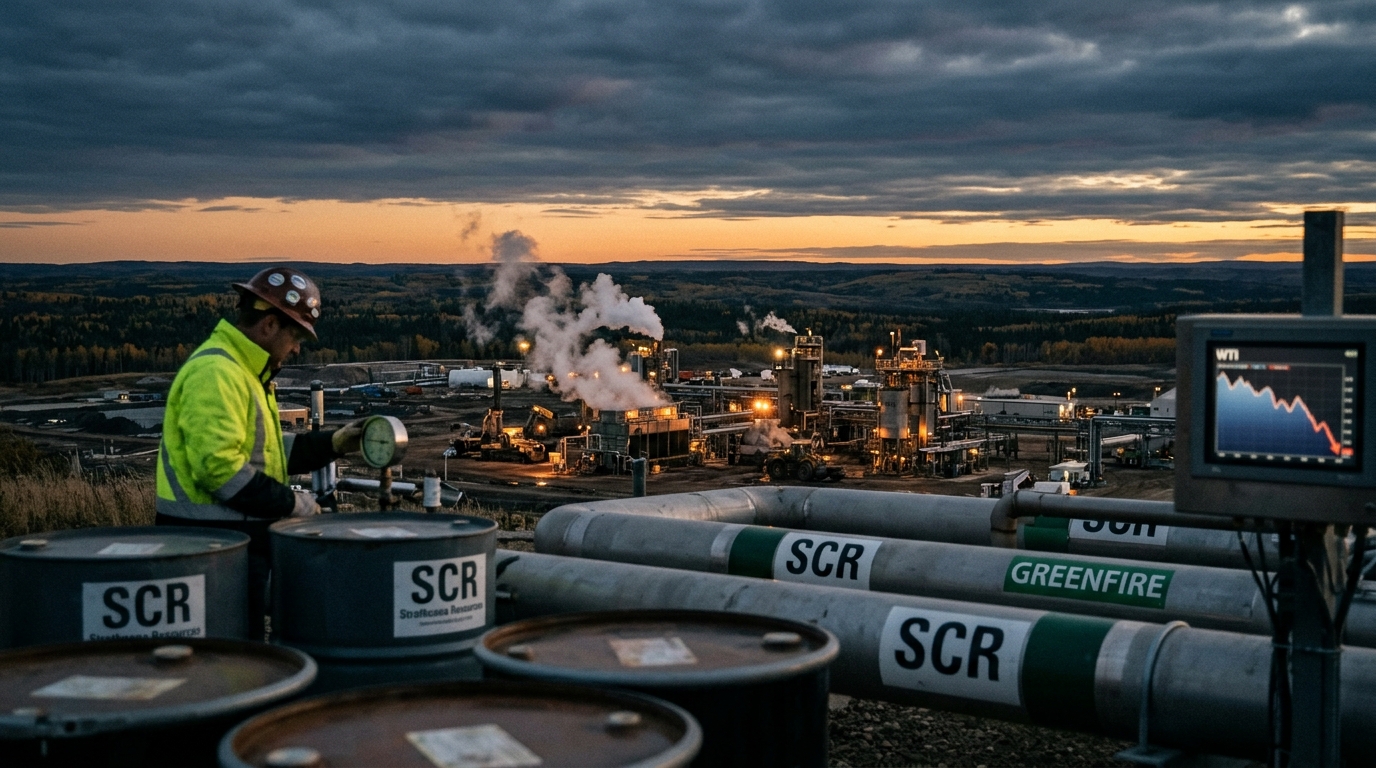
When oil sits near $91 and falling, paying a 39% cash premium for barrels in the ground is either a declaration of long-term conviction or a reminder that the best deals get signed precisely when the commodity looks most precarious. Strathcona Resources (TSX: SCR) made that choice Sunday night.
Under the terms announced November 8, Greenfire shareholders can elect either 0.25 Strathcona shares per share, valued at C$9.09 and a 15% premium to the November 6 close, or C$11.00 in cash, a 39% premium to that same close. The deal values Greenfire at approximately C$2.7 billion to C$2.9 billion, including debt.
What’s Driving the Deal
The timing is telling. Even after a steep slide, oil hasn’t fully surrendered the war premium: WTI started 2026 near $57 and peaked close to $113 on April 7, and it is still well above where the year began. That cushion is narrowing fast. Reuters reported November 4 that U.S. midterm election results led the oil market to believe President Trump now has a bigger incentive to cut a deal with Iran, and WTI lost 8.3% to close at $88.12 a barrel in a single session. Oil around $90 to $91 this morning means Strathcona is locking in reserves at a price it presumably considered even before the Iran premium inflated them.
The strategic logic runs deeper than crude price, which is exactly the right way to look at this for precious-metals investors trying to decode what resource consolidation looks like under price uncertainty. Strathcona’s bid is not about catching a momentum rally. It is about accumulating the kind of asset base that compounds through the cycle.
The Asset Case
The companies said the combined business would hold over 3.0 billion barrels of proved plus probable reserves, a 54-year reserves life index, and would rank as the fourth-largest SAGD operator in Canada. Strathcona also said it would be the only oil sands operator without natural gas or downstream operations, giving investors a long-life oil pure play.
Greenfire’s C$2.8 billion of tax pools, including C$2.0 billion immediately deductible, could extend Strathcona’s cash-tax horizon from 2027 to 2031 at US$75 per barrel WTI, producing approximately C$400 million of cash-tax savings over four years. That is a structurally important number: it means the transaction pays in tax efficiency alone even if oil drifts lower. Strathcona also expects approximately C$75 million of annual run-rate synergies within the first year.
Waterous Energy Fund, which owns 72% of Greenfire and 57% of Strathcona, has agreed to support the deal and elect the share option for its Greenfire holdings, meaning WEF is not taking the cash exit. It is rolling its chips into the combined entity, which limits the signal value of the premium itself.
The Waterous rollover is not the only sign that sophisticated capital prefers equity in long-life barrels over a cash exit. Citadel’s pursuit of physical U.S. oil production assets reflects the same conviction that owning barrels outright beats trading paper claims on them.
The Parallel That Matters Here
For precious-metals investors, Strathcona’s move is worth studying not because oil sands are the trade but because the consolidation impulse is the same one reshaping gold and copper. When a commodity price round-trips violently, as WTI has done from $57 to $113 and back toward $90 in under a year, mid-tier producers who survived intact become acquisition targets. Their reserves were always worth accumulating; the volatility simply compressed the window to act.
The same consolidation logic is playing out in base metals. Copper demand is forecast to rise 50% over the next 14 years while new supply remains structurally constrained, creating the same window for acquirers that Strathcona is exploiting in oil sands.
Gold has been in a similar situation. New York closing prices for gold rose more than 4.5% in a single week, recovering from a late-October low below $3,900, and spot gold sits near $4,062 this morning. Miners carrying long-life, low-cost reserves into that kind of price action become the Greenfire equivalent: assets a consolidator can lock in before the market consensus fully resets.
Risks to Monitor
Closing is expected in late January 2027, subject to shareholder, court and applicable regulatory approvals. The oil price is the obvious lever: if WTI falls toward $75, the economics of a 39% premium cash deal look different. The more subtle risk is that for minority shareholders, Strathcona’s post-deal liquidity and valuation multiple may end up driven as much by who owns the enlarged company and how much stock is left trading freely as by the C$2.7 to C$2.9 billion price tag itself. WEF will hold 60% to 64% of the combined entity regardless of how minority holders vote with their feet.
Bottom Line
Strathcona is telling the market something: a 54-year reserves life index built across all three major Alberta oil sands deposits is worth paying through cycle volatility to own. That is a conviction commodity majors and royalty companies in gold, copper and uranium have been acting on quietly for two years. The lesson is not to buy oil sands. It is that when a commodity sells off on a geopolitical peace trade, the producers sitting on the deepest and longest-life assets rarely stay cheap for long.