
There is a monetary shift building that retirement savers will not see until it has happened.
Almost every retirement account in America is held in dollars.
But what your account is really worth is not the number on the statement. It is what that number can buy.
And since 1971 when Nixon cut the tie between the dollar and gold, this number is buying less every single year.
You feel it at the pump. You see it at the cash register.
Your savings have been running uphill against that erosion for more than 50 years.
Now Congress is taking a second look at the gold the government owns.
And a bill in Congress would require the Treasury to reprice the government’s gold on its books, at market value.
Here is why it matters to you.
The government values its own gold at $42 an ounce. Congress set that price in 1973 and never changed it.
Gold trades at over $4,000 today.
America holds more gold than any country on earth. On the books, it is worth about $11 billion. In the real world, more than $1 trillion.
That is a gap of about 95 times, sitting on the nation’s books, in plain sight.
And Washington has noticed. That is what the repricing bill is.
If that number is ever corrected, Washington books a trillion-dollar gain. From gold.
The Americans who already hold physical gold did not wait for Washington to notice.
More than 60 million Americans qualify to move a portion of their savings into physical gold right now. Tax-free. Penalty-free.
The 2026 Gold Guide walks through every step.
Takes 30 seconds to request.
Nixon made his move on a Sunday night. No warning.
If it changes again, the only question is which side you are standing on.

Unity’s $25B Buyout Talks Reveal What Silver Lake Is Building
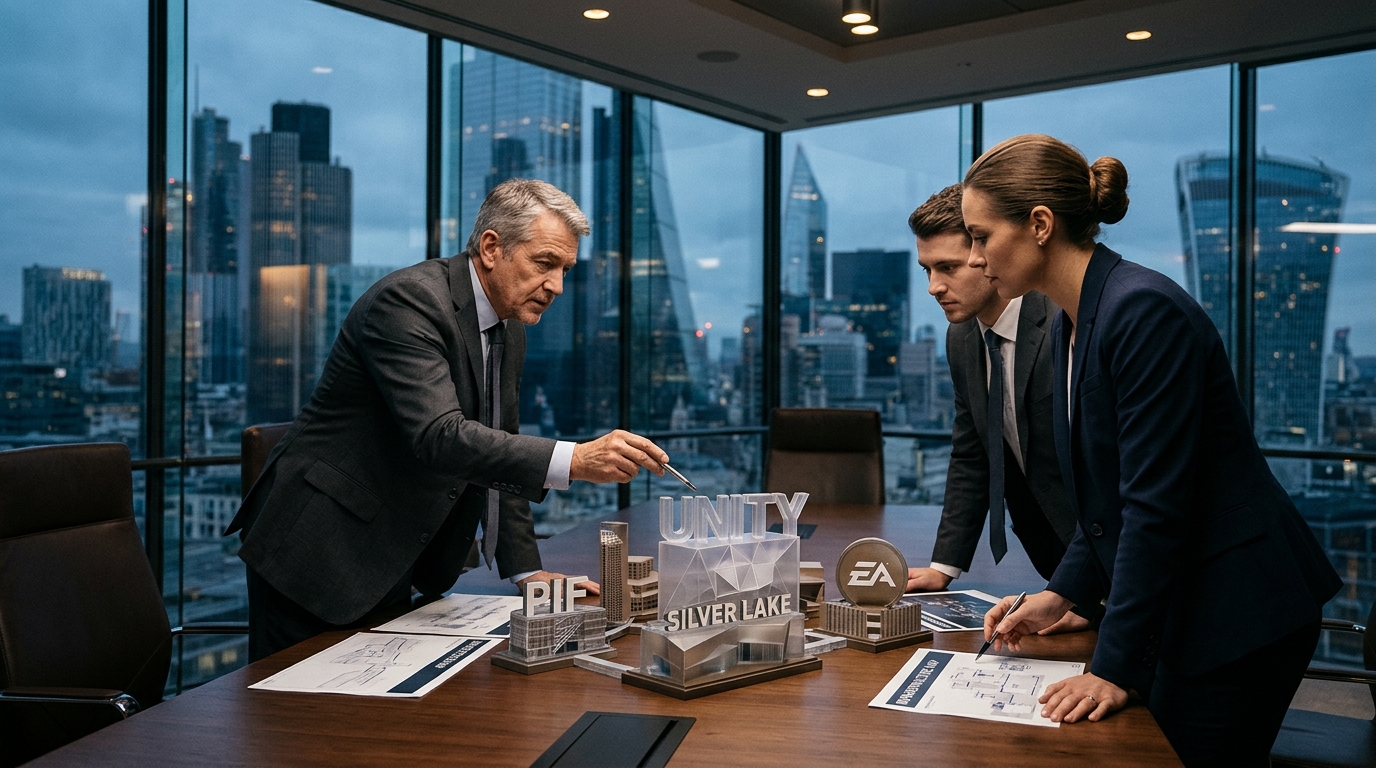
The speculation around Unity Software looks, on the surface, like another take-private opportunistic play on a software company that just turned profitable. It is not. What Silver Lake and Saudi Arabia’s Public Investment Fund are attempting to assemble is something considerably more deliberate.
Silver Lake and PIF were part of the consortium, alongside Affinity Partners, that took Electronic Arts private in a $55 billion deal that closed on August 4, 2026, one of the largest leveraged buyouts on record. Now, Reuters reported on November 5, 2026 that a consortium including Silver Lake and PIF approached Unity in recent weeks about a deal that would take the game engine maker private at a valuation of roughly $25 billion.
The timing matters. The $25 billion figure was discussed before Unity’s earnings lifted its market value to about $21.5 billion, putting the mooted price roughly 16% above where shares trade. That is not a distressed buyer swooping on a cheap asset. It is a strategic acquirer willing to pay a premium because the target is worth more inside the portfolio than outside it.
Here is why. Reuters reported that Unity’s engine and developer tools are used by Scopely, the maker of Monopoly Go, and Niantic, behind Pokémon Go, and that both are owned by a group that includes PIF, Silver Lake, and Affinity Partners. Owning the picks-and-shovels that power your own games is a different business logic than owning games alone. The royalty stream collapses; the vertical integration accelerates.
Unity’s operational case for a deal has only grown stronger. Unity reported its first quarterly GAAP profitability since its IPO, posting $122 million in net income. The company said Vector, its AI-powered advertising engine, grew revenue 126% year over year and 40% from the previous quarter, exceeding management’s own guidance of about 20% sequential growth. Q4 strategic revenue guidance came in at $683 million to $691 million, representing projected year-over-year growth of 65% to 67%. A company accelerating at that rate is not one you discount. It is one you lock up before the market prices it properly.
Silver Lake owns about 8% of Unity after investing up to $400 million in the company in 2017. An existing insider at the table knows exactly what the books say. That structural advantage in due diligence reduces deal risk considerably and helps explain why preliminary talks moved quickly after the Q3 results.
Risks to Monitor
None of this is closed. Reuters said talks remain preliminary, and there is no guarantee that a deal will materialize. Leverage is the central question at $25 billion: the EA deal included $20 billion of debt financing committed by JPMorgan Chase Bank, N.A., with $18 billion expected to be funded at close, and stacking a second large deal so quickly will draw scrutiny from lenders and regulators alike. Antitrust exposure is real if one consortium owns a dominant game engine alongside several of gaming’s largest publishers.
For precious metals investors, the read-across is indirect but worth noting. PIF’s 2025 annual report put its assets under management at over $900 billion. When sovereign wealth funds of this scale rotate aggressively into assets like gaming IP, infrastructure, and software platforms, they are expressing a preference for real earnings and scarcity over financial assets. That same logic, applied across portfolios, is part of what has kept gold’s structural bid intact even as nominal yields have risen. The asset class consolidation playing out in gaming reflects the same search for durable, non-sovereign stores of value that underpins gold’s long-term demand base.
Bottom Line
Silver Lake and PIF are not buying a game engine. They are building a vertically integrated private gaming platform, and Unity controls the development layer that makes all of it run. Whether the deal closes at $25 billion, at a revised figure post-earnings, or not at all, the underlying thesis, that the best software infrastructure commands premium valuations from the most sophisticated private capital in the world, tells investors something important about where durable value resides right now.